Don’t whitewash Paterno, but don’t cancel him, either
Author Jonathan Zimmerman criticizes a new Penn State University exhibit honoring football coach Joe Paterno for omitting the details of the Jerry Sandusky child sexual abuse scandal.
Earlier this summer, I visited the National Galleries of Scotland in Edinburgh. Its walls are adorned with portraits of famous Scots, including the actor Sean Connery. The text accompanying Connery’s portrait notes that he appeared in seven movies as James Bond, the British spy who was licensed to kill.
Bond was also a ladykiller , to borrow the language of his day, racking up sexual conquests in every film. But that reflected poorly on him and on Connery, who in some ways resembled the figure he played. “The sexism of the Bond character Connery portrayed sometimes extended into the actor’s openly expressed views towards women,” the text below his portrait concludes . Most notoriously, Connery said it was OK to hit them .
In short, Connery was a brilliant actor and a misogynist. Both things can be true at the same time.
But not in America, which seems allergic to that kind of nuance. We want people to be angels or devils, perfect or putrid. So we either whitewash or cancel them, which makes it impossible to reckon honestly with their legacies.
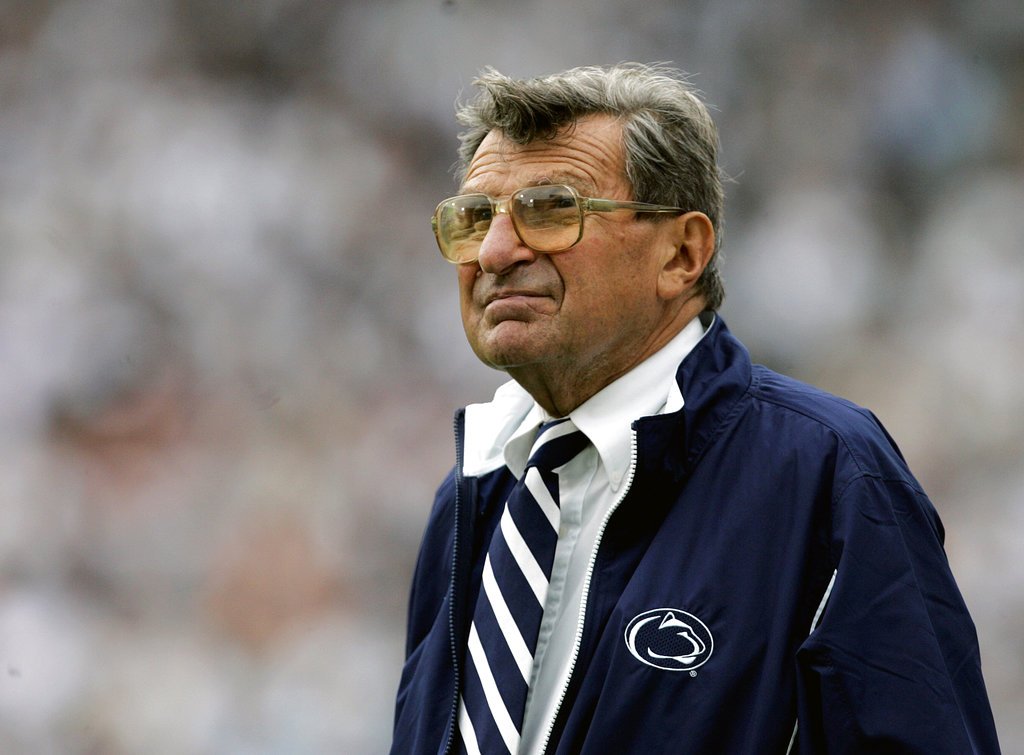
Witness the controversy over an exhibit that opened last week about football coach Joe Paterno at the sports museum inside Beaver Stadium at Penn State University. It features Paterno’s original office desk, a Wheaties box with his picture , and “a curated timeline documenting significant moments from his more than six decades at Penn State,” the university said .
But there’s one hugely significant moment that the timeline ignores . Paterno was fired in 2011 after his longtime assistant, Jerry Sandusky, was arrested and charged with dozens of counts of child sexual abuse.
Another assistant had seen Sandusky raping a boy in the shower in 2001 and told Paterno , who informed Penn State’s athletic director and vice president but did not contact police. Paterno denied knowing about Sandusky’s behavior before that time, but an extensive investigation by former FBI director Louis Freeh showed that Paterno had been informed about a similar allegation against Sandusky in 1998.
None of this appears in the new Paterno Family Football Experience Room , of course. It’s a straight-up whitewash.
Ironically, it is also brought to you by people who say they are preserving the past. “It means the world to me to understand our history, ” new Penn State coach Matt Campbell said , praising the exhibit. But visitors to it will not understand — or even see — the actual history that brought Paterno’s career to a close.
That’s the kind of thing that occurs in authoritarian countries like China, where the difficult parts of the past are airbrushed out . And it’s also what Donald Trump and his allies have tried to do at museums and national historical sites like the President’s House in Philadelphia, where federal officials recently removed panels describing the African-Americans whom George Washington enslaved.
Why can’t we hold two different ideas in our heads at the same time? Joe Paterno was a fantastic coach, winning 409 games for Penn State, and he also failed to protect children from a sexual predator. “I wish I had done more,” Paterno said in 2011, announcing his retirement.
I wish the new exhibit at Penn State had done more, too. It could have provided an opportunity to make sense of Paterno: his greatness and his weakness. But it ignores the ugly truths about him, because it doesn’t trust us enough to judge Paterno on our own.
Nor do social-media critics who simply want the Paterno exhibit to be removed or renamed. Sandusky’s victims “already got the ‘Paterno Family Experience,'” one angry observer posted . Another wrote that Paterno’s name “will forever be an asterisk and a stain on the institution.”
Perhaps so. But that, too, should be up to us. If the exhibit addressed Paterno’s entire life — including its awful final chapters — viewers could decide how to take the full measure of the man. Closing the exhibit or taking Paterno’s name off of it would not help us do that. Cancellation blinds us to history, just like whitewashing does.
Let me be clear: I am outraged by Penn State’s cowardly decision to omit the Sandusky scandal from its exhibit about Joe Paterno. The university is distorting the past, all in the guise of preserving it.
But the answer to that problem isn’t to cancel history, all in the guise of protecting us from it. The university should bring back the seven-foot, 900-pound sculpture of Joe Paterno — which it removed from Beaver Stadium in 2012 — and place it in the new exhibit, accompanied by signage explaining why it was taken down: because at least 10 boys were sexually abused under Paterno’s watch.
The statue is still housed in a secret location . And that’s cowardly, too. Let’s see the statue of JoePa, along with everything else we know about him: the good, bad, and the ugly. Let’s talk. Let’s learn. It means the world to me to understand our history.
Jonathan Zimmerman teaches history and education at the University of Pennsylvania and serves on the advisory council of the Albert Lepage Center for History in the Public Interest .
Topics in this story
Gathered from external sources. Rights to this text belong to whoever originally published it.