South Carolina runoff pits America First against MAGA
Voters, especially Republican primary voters, don’t tend to make their decisions based on what’s going on overseas. But with Uncle Sam’s place in the world looking a little unsteady and a doozy of a debate gaffe in a snap election, we suddenly have in today’s South Carolina Senate runoff the first big electoral test of…
Voters, especially Republican primary voters, don’t tend to make their decisions based on what’s going on overseas.
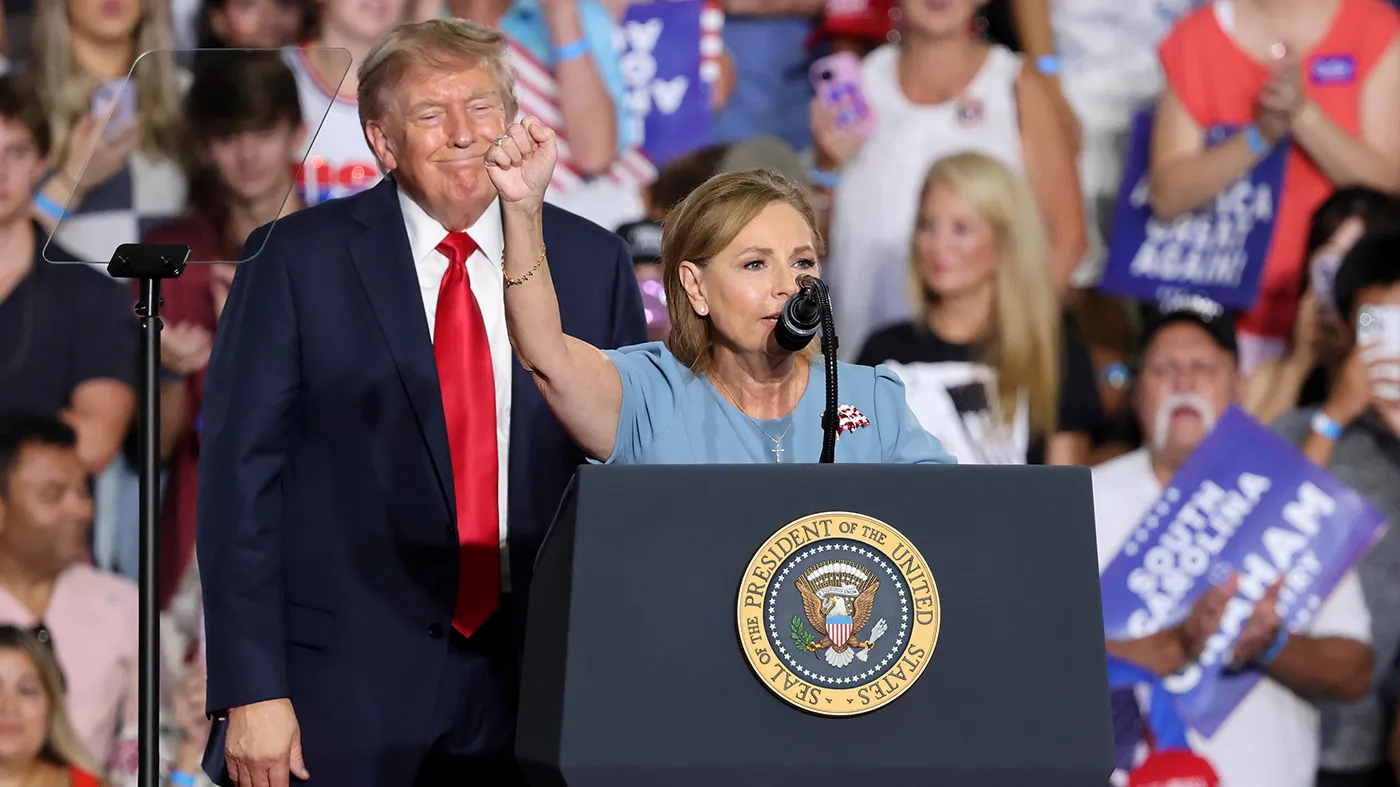
But with Uncle Sam’s place in the world looking a little unsteady and a doozy of a debate gaffe in a snap election, we suddenly have in today’s South Carolina Senate runoff the first big electoral test of President Trump’s Iran war strategy with Republican voters.
Sen. Darline Graham’s (R-S.C.) already-legendary line — “I’m not that informed on national security” — is thought by many to have recast what had appeared to be a perfunctory runoff with Rep. Ralph Norman (R-S.C.) into a competitive race. I say perfunctory because in the first round, the MAGA candidates got most of the vote, almost all of which presumably would filter down to Graham in today’s contest.
There were five candidates who got at least 5 percent of the vote in the first round of the snap primary on Aug. 11, held to replace Graham’s brother, Lindsey. The elder Graham died in July after winning renomination for a fifth Senate term, leaving the state GOP without a Senate candidate in a good Democratic year — one in which the blue team happens to have a nonterrible Senate nominee in Annie Andrews. It’s South Carolina, where no Democratic Senate candidate has come within even 10 points of winning in decades. But still, a bad enough Republican nominee in a bad enough year could have put the Palmetto State race on the map, at least notionally.
There’s plenty that’s weird and wild in South Carolina Republican politics, so Gov. Henry McMaster (R) took no chances and appointed Darline Graham to serve out the final months of her brother’s term. That appointment and her decision to seek a full, six-year term came at the behest of Trump, who has had his own troubles with South Carolina politics.
Before Lindsey Graham became Trump’s wingman and shadow secretary of State, he had been among Trump’s fiercest early critics. And then there’s former South Carolina Gov. Nikki Haley (R), who went the other direction, serving deferentially as Trump’s first-term ambassador to the United Nations before running a dogged if doomed race against Trump as he sought renomination in 2024. Sen. Tim Scott (R-S.C.) also opposed Trump that year, but only halfheartedly and not for very long.
Knowing that South Carolina can be problematic and looking for another member of the Senate MAGA caucus, Trump clearly judged that backing a sentimental favorite in the beloved sister of the late senator would be easy electoral politics and give him an easy vote in Washington, where things have only been getting harder for the lame-duck commander in chief.
In that way, Graham’s gaffe was proof of concept for Trump. Asked about her professed ignorance ahead of his trip to campaign for Graham, Trump told reporters , “She is going to do what the military wants, and really what the president wants. She understands that national security is my thing.” That presumably applies when his “thing” is increasingly unpopular with voters.
Trump’s electoral assumption about Graham was proven right in Round 1 of the snap primary, when she got about a third of the vote, besting Norman by 8 points. Norman is not MAGA but rather a dissident from South Carolina’s underlying don’t-tread-on-me tradition. The House Freedom Caucus is pretty much a MAGA operation now, but back when Norman joined in 2017, there was still a little of the rebellious streak left. Norman has always had a little of Marjorie Taylor Greene energy about him — more about the movement than the man. But he’s also won friends among traditional conservatives for his hawkishness on spending and Reaganite foreign policy. It wasn’t just home-state sentiment that led Norman to back Haley in 2024 or Haley to back him now.
In third place on Aug. 11 was Rep. Russell Fry (R-S.C.), who is stone-cold MAGA to his core. Team Trump backed Fry in his 2022 primary bid against then-Rep. Tom Rice (R-S.C.), an old-school conservative who had voted to impeach Trump for trying to overturn the 2020 election. Fry beat Rice in a major show of strength for Trump early in his interregnum, making Fry a made man in MAGA. He got nearly 20 percent of the vote in Round 1 and then, to the surprise of no one, fell in behind Trump-endorsed Graham for the runoff.
Next in the running was Mark Sanford, the former governor and congressman who was a conservative heartthrob until the vivid unraveling of his marriage while still the state’s chief executive. Sanford is neither MAGA nor America First in any strict sense. He’s a traditional, small-government conservative with some areas of overlap with both groups but is clearly and stubbornly a dissident. He is also a hated figure in MAGA World for his frequent opposition to Trump during Sanford’s House tenure. No surprise, then, that he is backing Norman over Graham on Tuesday. It’s an echo of the onetime conservative dream team in the state that once included Sanford, Haley, Scott and former Rep. Trey Gowdy (R-S.C.), now long eclipsed by Trump and McMaster’s very effective machine.
Rounding out the top five was Mark Lynch, who has a massive appliance store in South Carolina’s Upstate. Lynch proved that he is more America First than MAGA when he ran against Lindsey Graham in the original June primary. While Lynch is part of a movement that takes out-there stances on things like allegations of election corruption and vaccines , he is willing to publicly disagree with Trump. And given that his central charge against the elder Graham was that he was too much of an internationalist, one suspects Lynch isn’t a “forever war” kind of guy. He too has endorsed Norman .
All of which makes the Iran question particularly interesting. Darline Graham accidentally summed up the MAGA Iran position: Back the president and let him do his “thing.” The America First position tends to be that the war was a betrayal of Trump’s promises and a mistake from the start that is only getting worse. The conservative stance seems to be that bombing Iran could have been the right move but that Trump has subsequently blundered it away. The candidates in this race have been cagy about their own stances, but voters are going to make their own inferences.
Not everyone who voted in Round 1 will vote in Round 2, but we can use the results as a rough guide for where today’s electorate started. The MAGA candidates — Graham and Fry — combined for 52 percent of the vote. America Firsters and conservatives — Norman, Sanford and Lynch — combined for 46 percent, with 2 percent sprinkled across minor candidates.
The question today is whether Graham’s textbook Kinsley gaffe is worth at least 4 points for Norman with swing among voters who are having their own doubts about whether the president should be running foreign policy without supervision. Norman’s hope has got to be that he’s got enough cred with both America First and the conservatives to make it happen.
Stirewalt is the politics editor for The Hill, veteran campaign and elections journalist and best-selling author of books about American political history.
Topics in this story
Gathered from external sources. Rights to this text belong to whoever originally published it.