Odd that Lake Ontario would be what finally turns the public against Trump
The naysayers might have jumped on the wrong legal bandwagon.
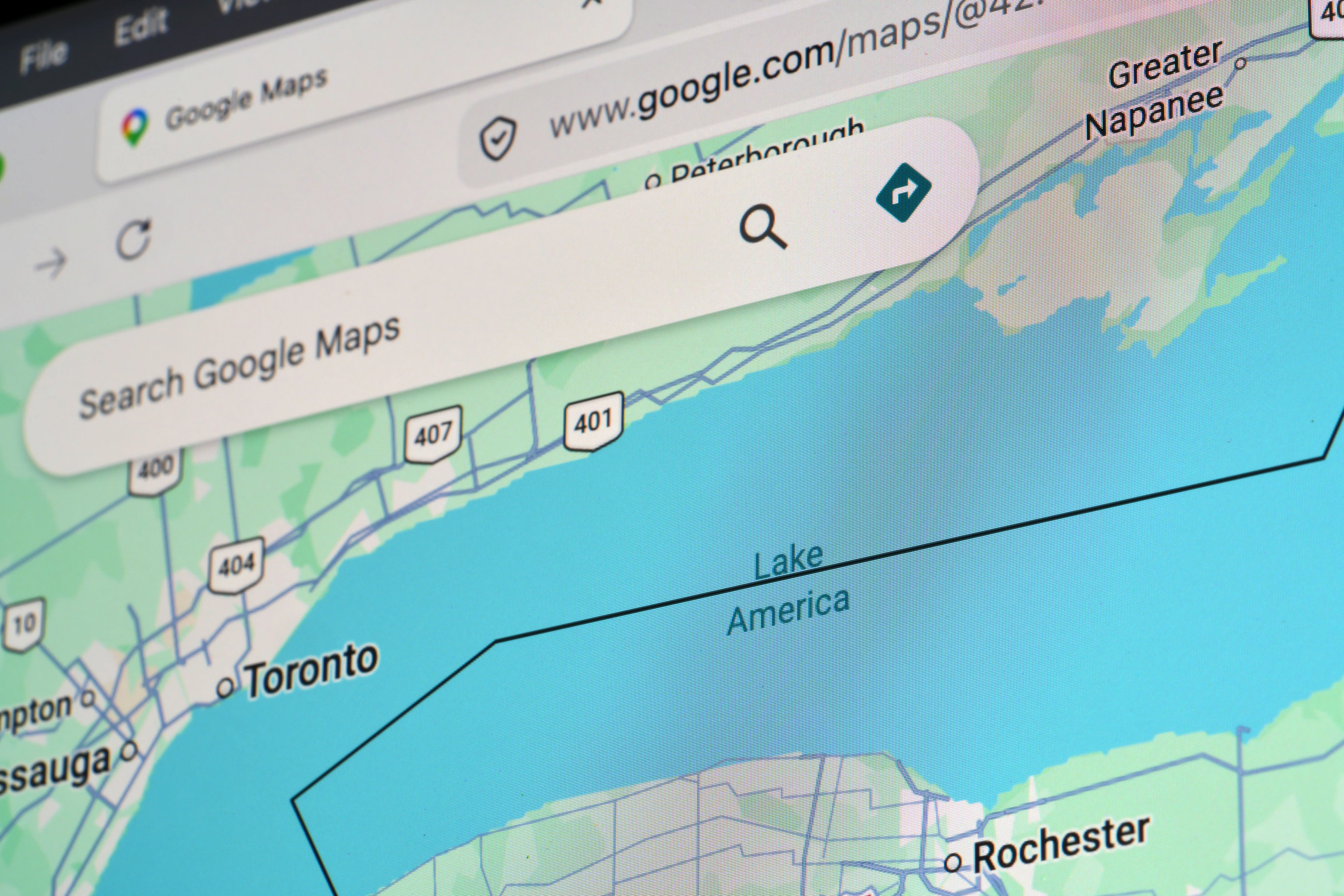
On Thursday, President Trump issued an Executive Order entitled “Honoring the American History of the Great Lakes and Renaming Lake Ontario as Lake America.” In it, Trump asserts that because “the deepest parts of the Lake’s waters” are “within United States territory” and “the United States claims most of the Lake’s volume,” he gets to change the lake’s historic name unilaterally.
But approximately 55 percent of Lake Ontario’s surface area is in Canada, with the official international boundary running through the middle.
According to a YouGov poll, only 19 percent of Americans support Trump’s maneuver, an obviously petty snub of our friendly neighbor to the north. Before declaring the negative polling “better late than never,” however, it is worth pointing out that the naysayers might have jumped on the wrong legal bandwagon. This is one executive order that finds Trump on relatively legitimate legal footing — which makes the public outrage almost tragic.
The same poll puts Trump’s overall approval rating at 36 percent. The public seems more disturbed about his renaming of Lake Ontario than, say, the 18 U.S. service members killed and 756 wounded in Trump’s senseless Iran war; the 66,000 people currently in immigration detention camps, over 70 percent of whom have no criminal convictions ; the roughly 0.2 to 0.4-point rise in inflation due to Trump’s ongoing tariffs; his astonishingly corrupt pay-to-play engagements with ultra-wealthy individuals, corporations, special interests, and foreign governments; his recent lowering of standards for FBI recruits to tolerate stealing, the hiring of sex workers, and even bestiality; the appearance of his name over 38,000 times in the Epstein files, which still have not been released in their entirety despite a congressional mandate; and the staggering wealth Trump and his unelected family members have accumulated since he retook office.
The list of things to be upset about is endless. The renaming of Lake Ontario amounts to dust on the national windshield by comparison.
Trump cites a specific federal law to justify the renaming. That law broadly gives the Secretary of the Interior, “conjointly with the Board on Geographic Names,” authority to “provide for uniformity in geographic nomenclature and orthography throughout the federal government.” One section goes on to state that the joint agencies’ naming decisions must be “designed to serve the interests of the federal government and the general public” and “give full consideration to the specific interests of particular federal and state agencies.”
Established in 1890, the Board of Geographic Names has members from numerous federal agencies, including the the CIA, the Department of Agriculture, the Department of Commerce, the Department of Homeland Security and the so-called Department of War — another nominal reinvention of Trump, who also renamed the Gulf of Mexico the “Gulf of America.”
Cornell law professor Michael Dorf has thoughtfully argued that the law requires more than just following Trump’s orders — that unless Interior Secretary Doug Burgum and the Board of Geographic Names actually undertake an inquiry into whether renaming Lake Ontario is in the interests of the federal government and the general public, Burgum’s actions to implement the executive order are illegal.
As Dorf points out, however, Trump and Burgum already thwarted these criteria when they avowedly changed the Gulf of Mexico’s name to the Gulf of America. Since then, the Trump-friendly majority on the Supreme Court has overruled a 90-year-old precedent allowing Congress to establish agency independence from presidents by requiring that certain officials be fired only “for cause” rather than for purely political reasons.
The court thereby stripped that constitutional power from Congress. Except for members of the Federal Reserve Board — an exception that is intellectually disingenuous as a matter of Article II of the Constitution — presidents now have unfettered power over agency heads and thus, in effect, everything they do, lest they be fired for insubordination. In 2024, the same court gave presidents virtually limitless legal immunity from liability for the commission of crimes using the massive powers of the office.
It is therefore folly to suggest that Burgum will think independently about whether Lake Ontario’s name after Trump’s unequivocal executive order. Although Burgum could face a civil lawsuit for failing to comply with the technical procedural requirements of the Administrative Procedure Act in implementing the order, the potential impact of such litigation, even if successful, is almost comically anemic.
The leader of the Seneca Nation, President J. Conrad Seneca, has also argued that Trump’s action is barred by the 1794 Treaty of Canandaigua, which the U.S. entered into with a group of six tribal nations called the Haudenosaunee Confederacy. But Trump already managed to bypass Congress in violation of the Constitution when he attacked Iran, to kidnap the sovereign president of Venezuela and his wife from their bedchamber in defiance of international law, and to impose new tariffs on foreign nations despite a Supreme Court ruling confirming that the constitutional powers over tariffs belongs exclusively to Congress.
Over 100 international law experts have even gone so far as to suggest that Trump has engaged in war crimes. Complaining about an historic tribal treaty seems downright quaint.
The rule of law is over in America. If it takes the end of Lake Ontario for the American people to wake up to that reality and demand a reckoning, so be it. The Canadian people are with us.
Kimberly Wehle is currently a fellow at the Netherlands Institute for Advanced Study in the Humanities and Social Sciences and author of “How to Read the Constitution — and Why,” as well as “What You Need to Know About Voting — and Why” and “How to Think Like a Lawyer — and Why. “
Topics in this story
Gathered from external sources. Rights to this text belong to whoever originally published it.