Iowa Senate candidates zero in on cancer crisis as key race tightens
Candidates for Iowa’s open Senate seat are zeroing in on the state’s high rate of cancer diagnoses as the race emerges as one of the most unexpectedly competitive contests this cycle. The race features Democratic state legislator Josh Turek challenging Republican Rep. Ashley Hinson (Iowa) for the seat held by retiring Iowa Sen. Joni Ernst…
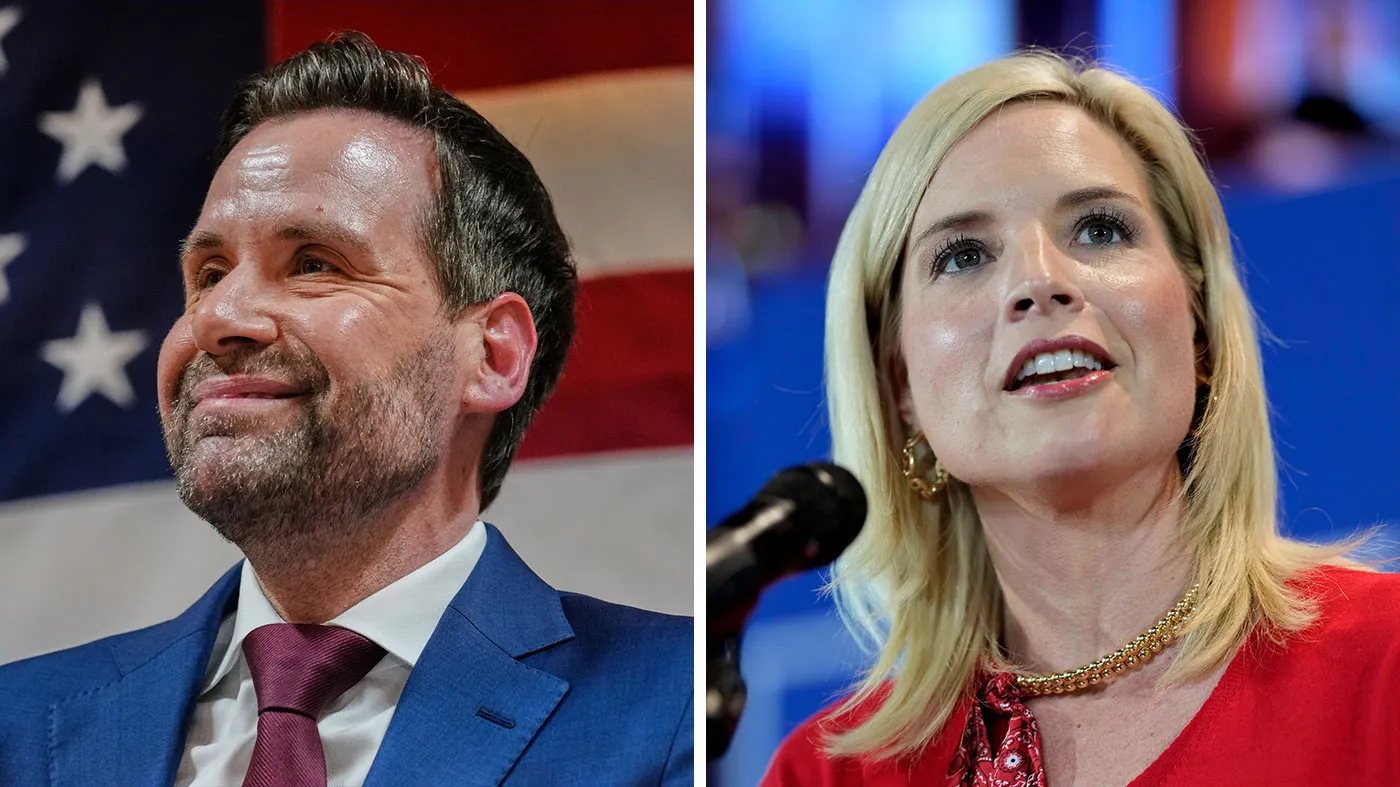
Candidates for Iowa’s open Senate seat are zeroing in on the state’s high rate of cancer diagnoses as the race emerges as one of the most unexpectedly competitive contests this cycle.
The race features Democratic state legislator Josh Turek challenging Republican Rep. Ashley Hinson (Iowa) for the seat held by retiring Iowa Sen. Joni Ernst (R). The Cook Political Report, a nonpartisan election analyst, last week moved the state’s Senate contest from “lean Republican” to “toss-up.”
Turek, a two-time Paralympic gold medalist in basketball, is emphasizing his bipartisan record, trying to pitch himself as an independent voice. His latest ad notes that he has voted with Republicans in the statehouse 700 times. Hinson, a former broadcast journalist, is leaning on her record leading bipartisan bills and overseeing appropriations in the House. She also carries an endorsement from President Trump.
But an X factor is each candidate’s approach to Iowa’s cancer rates, which are some of the worst in the country. Iowa has the second-highest incidence rate for cancer in the nation, behind only Kentucky, and that rate is rising while most of the country’s incidence rates are stable or decreasing.
Kerri Johannsen, the senior director of policy and programs at the Iowa Environmental Council (IEC), said knowing many people with cancer was common around the state when she and her team started researching the crisis last summer.
“We all knew a lot of people, of course, who had cancer,” Johannsen said. “But I think that there was an idea that it was kind of just normal.”
The biggest culprits, according to IEC’s research, are environmental contaminants, especially PFAS, nitrates, radon and pesticides — the levels of which are higher in Iowa than other states.
“You can’t ever say like, ‘This thing caused this cancer,’ but we do have what we call kind of a skyscraper of risk factors,” Johannsen said. “And when you start to say, okay, well, maybe you have radon in your home. That’s a carcinogen. On top of that, perhaps you’ve had exposure to pesticides or nitrate in your drinking water. Each of those things, when they stack on top of each other, increases the risk of developing cancer.”
The prominence of pesticides and nitrates, in particular, are due to the heavily agricultural economy that makes Iowa run.
Johannsen said those spreading awareness of the issue have to carefully thread a needle between discussing solutions and not demonizing the agriculture industry that is the backbone of the state.
“I’m a farmer’s daughter,” Johannsen said, noting that while she understands “this is a tough thing to talk about,” the IEC has found that “the elephant in the room when it comes to this issue is: What part is our industrialized agricultural system playing in this crisis?”
“Many people in Iowa already were feeling and suspecting this was a part of the problem,” she continued.
The candidates for political offices are taking that balance seriously.
Turek has been talking a lot about cancer as he travels the state. He has told stories about his grandmother, who died of pancreatic cancer; his father, who was exposed to Agent Orange and had a variety of health complications including cancer; and his sister, who was diagnosed with Stage 2 breast cancer the day Turek launched his campaign for Senate.
His message is focused on cracking down on insurance companies so patients have more access to care they can afford.
“I talk a lot about healthcare as a human right, and that if I’m able to get to the U.S. Senate, I want to fight for a public option to make sure that every single American has access to a baseline level of healthcare coverage,” he said in an interview with Ability Magazine published earlier this month.
Hinson, in a statement to The Hill, said she supports efforts to address the growing cancer rate by expanding access to detection and care.
“I’m proud to co-lead legislation that would improve access to mammogram machines, mobile cancer screening tools, and other preventative equipment in rural areas,” Hinson said. “We’ve got way more to do – I’ll keep fighting for results that help families fight cancer and save lives.”
Hinson also introduced a bill recently that would redirect revenue from existing taxes on tobacco into cancer research, and a spokesperson pointed to her involvement in passing the Rural Health Transformation Fund as part of last year’s Republican reconciliation package, the One Big Beautiful Bill.
The focus on cancer rates comes as the race for Senate tightens.
A red stronghold for the past decade, the agricultural prairie state has taken a heavy hit from Trump’s tariffs and rising fertilizer prices. At the same time, Republican candidates nationwide are bogged down by the Trump administration’s low approval ratings.
In announcing the seat’s shift to “toss-up,” the Cook Political Report’s Jessica Taylor wrote that “the political environment is uniquely challenging for the GOP” in Iowa.
An Emerson College poll earlier this month found Hinson leading Turek, 48 percent to 45 percent, within the poll’s credibility interval. Six percent of respondents were undecided.
The Cook report also shifted the governor’s race from “toss-up” to “lean Democrat.” And the gubernatorial candidates, Democrat Rob Sand and Republican Zach Lahn, have made a central issue of addressing the cancer crisis.
Sand this week took it a step further, using headlines about a new mRNA treatment for melanoma to bash Lahn over his skepticism of mRNA vaccines.
Lahn, speaking at an American Cancer Society Cancer Action Network roundtable on Tuesday, singled out water quality as a cause for colon and ovarian cancer rates rising and said addressing contaminants in Iowa’s food and water supply is a “major, major focus.” He has also talked about his father’s battle with non-Hodgkin lymphoma.
Timothy Hagle, a professor of political science at the University of Iowa, said he’d seen the cancer crisis showing up in races all across the ballot, including the three competitive House races. In particular, Democrats are hitting Republicans over their votes to cut cancer research and funding for care in the reconciliation bill last year.
“I did see at least a couple of ads, not from Turek directly, but from some of the PACs that are advertising against Hinson, that kind of were chastising her for votes that she took in Congress, and so it’s sort of an indirect way to get at some of these medical issues,” Hagle said.
Turek has said as much on the campaign trail.
“Looking at a state with a legitimate healthcare crisis,” Turek said in June. “Only state with a growing cancer rate. Closed 250 more healthcare clinics than we’ve opened and what has she [Hinson] done? She has voted to see 110,000 Iowans lose their healthcare.”
But Hagle predicted the race will mostly turn on more conventional issues, like name recognition. Turek is still trying to introduce himself to voters, Hagle said, while Hinson as a U.S. representative is better-known. It’s the reverse in the governor’s race, though, where Sand as state auditor cut an outsized profile and is making pains to distinguish himself from other Democrats.
“The hope is that to the extent that Sand might actually win, that he’ll cause the other Democrats and the other competitive races to do better, which is probably one of the reasons why some people think that the Senate race is a toss-up at this point,” Hagle said. “But I’m just not buying it, at least not yet.”
Topics in this story
Gathered from external sources. Rights to this text belong to whoever originally published it.