Senate passes ‘Protect College Sports Act’ with sweeping bipartisan vote
The Senate on Monday passed a landmark piece of legislation that aims to address growing concerns about fairness and equity in college sports, bolstering the National Collegiate Athletic Association’s (NCAA) power to enforce its rules and potentially reshaping the future of collegiate athletics for years to come. The “Protect College Sports Act” (PCSA), a bill championed…
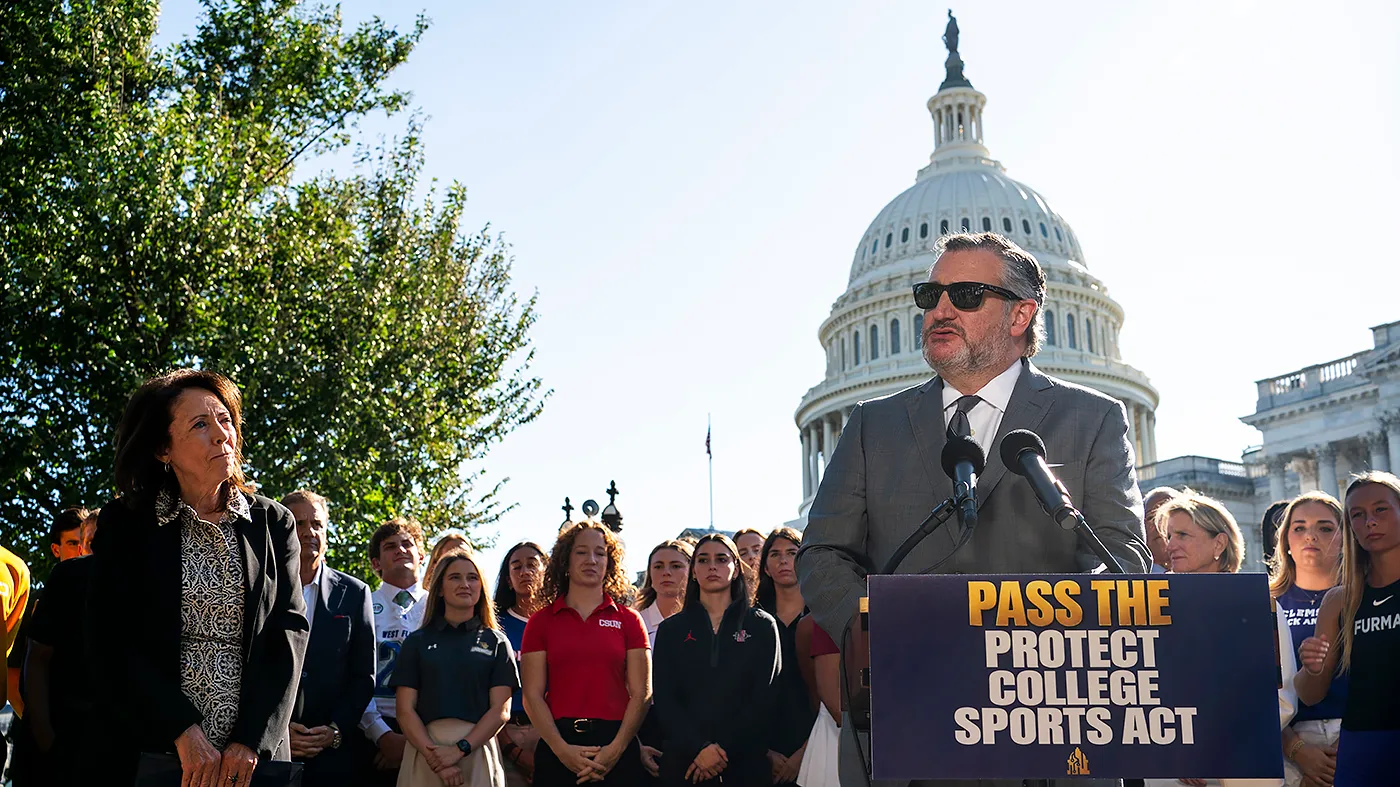
The Senate on Monday passed a landmark piece of legislation that aims to address growing concerns about fairness and equity in college sports, bolstering the National Collegiate Athletic Association’s (NCAA) power to enforce its rules and potentially reshaping the future of collegiate athletics for years to come.
The “Protect College Sports Act” (PCSA), a bill championed by Sens. Ted Cruz (R-Texas) and Maria Cantwell (D-Wash.), cleared the upper chamber 77-22 after months of tense bipartisan negotiations and vocal pushback from critics of the NCAA and senators in both parties.
The bill, among its top priorities, hands the NCAA sweeping federal antitrust protection shielding it from lawsuits around the enforcement of its rules and caps the amount of money student athletes can be paid for their name, image and likeness.
It limits agent fees at 5 percent and school spending on athletes at $50 million annually. It guarantees scholarships for 10 years after eligibility, as well, while allowing athletes to transfer once without having to sit out a year.
The bill also sets guidelines on conference realignment and seeks to enforce minimum revenue sharing standards at major colleges where football and men’s basketball earn schools millions each year, while smaller sports are under growing financial pressure.
“It would be nice if college sports could somehow magically fix itself, but this is a matter of law, federal law, and only Congress can fix it,” Cruz said during a recent floor speech promoting the bill. “Now I know some argue that college sports are doing just fine. They point to high television ratings, enthusiastic fan bases, and packed stadiums. But popularity does not demonstrate that the system is healthy. It simply proves that the system is worth saving. “
Monday’s vote was the culmination of months of work by a bipartisan group of Senators, led by Cruz and Cantwell, to win over skeptical Democrats, who raised concern the bill would disproportionately harm minority athletes’ earning potential and hand the NCAA and top member schools too much power.
Several labor groups, the NAACP and the Congressional Black Caucus have come out against the bill and vowed to fight it in the House, where it is expected to be considered when lawmakers return to Washington, D.C., after the midterm elections.
Among the bill’s top critics in the Senate were Cory Booker (D-NJ), who played football at Stanford University and Chris Murphy (D-Conn.), who argued the bill would essentially “preserve the exploitative model of college sports.”
“This is a bill not about student athletes, it’s about wealthy coaches and wealthy institutions and an NCAA who has enjoyed unbridled power for decades as we watch discrimination and hardships [of student athletes],” Booker said during floor speech on Monday that blasted the bill. “And finally the athletes were getting some power … and this body rushes in to say we’re protecting college athletes. Well that is not true.”
Monday’s final vote came after lawmakers voted down a handful of amendments to the sweeping bill, including a provision introduced by Sen. John Kennedy (R-La.) limiting increases to ticket prices schools can charge for major sporting events and a measure that would have capped coach salaries, introduced by Booker.
The PCSA’s passage marks a major achievement for the NCAA on Capitol Hill, where it has spent millions lobbying lawmakers and rolling out an aggressive advertising campaign advocating federal intervention in its rulemaking and enforcement in recent months.
In a statement on Monday evening, NCAA President Charlie Baker thanked Senators for their work on the bill and said “there is much work left to do” in the House “to ensure student-athlete benefits are codified into federal law and future generations of young people can access those benefits and use college sports as the launching point for their careers.”
A key moment for the legislation came in August when the SEC and Big Ten, the top two conference in college athletics, endorsed the bill, saying it was necessary to preserve competitive balance and put an end to the constant litigation schools face in regard to issues like the transfer portal and eligibility.
The measure passed out of the Senate Commerce Committee in June with a bipartisan vote and notched its first major legislative victory earlier this month when it cleared a procedural vote , with more than 70 votes for, despite pushback from senators in both parties.
Several conservative members held out on the legislation over concerns about how it would impact state laws on funding for transgender athletes in sports, while a pair of Florida lawmakers raised issue with its provisions regarding conference realignment standards.
The bill has been endorsed by President Trump , who earlier this year set up a task force on college sports that includes major figures like former University of Alabama coach Nick Saban and New York Yankees President Randy Levine.
After the PCSA passed its first procedural vote earlier this month, Trump in a Truth Social post called it “great news” that Congress was “straightening out the horrible situation taking place with respect to College Sports.”
“It is out of control, and will lead to bankruptcies and disaster for many Colleges,” the president said. “If nothing is done, it is also very bad for Women’s Sports, all Olympic Sports, and everything else other than Football — But even Football is bad because, without ‘caps,’ all Colleges will be financially consumed and, in many cases, it will ruin them.”
The bill is expected to face an uphill battle in the House after the midterm elections, where other similar efforts to regulate the big business of college sports have faltered.
The “SCORE Act,” a GOP-led measure that would have created similar federal standards and protected the NCAA, died this summer in the House after the Congressional Black Caucus held out support.
Cruz, who appeared on ESPN’s “College Gameday” earlier this month to advocate for the bill, has repeatedly suggested the House should make the PCSA a priority in the coming session and went so far as to say Trump should sign the bill live on the popular college football pregame show.
“We’ve gotta get there first,” Cruz told reporters the day before the Senate’s first vote on a bill he has been spearheading for months. “But it would be an amazing victory for student athletes if we can get that done.”
Topics in this story
Gathered from external sources. Rights to this text belong to whoever originally published it.