Trump shifts toward regime change in Iran, but by other means
Team Trump had to find a different pressure point.
The Trump administration is now 181 days into what began as Operation Epic Fury, which later transitioned into a forever ceasefire on day 38.
President Trump has tried unsuccessfully to use the military and diplomatic instruments of national power to bring this war to a conclusion, but a resilient Islamic Republic of Iran has withstood them.
And now he has turned to the economic instrument of national power, in the form of sanctions — supported by a naval blockade on the Strait of Hormuz.
Last Wednesday on Truth Social Trump promised an “Economic D-Day ,” vowing to wield “economic warfare and isolation on an unprecedented scale” against Iran.
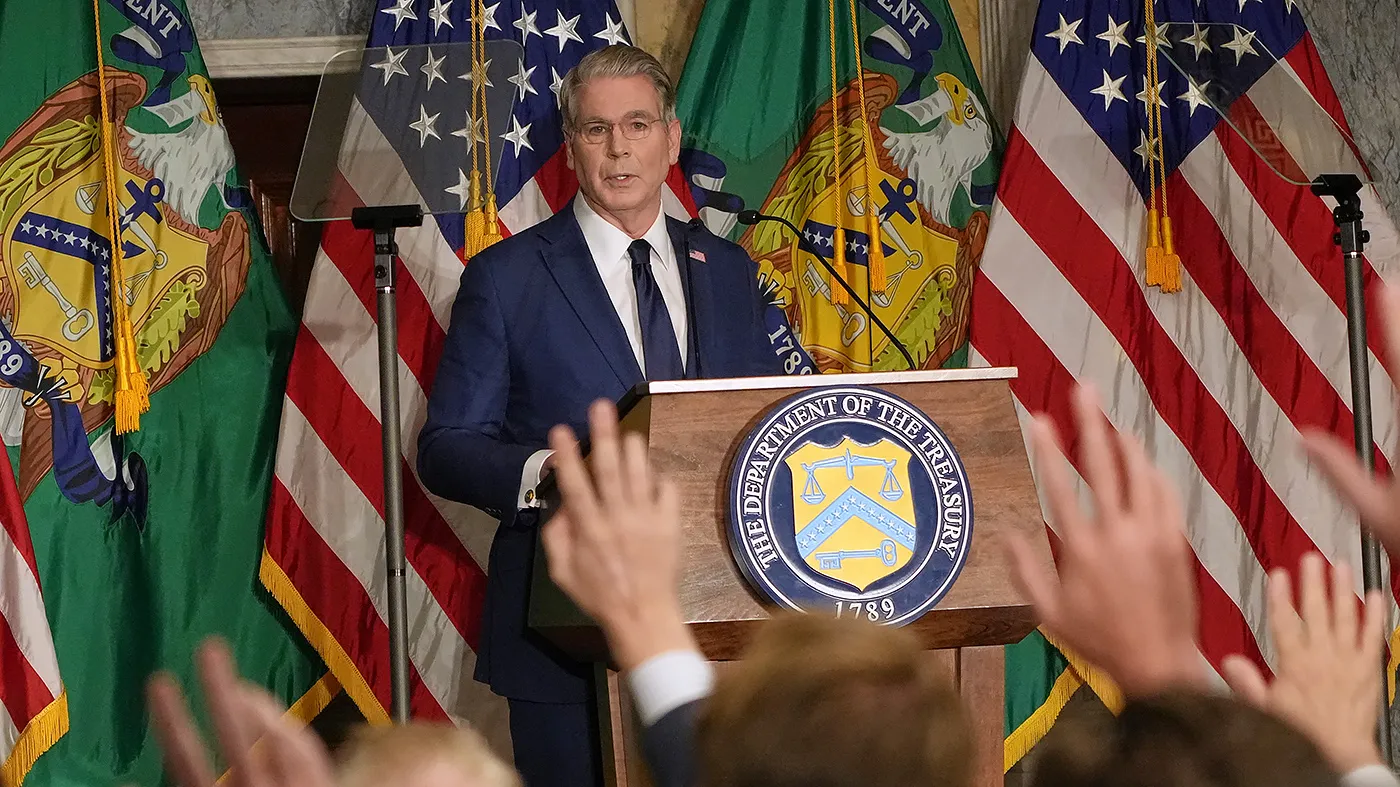
Treasury Secretary Scott Bessent added that Washington expected its allies and rivals to join the ramped-up campaign against Iran. “This is going to be the greatest coordinated economic isolation in the history of the world. And we are going to them and saying you are either with us or against us.”
Iranian Foreign Minister Abbas Araghchi dismissed the threat as a distraction and said it would backfire .
China said U.S. “sanctions and pressure” would not resolve the Iranian war. Foreign ministry spokesman Lin Jian said “all relevant parties [need] to take responsible measures and resolve the problem through political and diplomatic means.”
But the White House still does not know who the relevant parties are within the Iranian regime. They tried Araghchi and the Speaker of Iran’s parliament, Mohammad Bagher Ghalibaf. They even tried backdoor negotiations with Islamic Revolutionary Guards Corps commander Maj. Gen. Ahmad Vahidi.
But is Trump’s Economic D-Day just regime change repackaged?
Since the onset of Operations Epic Fury and Roaring Lion, the goal has been regime change. Trump and Israeli Prime Minister Benjamin Netanyahu have said as much — Trump during his Feb. 28 speech to the American public, and Netanyahu on March 13.
The plan was to set conditions for the Iranian people to rise up and “take back their country.” Removing the Supreme Leader and his senior advisors on day one did not have that effect. Although Iran’s conventional military was decimated, the Islamic Revolutionary Guard Corps — the regime’s center of gravity — was still in place, along with its Basij paramilitary , whose mission is to keep the Iranian people under control. And they did.
At day 38, Trump abandoned his military campaign to negotiate with what was left of the regime. But the new faces that emerged carried the same torch. Thus began the forever cease-fire and pursuit of a deal.
A 14-point memorandum of understanding and a 60-day cease-fire eventually emerged. Neither lasted, in large part because Iran’s negotiators and the people actually in charge were not on the same sheet of music .
The hard-liners were not going to give up the Strait of Hormuz, nor their enriched uranium nor the pursuit of a nuclear weapon. They were intent on shutting down the strait — their only leverage. Tit-for-tat military responses prevailed.
The regime never felt threatened by the Trump administration. The welfare of their citizens was not their concern — only their regime’s survival.
Having reached this impasse, team Trump had to find a different pressure point. But Trump himself was hesitant. Those words of caution Gen. Colin Powell provided President George W. Bush in August 2002 during the run up to Operation Iraqi Freedom were playing in Trump’s head: “If you take out a government, take out a regime, guess who becomes the government and regime and is responsible for the country? You are. So if you break it, you own it.”
Trump saw what happened in Iraq and later in Afghanistan — and he wants no part of nation-building in Iran. He would rather make a deal with the current regime than remove it.
But maybe he would not have to — maybe the Iranian people could do it for him.
In January 2026, a nationwide uprising took place in Iran as economic protests in the Grand Bazaar in Tehran expanded to more than 400 locations nationwide. Merchants and citizens took to the streets in anti-government demonstrations calling for an end to the Islamic Republic.
The main reason the protests began in the Bazaar was the severe economic crisis and the collapse of the Iranian currency. In late December 2025, the Iranian rial had fallen to its lowest historical level against the U.S. dollar, placing immense pressure on the public and merchants struggling to price their goods.
Security forces executed a brutal and unprecedented crackdown on the protesters, along with implementing a near-total internet blackout, killing as many as 36,500 civilians and arresting over 1,500 .
Monday afternoon Bessent delivered the message, Operation Economic Outcast had begun.
The rial had already dropped to 2.02 million to the U.S. dollar when trading opened earlier that morning. By recreating deplorable economic conditions in Iran similar to those in January 2026, is the intent to incite an uprising to overthrow the regime?
Setting conditions is one thing — having a plan to support and then exploit those conditions is another. Instruments of national power work best when used together. Has the White House learned that lesson?
Col. (Ret.) Jonathan Sweet served 30 years as a military intelligence officer and led the U.S. European Command Intelligence Engagement Division from 2012 to 2014. Mark Toth writes on national security and foreign policy. They are the cofounders of INTREP360 and the INTREP360 Intelligence Report on Substack.
Topics in this story
Gathered from external sources. Rights to this text belong to whoever originally published it.