Shutdown odds rise as senators scramble for fragile deal on Iran
Senate negotiators are trying to thread the needle and find a deal to avoid a government shutdown before Christmas, but progress has been slowed by a Senate Democratic leadership fight. The key issue is the Iran war, which was a major factor in the sweeping Democratic midterm election victories. Senate negotiators are sketching the outlines…
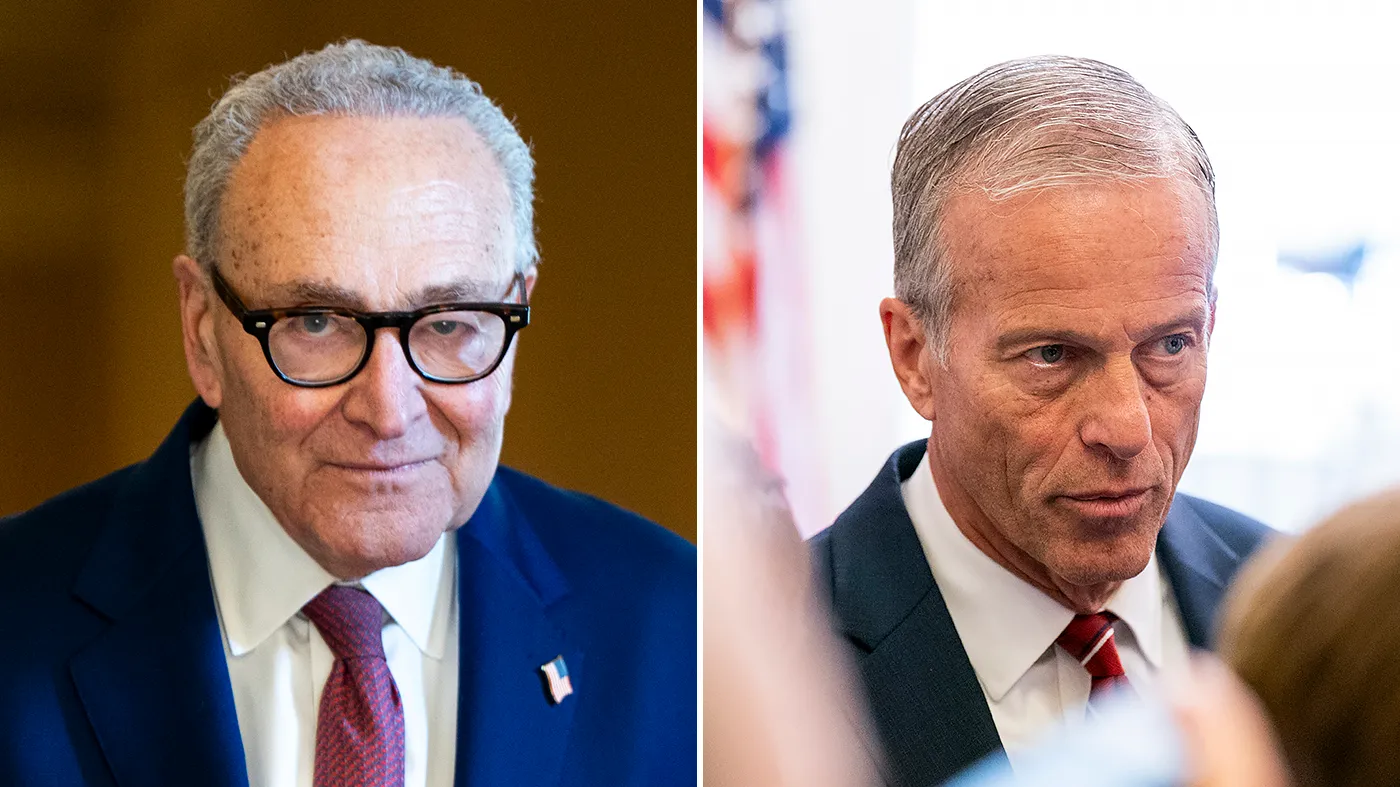
Senate negotiators are trying to thread the needle and find a deal to avoid a government shutdown before Christmas, but progress has been slowed by a Senate Democratic leadership fight.
The key issue is the Iran war, which was a major factor in the sweeping Democratic midterm election victories.
Senate negotiators are sketching the outlines of a deal that would provide the Trump administration with critical funding to replenish weapons and munitions stockpiles that have been depleted by the Iran war, but that would purport to stop funding the conflict itself.
The question is whether that deal can be accepted by progressive Democrats who have called for an immediate end to the war, or by President Trump, as his administration would get far less money than it sought.
And then there’s the complication of the Senate leadership fight pitting progressive Sen. Chris Van Hollen (D-Md.) against Senate Democratic Leader Chuck Schumer (N.Y.).
That battle is putting pressure on Schumer to keep his distance from the funding talks, since it could cost him support within his own conference.
Senators in both parties say they desperately want to avoid another shutdown, but party strategists say the odds of one increase each day Congress lurches closer to the Dec. 11 deadline.
“A government shutdown is a greater probability every day that goes by that Republicans and Democrats aren’t talking to each other,” said Ron Bonjean, a GOP strategist and former Senate leadership aide.
“The postelection lame duck has a recipe for a long, drawn-out process of a government shutdown,” he said. “You have Democrats who feel emboldened and a president who’s ready for a fight by hiring Stephen Miller as his chief of staff.”
Republicans say senior members of the Senate and House Appropriations committees are trying to lay the groundwork for a deal but warn that the talks won’t make substantial progress until Schumer, whose internal Senate leadership election is Dec. 1, gets involved directly.
“We’re not sure what’s going to come together,” said a Republican senator, who added that senators have a House-passed bill that they could bring to the floor quickly to fund the government.
The GOP source cautioned that Democratic colleagues don’t want to vote for any measure that could be criticized by progressive activists as funding the Iran war.
“We want military funding. The Dems have things they want, which is fine. The other thing is for [Democrats] to feel like the money isn’t going to the conflict in Iran. That’s one of the tricky parts,” the senator said.
Republican leaders believe Trump can only bring the conflict to a swift conclusion if the Pentagon is fully funded and he’s negotiating with Iran from a position of strength.
“We believe that you only end the conflict in Iran from a position of strength. You can’t limit our ability to be in a strong position, but [Democrats] want to know the money is going to munitions and Ukraine” and not to prolong the war.
Senate GOP sources say Schumer hasn’t played a significant role in the talks while defending against Van Hollen’s challenge from the left.
“We would like to get into the conversation about funding the government and whatever else comes with that as soon as possible,” Senate Majority Leader John Thune (R-S.D.), who says he is “pretty involved” in the talks, told reporters before the weeklong Thanksgiving recess. “I think there are some good conversations happening. No deals yet.”
Thune is not trying to pick off a group of eight to 10 Democrats to get a funding measure through the Senate — which is what he did in November 2025 to end a record-setting, 43-day shutdown.
Republicans familiar with the talks say Democrats are expressing openness to a funding deal that would direct any increases in defense funding to replenishing stockpiles or ramping up U.S. defense capabilities in space instead of to the conflict with Iran.
Senate Armed Services Committee Chair Roger Wicker (R-Miss.) said Sen. Jack Reed (D-R.I.), the ranking member on his panel, appears open to such a deal.
“I just talked to the once and future chairman of the Armed Services Committee. … He’s trying to frame a solution,” he said.
Democrats say that any funding to maintain the naval blockade of Iranian ports or to conduct other activities that could be defined as “acts of war” toward Iran cannot come out of new money appropriated in a December funding deal.
Given the dwindling number of legislative days left in the year, senators are looking at a potential deal that would fund the government through mid-April and include the annual defense authorization bill, disaster relief and emergency assistance for farmers.
A Democratic senator who requested anonymity to discuss the talks said the Pentagon has enough unspent funding to continue military operations against Iran even if Congress adds language to a short-term funding bill that prohibits new funding of the war.
“The Department of Defense has a gazillion dollars that they move around all the time kind of with impunity,” said the senator. “It’s not as if there’s some magic vote we can force that’s going to cause them to not do that. I also think some of my caucus members are legitimately concerned about the munition shortage.”
The Democratic lawmaker said the Pentagon’s budget for 2026 was approved before Trump ordered strikes against Iran at the end of February, which could allow Democrats to argue that voting for a continuation of current funding levels would not be the same as voting to prolong the war.
Even so, Democratic senators are wary not to support any funding deal that could be attacked by progressive colleagues and activists as a vote to continue the war.
Van Hollen issued a joint statement with several colleagues, including Sen. Bernie Sanders (I-Vt.), declaring that any short-term funding package “must include language that restricts the Trump administration from using appropriated funds to continue his war against Iran.”
Trump has demanded that Thune circumvent Democratic opposition and immediately move a budget resolution to provide an additional $350 billion to the Pentagon. GOP sources, however, say there aren’t enough Senate Republican votes to do that — at least not now.
If the bipartisan negotiations fail, then GOP senators will look to use a budget reconciliation package to circumvent Democratic opposition and fund the Pentagon, but that time-consuming process would take weeks.
There is hardly enough time to get a reconciliation bill passed by Dec. 11, even if Republicans manage to muster 50 votes to pass both a budget resolution and then a follow-up reconciliation package.
It would require Senate and House Republicans to first pass the same budget resolution simply to unlock the budget reconciliation process.
Such a resolution would instruct the committees of jurisdiction to craft a reconciliation package, which then would be subject to lengthy debate and an unlimited series of amendment votes before final passage.
Each measure would consume several days of Senate floor time.
Senate GOP aides say they doubt whether Speaker Mike Johnson (R-La.) will be able to enforce full Republican attendance in the House to ensure the passage of a budget resolution or reconciliation bill.
Senior Republican senators such as Senate Appropriations Committee Chair Susan Collins (Maine) and Sen. Mitch McConnell (Ky.), chair of the Appropriations Subcommittee on Defense, are telling colleagues they want to fund the Pentagon through the regular appropriations process instead of using a budget reconciliation bill.
Topics in this story
Gathered from external sources. Rights to this text belong to whoever originally published it.