The 2028 presidential election cycle is all about Trump
Looking ahead to the 2028 presidential election, Donald Trump’s influence over potential successors like JD Vance and Marco Rubio continues to shape a highly unpredictable political landscape.
Ever since Donald Trump descended Trump Tower’s golden escalator on June 16, 2015, to announce his presidential intentions, he has dominated the political universe. Eleven years later, as a term-limited, lame-duck president, loath to relinquish power and addicted to media attention, he will try to make the race to succeed him all about him.
Therefore, the 2028 presidential election cycle, President Trump’s last chance to wield power by selecting an heir to cement his legacy, is poised to be uniquely dramatic and unpredictable. No one could have predicted the 2024 presidential election’s out-of-bounds events — Trump’s near-assassination and President Biden’s last-minute withdrawal . So what sort of what-ifs can we reasonably discuss?
What if, by Election Day 2028, Trump is not the incumbent. This is a touchy topic but not a terribly unlikely one. Trump turns 82 in June 2028. Many people pass away at that age. Also, a severe mental or physical health crisis could trigger the 25th Amendment if Trump is “unable to discharge the powers and duties of his office.” That determination rests with Vice President JD Vance and a majority of Trump’s Cabinet, who would have to initiate removal by submitting a written declaration to Congress. Team Trump likely agrees that Trump’s disappearance from the political scene would improve Republicans’ chances of retaining the White House.
With Democrats soon to control the House and Senate, impeachment is possible and conviction unlikely. But Senate Republicans’ fear of losing in 2028 might change that assumption.
So what happens if Vice President JD Vance becomes president? Assuming he then runs for a full term; how would Vance lead the post-Trump era? Would he denigrate or defend the administration in which he played a starring role? Moreover, if necessary, would Vance pardon Trump, as President Gerald Ford pardoned President Richard Nixon, and risk losing his own election in the process?
Speculation aside, Vance is likely to retain his current title. The question of whether he will run for president without Trump’s endorsement will answered by spring 2027. I suspect that if Trump does not endorse him, Vance will announce that he will not run, and he will save face by citing family concerns. Trump could deflect, saying, “Let the people decide.” He may believe that anyone he endorses would lose the general election because they aren’t him.
Yet if Trump does endorse his likely heir, watch Vance turn himself into a political pretzel, defending Trump to win his “third term” as the president hovers over and monitors his campaign.
Meanwhile, Marco Rubio , secretary of State and national security advisor, is backstage, waiting for the Vance-Trump decision to be resolved. He has long dreamed of becoming the first Hispanic president ( see his 2016 campaign ), but he now carries Trump’s baggage. Will Rubio resign in 2027 to pursue his destiny? Would he “go rogue” and tell the world what he really thinks of Trump, as he did in 2016? If Vance bows out, would Trump endorse Rubio, who would then launch his campaign? What would Trump demand in return for an endorsement? Would Rubio even want Trump’s endorsement?
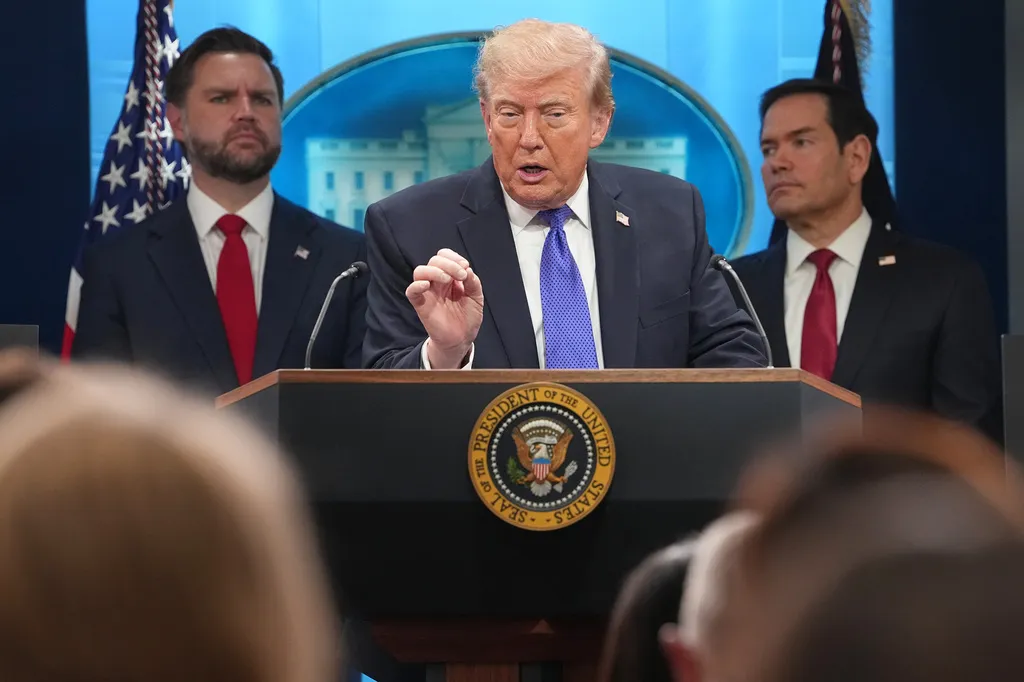
The latter question is relevant after Trump’s controversial Nov. 20 press conference , during which he said, “I can’t speak to America,” and rambled for nearly 90 minutes. Vance and Rubio stood behind the president like wooden puppets, even as Trump (jokingly) denigrated them as potential successors in favor of Stephen Miller, the new White House chief of staff. Miller’s performance at the podium, with countless lies and exaggerations was music to Trump’s ears.
For now, Vance and Rubio are caught in Trump’s magnetic political force-field, negatively supercharged since the midterms, resulting in a new tight race among Republican primary voters. RealClearPolitics polling averages show Rubio at 35.4 percent support to Vance’s 34 percent.
Furthermore, until the Trump-Rubio-Vance dance is done, less popular Republican presidential primary wannabes — such as Texas Sen. Ted Cruz and soon-to-be former Florida Gov. Ron DeSantis — can only make noise.
Turning to the crowded Democratic field, the RealClear polling averages are meaningless this early, before debates start in June . Still, the big news is that Sen. Jon Ossoff (D-Ga.) has leapt into second place with 15 percent support and is the man to watch .
Ossoff nips at the heels of first-place former Vice President Harris, who has 16.5 percent support. But the losing 2024 presidential nominee is only treading water with name recognition while debating whether to run again .
Summarizing the 2028 race, Trump, the showman, is the opening and closing act. The unpopular yet powerful lame-duck president is declining but remains the daily wild card. By design, he will dominate the next two chaotic years with jaw-dropping headlines , endless wars, bold lies and exaggerations, while shirking responsibility when things go wrong.
As always — just the way he likes it—Trump is a force of nature shaping the political climate , forcing every candidate to react to him.
Myra Adams served on the creative team of two Republican presidential campaigns in 2004 and 2008 .
Topics in this story
Gathered from external sources. Rights to this text belong to whoever originally published it.