Non merci: The ‘Arc de Trump’ and Shenzhen summit hit roadblocks
Trump has done nothing lately to be triumphant about.
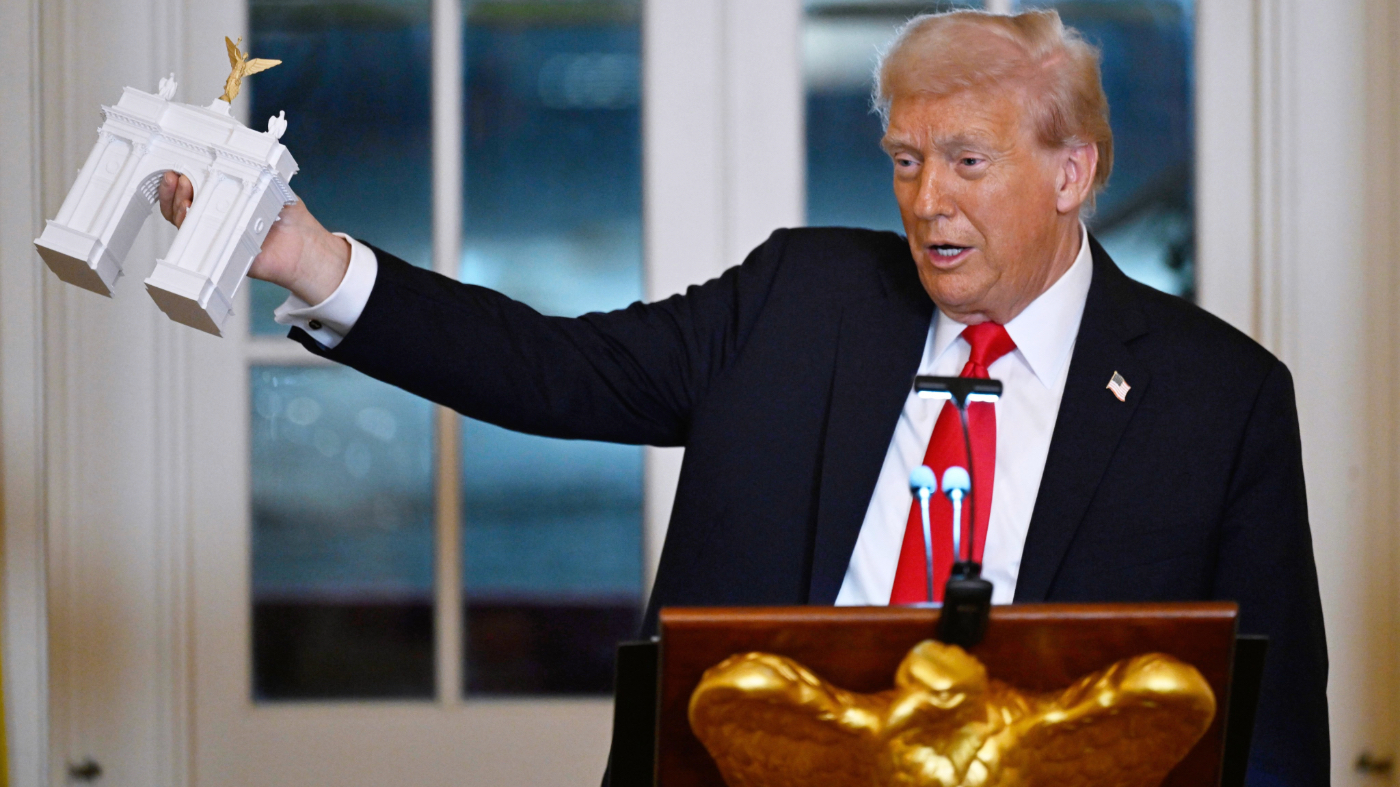
Washington Federal Judge Tanya Chutkan last week extended her block on construction of President Trump’s planned United States Triumphal Arch, called the “Arc de Trump” by some, for an additional 14 days. Chutkan sided with local leaders, who argued the 250-tall structure would harm the community. We can breathe a sigh of relief.
Trump has done nothing lately to be triumphant about. His 90-minute Shenzhen summit with Russia’s Vladimir Putin and China’s Xi Jinping produced no major breakthroughs on the issues that mattered most.
Shenzhen hardly advanced peace in Ukraine, though the leaders said in a joint statement that they would “increase the production and supply of refined petroleum” — a hint that the U.S. might start lifting some of the energy sanctions imposed on Russia after Putin’s 2022 invasion. And Trump’s push to persuade Moscow and Beijing to reduce their nuclear arsenals yielded only an agreement to begin a dialogue. Iran was the elephant in the room, but there was no sign that anyone addressed it. And there was nothing new on Taiwan.
Xi was the big winner at the summit. When the three posed for photo ops, the optics were terrible in many of them for Trump, with the Chinese leader in the center and the two others by his side, like two planets revolving around the sun.
Ukrainian President Volodymyr Zelensky called it “Yalta 2.0,” a reference to the trilateral eight-day 1945 meeting attended by the U.S., Britain and Russia, in which the victors after World War II carved up Eastern Europe . Concessions to Stalin paved the way for decades of Soviet dominance in Eastern Europe and Northeast Asia, giving rise to the foreign policy shibboleth that if you aren’t at the table then you’re on the menu.
The Shenzhen summit, held at a secluded lakeside villa away from city center of China’s tech capital , not only burnished Xi’s role as a convener of global powers, but was also a personal victory.
As it happens, a half century ago, the Chinese Communist Party appointed Xi’s father, Xi Zhongxun, to be in charge of China’s southern Guangdong province. Shenzhen — then known as Bao’an County — was a mere waystation for transients fleeing China’s poverty for the neighboring British colony of Hong Kong. Xi Zhongxun encouraged foreign companies to set up factories, creating a dynamic tech hub virtually overnight.
Xi ran the table in Shenzhen. As a weakened lame duck Trump landed on the Shenzhen tarmac, a triumphant but straight-faced Xi was there to welcome him to the dynamic city his father had built. I learned as a lawyer in negotiation 101 that it is always better if they come to you.
The post-meeting joint declaration bristled with generalities. The New York Times headline read , “Trump Flaunts Camaraderie with Xi and Putin but Has Little to Show for It.”
Meanwhile, back at the arch, Chutkan ruled that work be stopped while she weighs legal arguments. On Nov. 5, she had originally halted work for two weeks minutes after the Trump administration signaled it was poised to begin construction.
The proposed arch has been savaged by architectural critics. Architectural expert Paul Goldberger has written that “Trump’s idea of classicism is not dignity and order but over-the-top gaudiness” and “super-size Las Vegas vulgarity.” The arch would be built in Memorial Circle, offensively close to Arlington National Cemetery.
The White House has argued the project is an overdue addition to Washington’s skyline. They contend that Congress’s decision in 1925 to authorize a pair of 166-foot-tall columns at the site had not expired, and that federal commissioners had discretion to change the design, providing a legal groundwork to move forward. The problem with their argument is that two 166-foot columns doth not a 250-foot arch make.
Three Vietnam War veterans, a historical preservationist, the District of Columbia government and the Commonwealth of Virginia sued to halt construction. The case is expected to follow a similar path as Trump’s White House ballroom — all the way to the Supreme Court which ruled 5 to 4 that the project could continue.
The Kennedy family also moved to intervene in the lawsuit , arguing desecration of JFK’s gravesite and other graves in Arlington Cemetery.
David Maloney, Washington’s historic preservation officer, warned last month that the arch would “severely damage an exceptional cultural landscape and one of the most important symbolic places in the nation.”
Trump has defended the project, noting that many other cities boast triumphal arches, but Washington does not. He also has compared his plans to the Arc de Triomphe , the 164-foot Parisian monument commissioned by Napoleon in 1806. The project is broadly unpopular. Polls say 57 percent of Americans oppose the arch, while 22 percent support the project. Some Democrats ran in the midterms in opposition to the arch.
Protesters also have regularly demonstrated at the site.
“I think it’s popular with the real people, not, you know, the paid protesters,” Trump said. “I think it’s very important.”
He failed to identify who the “real people” were. While Trump reportedly paid people to stand around him when he first announced his candidacy, I guess he can’t fathom citizens standing up for their aesthetic convictions unless there is a dollar under the rock.
James D. Zirin is a former federal prosecutor in the Southern District of New York and a published legal analyst.
Topics in this story
Gathered from external sources. Rights to this text belong to whoever originally published it.