The Memo: Trump changes course on controversial ads, underscoring midterm dangers
President Trump did something rare Monday evening: He climbed down. Trump announced on social media that a series of TV ads extolling his supposed strengths would no longer be paid for by the government but would instead be funded by him and his main super PAC. To be sure, Trump admitted no wrongdoing and complained…
President Trump did something rare Monday evening: He climbed down.
Trump announced on social media that a series of TV ads extolling his supposed strengths would no longer be paid for by the government but would instead be funded by him and his main super PAC.
To be sure, Trump admitted no wrongdoing and complained that it was only the “Radical Left” who were unhappy about the original ad buys. But the switch told a different story, suggesting the series of taxpayer-funded Trump-centric ads was playing badly with voters.
The controversy was just one more battle in a midterm war in which Trump is the central figure.
Every midterm election is in part a judgment on the president of the time. But Trump has, characteristically, inserted himself into the campaign at every possible opportunity.
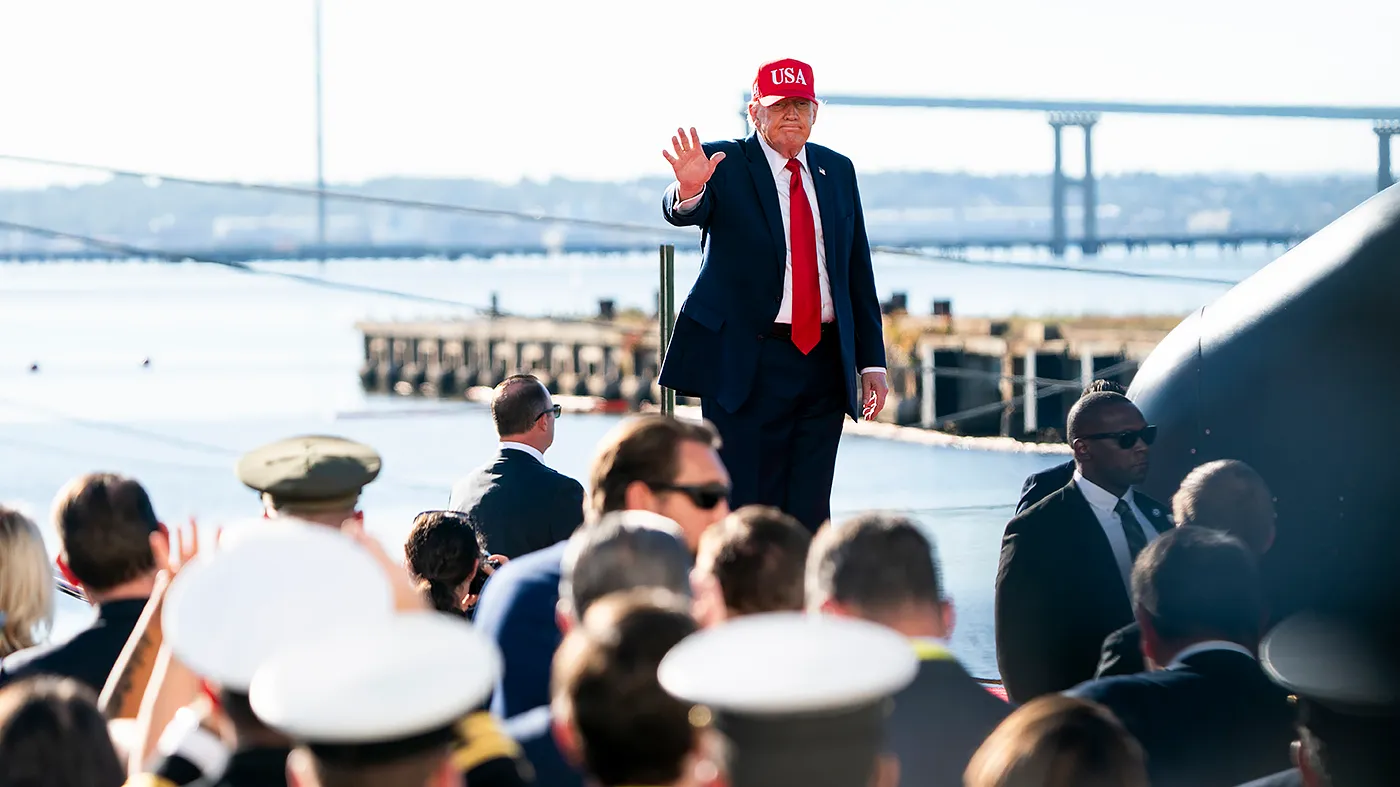
He has repeatedly urged supporters to vote as if he is on the ballot. He spoke during both nights of the GOP’s unusual midterm convention in Dallas, where a succession of other speakers hailed him and his record. He is in the middle of a sprint of campaign events, which he insists can elevate his party’s fortunes.
Speaking with reporters Tuesday, Trump asserted “the rallies have changed things around” and said, “I think we’re going to do very well.”
On social media, he was even more emphatic, insisting that he was in the process of saving the GOP’s electoral skin.
In two posts Tuesday morning, he wrote that “MY RALLIES ARE SAVING THE REPUBLICAN PARTY , AGAIN!!!” and “We are flipping races all over the place.”
But Trump’s itinerary appears to reveal a different dynamic. His travel so far has taken him mostly to conservative strongholds, including Nebraska on Monday, and Alabama and Oklahoma before that.
The locations may in part be intended to ensure the president is met by the adoring crowds from which he seems to draw energy. But they are also indicative of a midterm landscape where Democrats are advancing.
Senate races that Republicans did not believe would be competitive this cycle have tightened, including in GOP redoubts like Texas and Kansas.
This is surely due in large part to Trump’s sagging approval ratings. He stands at just 38 percent approval in the current polling average from The Hill’s data and polling partner, Decision Desk HQ.
There are signs, too, of some Republicans trying to create distance from the president.
A striking example came this week when it emerged that Texas Gov. Greg Abbott (R) would not attend the president’s rally in San Antonio, set for Wednesday.
Abbott has ascribed the decision to a scheduling conflict, but it’s a move that raises eyebrows.
Abbott is in an unexpectedly competitive race for reelection. Democratic challenger Gina Hinojosa, a Texas state representative, led him by 3 points among likely voters in a recent New York Times/Siena poll.
Previously, three GOP Senate candidates also in tough races — Sen. Jon Husted in Ohio, Rep. Ashley Hinson in Iowa and former Rep. Mike Rogers in Michigan — urged a quick end to the war on Iran, albeit without criticizing Trump directly.
When it comes to the House, Republican gloom is near-total. Sen. Thom Tillis (R-N.C.) told MS NOW’s “The Beat” on Monday that “the House is almost statistically impossible to win at this point.”
Some Democrats have taken to taunting Trump. Abdul El-Sayed, the Democratic nominee for Senate in Michigan, on Monday sardonically appealed to Trump to “come to Michigan,” during an interview with MS NOW’s Chris Hayes.
Trump’s centrality to the campaign is “very damaging” to the GOP’s chances, Julian Zelizer, professor of history and public affairs at Princeton, told this column. “Them being tied to him, him being more present, isn’t helpful.”
Zelizer cited voter discontent with the cost of living and the war on Iran as especially corrosive.
“Voters are connecting the dots between President Trump’s foreign policy, particularly Iran, and the cost of living. So when he is out there, it’s not just that he’s not dealing with the issues the public cares about. It’s reminding them of the person they blame.”
There is also Trump’s unquenchable appetite for controversy to consider.
On Monday, he sparked yet another furor with transphobic comments about the Democratic Senate nominee in South Carolina, Annie Andrews.
This comes on top of his long-running public battles over Washington landmarks from the Lincoln Memorial Reflecting Pool to the Kennedy Center, and his repeated attacks on the media.
Despite it all, some Trump loyalists maintain that the naysayers are wrong.
They argue that the president has a unique capacity to turn out the MAGA base and that voters motivated by animus toward him are immovable regardless of what he does or doesn’t do.
“If you told me there are a bunch of undecided voters, then maybe [there would be a downside] but there are none,” said Barry Bennett, a senior adviser to Trump’s first campaign in 2016.
Asserting that Democrats have nothing to offer but “hot air and hate,” Bennett was also scathing of the idea that Trump’s campaign trail appearances would backfire in any concrete way.
“Someone is going to hate him more because he came to their town? I don’t see it,” he said.
Yet others contend that Trump is ultimately hurting his party because he is now so synonymous with an economy that has left voters deeply discontented.
“Donald Trump is trying to change the narrative of a failed presidency by going and doing these rallies and showing these crowds,” said Todd Belt, a professor of political management at George Washington University.
“But that is probably not going to work with a lot of independents because the economy is the number one issue.”
The Memo is a reported column by Niall Stanage.
Topics in this story
Gathered from external sources. Rights to this text belong to whoever originally published it.