Maine’s lobster industry finds itself squeezed on all sides amid Canada trade war
STONINGTON, MAINE — The Maine lobster business has found itself in the crosshairs of a trade war and congressional infighting as rising costs and other pressures leave the heritage industry in a precarious state. The war with Iran has sent diesel fuel prices soaring at a time when warming waters mean lobstermen are traveling further…
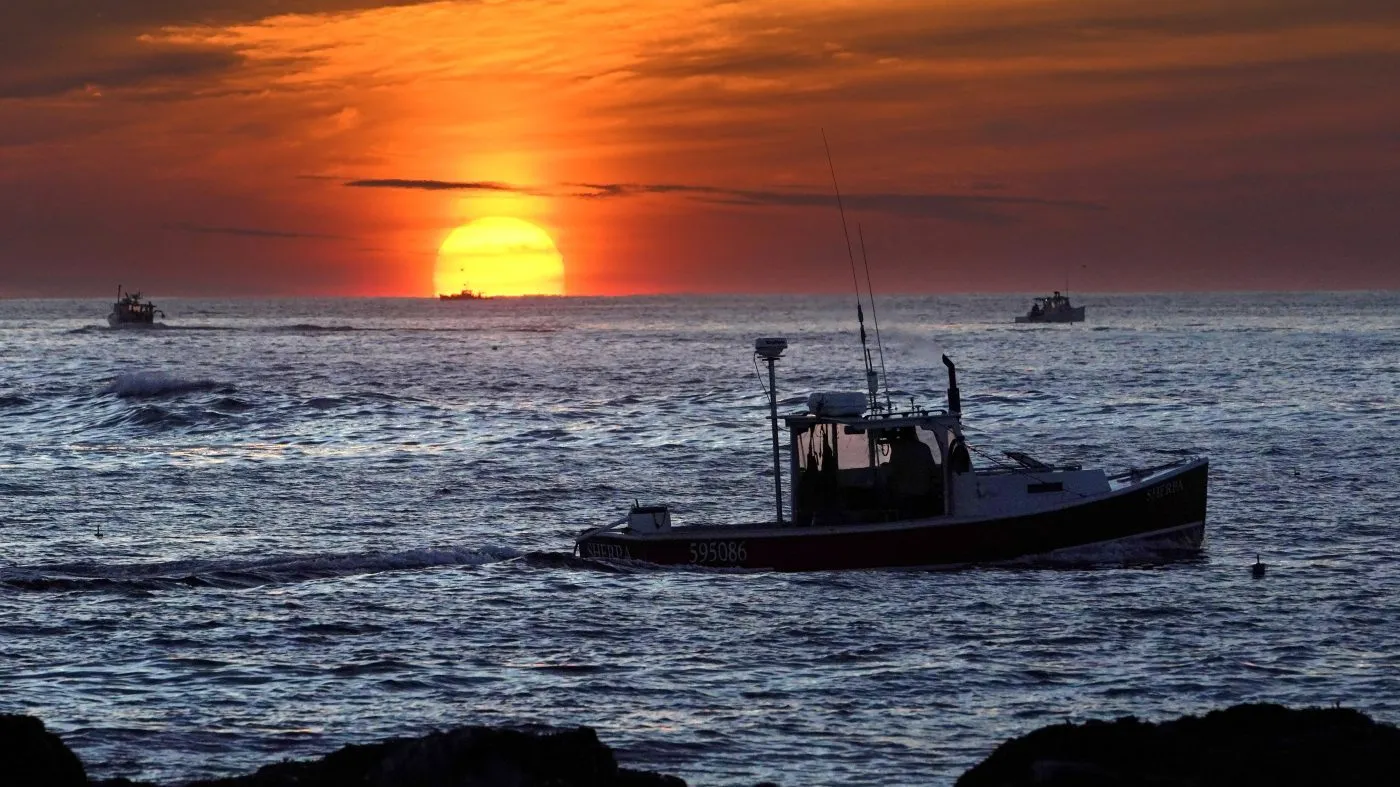
STONINGTON, MAINE — The Maine lobster business has found itself in the crosshairs of a trade war and congressional infighting as rising costs and other pressures leave the heritage industry in a precarious state.
The war with Iran has sent diesel fuel prices soaring at a time when warming waters mean lobstermen are traveling further offshore to look for lobster.
Profit margins have tightened significantly on the luxury good over the last 15 years, new research shows, while across the board, the industry is battling uncertainty.
“The cost now to just untie the boat is much, much more expensive than it has traditionally been. So it’s affected all of the gear, traps, rope, fuel, labor — I mean, everything that they touch — bait has gone up, everything’s gone up,” said Patrice McCarron, executive director of the Maine Lobstermen’s Association.
Nathaniel Lane, a lobsterman fishing off of Deer Isle, which includes the state’s most productive lobster port, said he’s joked with others in his profession that fishing trips have become a beautiful day for a boat ride.
“If you’re not profitable, all we’re doing is sports fishing,” he said at a recent talk sponsored by the Maine Center for Coastal Fisheries on the future facing the industry.
The price of lobster is at a 50-year low when adjusted for inflation, and while the crustacean is a splurge for the average consumer, many might be surprised by the slim margins under which Maine’s independent fishermen operate.
Alexa Dayton, executive director of the center, conducted a comprehensive survey on lobster economics to compare with one she first conducted in 2010.
The results show what she called a “gut punch” — a significant decline where in some cases boats are just barely exceeding their operating costs.
Boats of all sizes have seen profit plummet over the last 15 years, but it’s particularly true for boats of less than 25 feet, which now have just a 4 percent profit margin. Even larger boats in the 34- to 39-foot range have also seen their margins shrink drastically.
“The captain is fishing for free on many of these trips. Welcome to owning your own business, right?” she said.
“The boat gets fuel, crew is fed, bait’s been provided for, but the captain’s operating on a really low margin.”
It’s been a tumultuous few weeks for the industry.
Canada, already in a trade war with the U.S., threatened to respond to 50 percent tariffs imposed by President Trump with a 25 percent retaliatory tariff on U.S. lobster.
Such a move would be devastating for the Maine lobster industry, which is heavily intertwined with Canadian companies.
It also comes as Sen. Susan Collins (R-Maine) is fighting for her political life in a race that could decide the Senate majority. She’s criticized Trump’s tariffs on Canada.
Though Canada has a much shorter lobstering season, they have significantly more processing capacity, and Maine lobster is often peeled and packaged across the border before returning to the U.S.
Canada quickly backed away from the plan to impose tariffs on lobster, but it unnerved those who work so closely with partners across the border on a daily basis. It’s also unclear whether the matter could surface again given tensions between the two once-reliable trading partners.
“We’ve dodged another one, but it’s scary to be in the crosshairs of something like that that would really, really, really hurt individual businesses,” said McCarron.
The industry was also thrown into a congressional battle shortly thereafter, when retiring Rep. Jared Golden (D-Maine) crossed the aisle to back a procedural vote to take up several GOP bills, including one sponsored by him and a Republican lawmaker that would extend the period for adopting new regulations to protect the right whale, punting the matter from 2028 to 2035.
The whales have been killed in both ship strikes and entanglements in fishing gear. However, deaths have dipped significantly in the last two years , and the lobster industry notes that many of the entanglements have not been in lobster gear and occurred far beyond Maine, as the whales migrate up and down the Atlantic coast.
The legislation ultimately passed with 10 Democratic votes, but the party’s leadership was furious that Golden and another member gave up Democratic leverage in backing the GOP effort to bring forward the legislation with a package of other Republican-led bills.
“It’s a challenging topic in Maine, but obviously the lobster fishermen are a huge part of our constituency and have been worried a little bit about insufficient progress on this data before the deadline came down,” said Rep. Chellie Pingree (D-Maine), who represents the other of the state’s two congressional districts and backed Golden’s bill once it came to the floor.
“I think most of us are trying to make sure we have a way to save the right whale and the lobster fisherman.”
Maine’s lobster industry is hopeful that more time to collect data will show improvements in the current population of less than 400 right whales as well as shifting migration patterns that may lie largely outside of lobster territory.
It’s not clear if Golden’s bill will be taken up in the Senate, particularly with so little time in session between the midterms and the end of the year.
Dayton sees the proposal as a “doubled-edged sword.”
“We can track the whales now. We have a much better understanding of their patterns and where they are, and that’s informing the spatial question of where is the risk the highest,” she said.
The state and federal government have made significant investments in tracking the whales — funding that might lapse as a continued pause wouldn’t back the ongoing research the industry could use to make their case.
“They’re going to have access to all that great data that was collected through the monitoring program. If we don’t kind of jump on the bandwagon and go with the process and kick it out four or five years, we could be sitting here five years from now with no data, more whale deaths, and a much different regime and administration that will look at the rulemaking more stringently,” she said.
“It could be a worse outcome for the lobster industry four or five years from now than if we just take it on today.”
Maine has previously had some very good years for lobster, particularly between 2012 and 2018. But while some lobstermen may have made significant investments in infrastructure during that time period, the total number of lobster landings has been on the decline since.
“We peaked at a level that nobody ever thought was possible, and I think the resource was kind of settled back down into a new place. And that is not a place where if your price is just not helping you make ends meet, you can’t go out and fish harder,” McCarron said.
“There are only so many lobsters to catch.”
Lane said the future of lobstering will be one in which successful lobstermen will have carefully managed their finances and investments so as not to overextend themselves.
“I think there’s going to be an industry, but it has to be balanced between finding that sweet spot operationally. Who can continue to fish is going to be who’s kind of figured out the sweet spot between having the right equipment and having that equipment work for you,” he told The Hill.
“You’re going to have to be nimble enough to have a quality operation, but to make sure it doesn’t own you. You have to own your business, not let the business own you.”
Dayton fears, however, that current conditions could deter a new generation of lobstermen, while other shifts in the industry favor the biggest boats with more staff — undercutting generations of small family businesses that earn their living out on the water.
“This industry has been resilient and has adapted to change over 100 years, and I think that’s going to happen again,” but, she added, “uncertainty is not our friend.”
“Making room for the next generation is the biggest thing, in my view. That’s what we have to figure out is if you’re a young person today looking at all the news and saying, ‘Should I go be a carpenter or should I go be a lobsterman like my family did?’ … That’s my fear is that people will get sucked up in the uncertainty, and that next generation will choose not to commit to the fishery, and if we lose fishing here, we lose our place.”
Topics in this story
Gathered from external sources. Rights to this text belong to whoever originally published it.