Senate GOP sees battleground map widen amid voter anger over economy
Senators in both parties say the Senate midterm election battleground map has expanded significantly six weeks before Election Day, putting the GOP majority in greater jeopardy. Several solidly Republican-leaning states — including Kansas and Nebraska — are now seen as being in play, the senators say. Democrats can also add New Hampshire to the list…
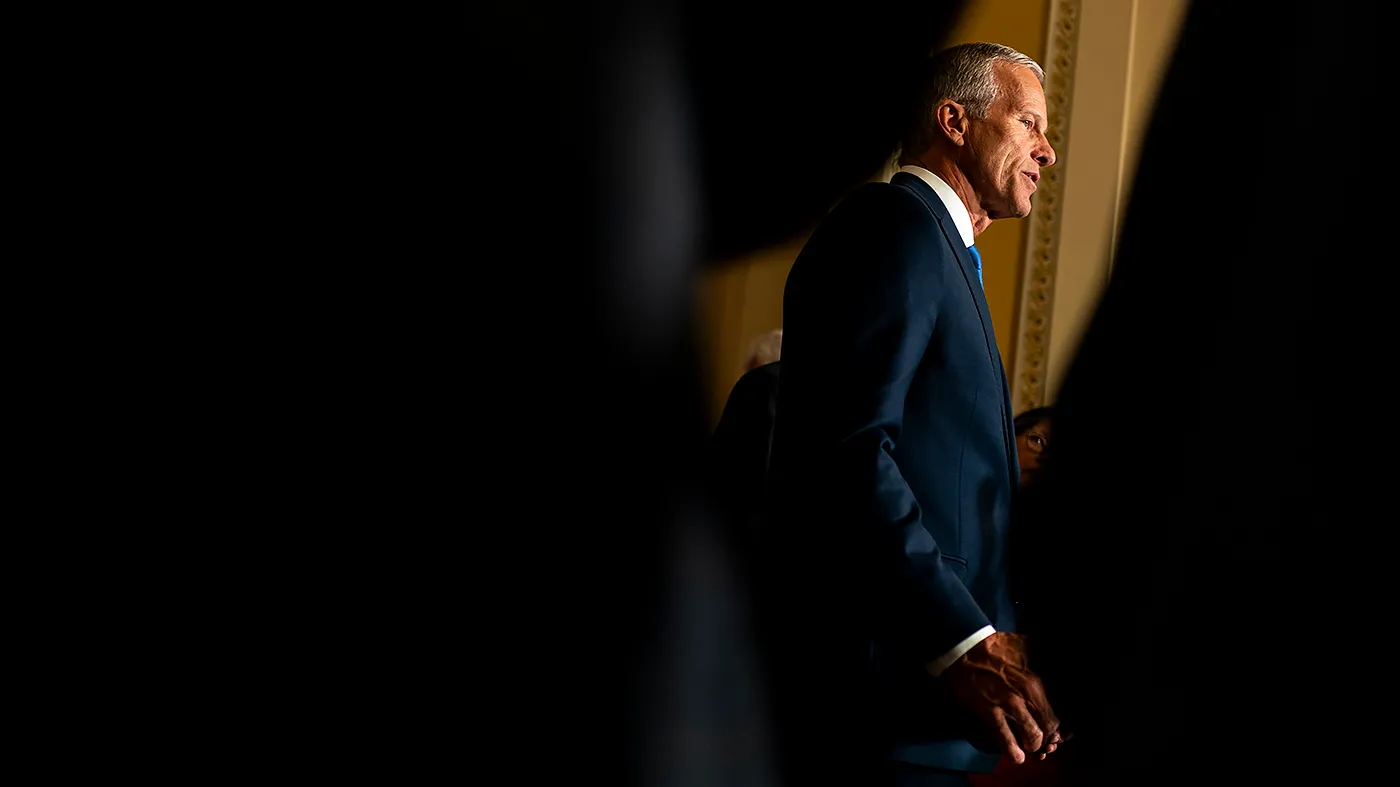
Senators in both parties say the Senate midterm election battleground map has expanded significantly six weeks before Election Day, putting the GOP majority in greater jeopardy.
Several solidly Republican-leaning states — including Kansas and Nebraska — are now seen as being in play, the senators say.
Democrats can also add New Hampshire to the list of toss-up seats they are defending. The Granite State and Michigan are hosting competitive races that are providing hope for Republicans and some nervousness for Democrats.
But overall, the widening map is putting more pressure on Republicans.
While Sen. Jon Ossoff (D-Ga.) is seen as relatively safe in Georgia, a number of GOP incumbents are looking nervously at polls given the changing dynamics.
The senators point to voter anger over rising gas and diesel prices as the biggest factor driving the shift of sentiment toward Democrats even in traditionally GOP-leaning states.
“Donald Trump is doing everything he can to sabotage the campaigns of Republican incumbents,” said Sen. Peter Welch (D-Vt.). “This could be a big blue wave, absolutely.”
Democratic senators want to see their leaders get aggressive by pouring money into GOP states as polls show Democratic candidates could win in places that were thought to be out of reach only a few months ago.
“I think we have nine Senate pickups possible and need to put our resources into making sure we win as many of those that we can,” Sen. Sheldon Whitehouse (D-R.I.) said.
Senators in both parties say Democratic candidates have growing momentum because of rising energy prices. Voters are blaming the increasing costs on the military conflict with Iran, which President Trump started back in February without prior authorization from Congress.
Senate Democratic Leader Chuck Schumer (N.Y.) told The Hill that Democrats are expanding the Senate map “big time.”
Polls show close Senate races in Maine, Ohio, Iowa, Texas and Alaska, and the Democratic candidate pulling away in North Carolina.
One GOP senator said internal polls show the Kansas and Nebraska Senate races are very close and the “overall environment” is bad for Republicans.
“Energy prices are way too high. The war, people don’t like. And the real reason they don’t like the war is it’s making everything more expensive. Voters are not in a good mood. In farm states like Nebraska and Kansas, farmers are just irate about the beef issue, they’re irate about energy prices,” the senator said. “It’s a tough environment.”
To be sure, the GOP remains a heavy favorite in both Nebraska and Kansas.
Kansas and Nebraska are both seen as likely GOP seats by the nonpartisan Cook Political Report. Florida and South Carolina are among the states where the GOP is seeking to retain seats that Cook rates as solidly Republican.
Still, the senator who spoke to The Hill called recent polls showing rising voter anger over gas prices and the war in Iran “grim” for the GOP and underscore worries about a widening map.
A Fox News poll of 1,211 registered voters nationwide conducted from Sept. 11-14 found that 71 percent of Americans said the Trump administration lacks a plan to end the Iran war and 34 percent of voters rated the cost of living and inflation as the top issue in this year’s election — more important than any other issue.
Sen. Lisa Murkowski (R-Alaska) said the Iran war’s impact on diesel and gas prices has become a major political problem.
“This is what people are talking about. How do we address it? I think we have to recognize, yes, we have seen the prices of fuel and related products, diesel — other refined products, fertilizer, we have seen all that rise as a consequence of what we’re seeing in Iran,” she said.
“People are feeling it, and they don’t like it. They don’t like it at all. And what kind of response are we seeing from the White House? Is there a recognition that there’s a connection here? If there is, I’m not hearing anybody enunciate it,” she added, expressing frustration over the president’s response to high energy prices.
Senate Republicans acknowledge they now face tough Senate races in several Midwestern states because farmers are angry over the cost of fuel and the impact of Trump’s trade policies, especially a recent decision by the president to allow 300,000 metric tons of foreign beef imports into the United States.
“Clearly beef is a critical issue for us. Our producers love the president, they consider him to be one of their own, and what he did in sending a message about increasing beef supplies in the United States by bringing in outside [foreign] beef really hurt them,” said Sen. Mike Rounds (R-S.D.), whose reelection race is rated solid Republican by Cook.
“That has shown up in his ratings in places that normally would be solidly in his corner. They’re frustrated and they’re hurt,” he said of the backlash among farmers against Trump.
Rounds said that’s “absolutely” giving Democrats a chance to win in Kansas and Nebraska, where the local economies depend heavily on farming.
A new Hill/Emerson College Polling survey conducted among 750 likely voters in Kansas from Sept. 15-16 showed Democratic Senate candidate Adam Hamilton leading incumbent Sen. Roger Marshall, 45 percent to 43 percent.
A Republican source familiar with the race said private polling also showed Hamilton with a slight lead.
Some polls showed a tight race in Nebraska, where independent candidate Dan Osborn is within a few points of incumbent Sen. Pete Ricketts (R).
A Wedgewood Polls survey of 500 likely voters conducted from Sept. 14-16 showed Ricketts ahead by 4 points while a SurveyUSA poll of 503 likely voters conducted from Sept. 8-13 showed Osborn with a 4-point lead.
Ricketts did not dispute that Nebraska is now in play in the battle for the Senate majority.
“I’ve been taking my race seriously for over a year,” he said when asked about Democratic claims that the battleground map has expanded to the Cornhusker State.
Democrats are growing more confident, with some pointing to a InsiderAdvantage poll of 1,200 likely voters conducted from Sept. 8-9 to say their party could win South Carolina. The poll showed that Sen. Darline Graham (R-S.C.) is only 2 points ahead of her Democratic opponent, pediatrician Annie Andrews.
“I just saw Annie Andrews yesterday, I believe she has a real shot at this,” Sen. Mark Kelly (D-Ariz.) told The Hill. He said he plans to campaign for Andrews.
“She’d be great to have in our caucus. We don’t have a physician on our side of the aisle. … I’d love to see her win,” Kelly said.
Republicans argued they’ve expanded the map to put Michigan and Minnesota — two Democratic-leaning seats — within their reach, as well as the race for the seat being vacated by the retiring Sen. Jeanne Shaheen (D-N.H.).
Cook rates New Hampshire and Michigan as toss-ups, while Minnesota is likely Democratic.
But Real Clear Politics, the nonpartisan media company that tracks polls and elections, on Friday moved the Minnesota Senate race to “toss-up” status.
Bernadette Breslin, a spokesperson for the National Republican Senatorial Committee, said Democrats are talking about Republican-leaning states such as Kansas, Nebraska and South Carolina being in play to distract from Republican threats in Democratic-leaning states such as New Hampshire and Minnesota.
“Chuck Schumer’s claim that the Senate map is expanding for Democrats is false spin meant to distract from his waning hopes of rescuing [New Hampshire’s Democratic Senate nominee] Chris Pappas and [Minnesota’s Democratic Senate nominee] Peggy Flanagan in states he once thought were safe,” Breslin said.
A KSTP/SurveyUSA poll of 654 likely voters in Minnesota conducted from Sept. 9-14 showed Flanagan tied with Republican Michele Tafoya, 42 percent to 42 percent.
Marshall says he feels good about his race, but he warned that affordability is a major issue and that it will be critical that low-propensity voters who support Trump show up to the polls on Election Day.
Kansas hasn’t elected a Democrat to the Senate since 1932.
Topics in this story
Gathered from external sources. Rights to this text belong to whoever originally published it.