This Week on The Hill: Congress returns to a packed agenda
The Senate returns this week to a packed agenda, with lawmakers facing a trio of unfinished priorities: crypto legislation, the farm bill and the budget resolution that Republicans need to unlock a third reconciliation package. The biggest question hanging over the chamber is whether Republicans can get on the same page on the budget resolution.…
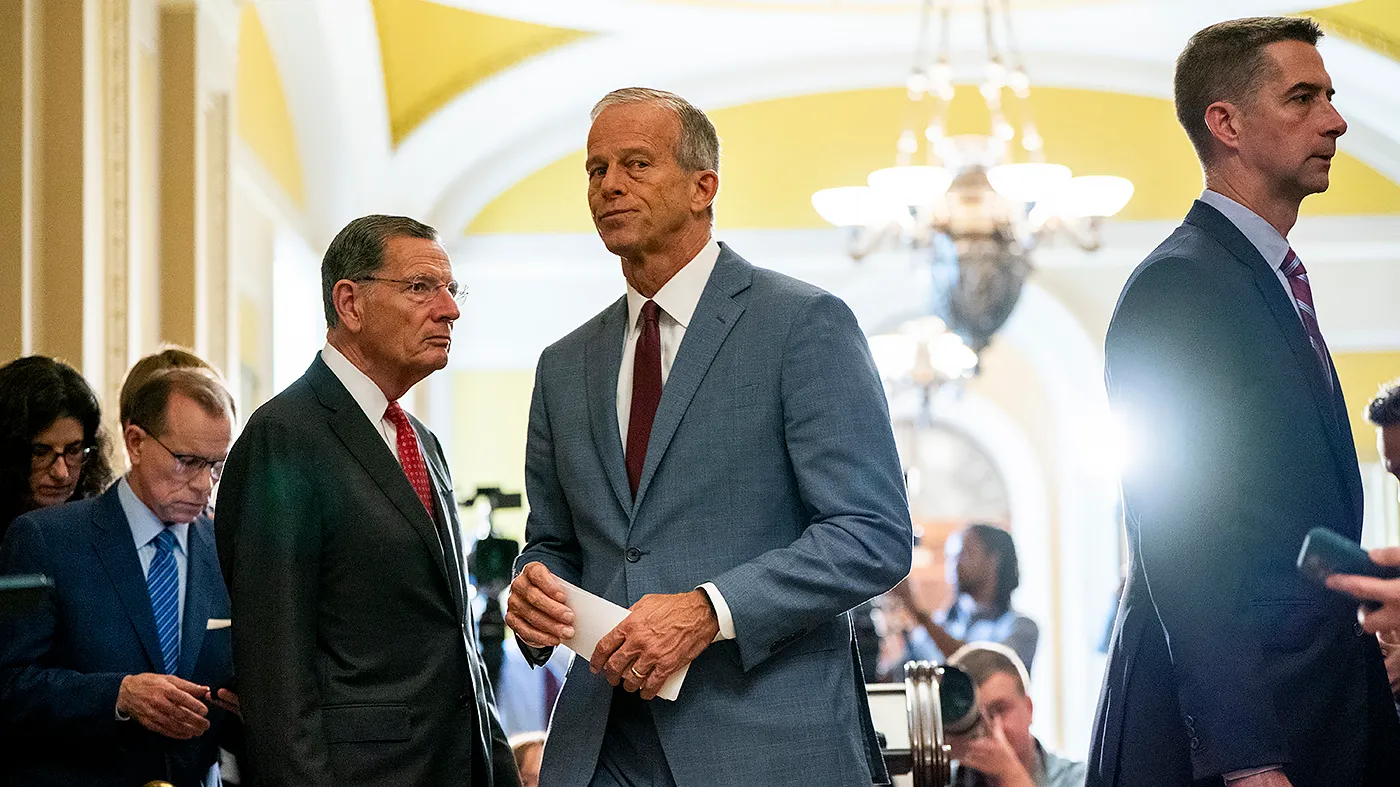
The Senate returns this week to a packed agenda, with lawmakers facing a trio of unfinished priorities: crypto legislation, the farm bill and the budget resolution that Republicans need to unlock a third reconciliation package.
The biggest question hanging over the chamber is whether Republicans can get on the same page on the budget resolution. Conservative fiscal hawks have railed against the lack of spending offsets in the package.
The chamber is also expected to take up a new version of a landmark crypto bill dubbed the Clarity Act, with a procedural vote slated for Tuesday. The legislation aims to establish a regulatory framework for cryptocurrency.
But it is not expected to win support from most Senate Democrats, who have long pushed for a provision restricting elected officials’ ability to profit from the industry.
The Senate Agriculture Committee, meanwhile, is expected to hold another vote on the farm bill, which would reauthorize agricultural and food programs for the next five years, according to Politico. The committee failed to advance the bill in early August, when Sen. Mitch McConnell (R-Ky.) was absent.
The House is also set to return this week and take up a number of bills.
The crowded agenda comes as lawmakers face a shrinking legislative calendar ahead of the November midterms, raising the stakes for Republicans hoping to move their priorities while they still control both chambers of Congress. The coming week will offer an early test of how much the Senate can accomplish.
Senate to continue talks on budget resolution: Advancing the budget resolution will be key to unlocking a third reconciliation bill.
Senate Agriculture Committee to vote on farm bill: The legislation failed to advance out of the committee last month due to Republican absences and Democratic opposition.
Senate to hold procedural vote on Clarity Act: The legislation is not expected to garner Democratic support over the lack of an ethics provision.
House to consider Russia sanctions bill: The House will consider Senate-passed legislation that will impose harsher sanctions on Russia.
House to put Ratepayer Protection Act on floor: The lower chamber will take up a bill aimed at mitigating the impact of data center costs on household electric bills. It is expected to garner bipartisan support.
Senate tries to unlock reconciliation process
The upper chamber is trying to reach a deal on a budget resolution that would unlock a third reconciliation bill to potentially fund defense and intelligence, agriculture aid, and incentives for states to adopt Trump-backed voting restrictions.
The House passed its own budget resolution before the August recess, but Senate Budget Committee Chair Ron Johnson (R-Wis.) released his own version of the resolution and has been working on it over the recess.
Senate Majority Leader John Thune (R-S.D.) had repeatedly warned before the August recess that he doesn’t have 50 votes to pass the budget resolution, which is the first step in the reconciliation process.
And vulnerable incumbents like Sen. Susan Collins (R-Maine) have made clear that they don’t want to face another vote-a-rama, with the opportunity for Democrats to force them to take tough votes, before the midterms.
GOP leaders and conservative Republicans have been eyeing a third reconciliation bill as a vehicle to advance the Safeguard American Voter Eligibility (SAVE America) Act, a long-standing conservative priority that would require proof of citizenship to register to vote in federal elections and photo identification to cast a ballot.
Trump has been pressuring Thune to pass the budget resolution, arguing in a Truth Social post last month that the measure is the “first step towards getting as much of THE SAVE AMERICA ACT as possible in a Budget Bill, funding our Troops, and helping our Farmers.”
Sen. Joni Ernst (R-Iowa), a member of the Senate Armed Services Committee, has previously said she wants more transparency about the Pentagon’s needs before the Senate votes on the budget resolution.
“We’ve heard so many different numbers coming from the Pentagon over the course of the last six months, so I really want to know what do they need,” she said last month. “I haven’t had anybody personally sit down and visit with me on those numbers, so I’m pretty skeptical that’s all they need.”
Sen. Mike Rounds (R-S.D.), a member of the Senate Appropriations Committee and the Armed Services Committee, said earlier this month that Republicans will likely move an omnibus spending package with emergency funding for the Pentagon and other priorities, and then move the separate budget reconciliation package with funding for the six-month conflict with Iran.
Senate Agriculture Committee takes another shot at farm bill
Sen. John Boozman (R-Ark.), the chair of the Senate Committee on Agriculture, Nutrition and Forestry, plans to hold another committee vote on the farm bill this week, Politico reported.
“I really feel like it’s important to continue to have members express where they’re at on this, and so we are going to vote again next week,” Boozman told the outlet.
The committee failed to advance the legislation in August, amid Republican absences and unified Democratic opposition to the bill’s food aid provisions.
McConnell has been absent from Congress after he suffered a serious fall in June. His office said he will continue his physical therapy routine from home during the Senate recess period.
“It seems like Sen. McConnell is continuing to recover and doing well. So hopefully, we’ll get him back. We don’t have any assurance of that, but we do have the assurance that he is doing better,” Boozman told Politico.
Democrats on the panel, meanwhile, have pushed back against a provision in the bill that would require states to help cover the cost of Supplemental Nutrition Assistance Program (SNAP) funding, demanding that the implementation date be delayed by two years to allow states to reduce SNAP error rates. Boozman had offered a one-year delay, but the panel’s Democrats said this was not enough time.
Senate to hold procedural vote on Clarity Act
The Senate is expected to hold a procedural vote Tuesday on an updated version of the Clarity Act, a bill aimed at creating a regulatory framework for cryptocurrency.
Sen. Cynthia Lummis (R-Wyo.), who chairs the Senate Banking subcommittee on digital assets, argued last week that Democrats have secured more than 100 revisions to the cryptocurrency regulation bill.
Her office pointed to 114 “substantive, distinct wins requested by Democrats and agreed to by Republicans” in a document shared first with The Hill. This included changes to the framework through which the Securities and Exchange Commission (SEC) regulates digital assets, the application of anti-money laundering laws and the oversight of non-decentralized finance platforms.
“I’ve bent over backwards to make this a truly bipartisan bill that both sides can be proud of and which protects both consumers and this industry,” Lummis said in a statement to The Hill.
But still, Senate Democrats have pushed for a provision restricting the ability of elected officials to profit off the industry amid concerns about Trump and his family’s various crypto-related business ventures. And the updated version of the bill doesn’t appear to include that language.
“If this bill fails it won’t be because of ethics, it will be because Democrats didn’t join Republicans in embracing a bipartisan bill that protected consumers, cements America’s leadership in digital assets, and empowered law enforcement to clamp down on illicit finance,” Lummis wrote on X.
The House Rules Committee will meet Monday to consider a Russia sanctions bill championed by the late Sen. Lindsey Graham (R-S.C.) and backed by Trump.
If enacted, the measure would impose harsher sanctions on Russia and buyers of Russian oil and gas than the U.S. has previously enforced and extend existing sanctions on Iran, aiming to economically squeeze the two countries.
House GOP leaders are seeking to move the measure through regular order, meaning Speaker Mike Johnson (R-La.) will need near-unanimous Republican support on a procedural vote to advance the bill on the floor. But it remains unclear whether Johnson has enough GOP votes to clear that hurdle.
And some Democrats have bristled at giving Trump tariff authorities even if they want to find a way to provide additional U.S. support to Ukraine. They argue that the president already has ample authority to impose sanctions on companies, individuals and oil tankers financing Russia’s war machine.
Reps. Don Beyer (D-Va.), a senior House Democrat of Congress’ Joint Economic Committee; Gregory Meeks (D-N.Y.), the ranking member of the House Foreign Affairs Committee; and Richard Neal (D-Mass.), the ranking member of the House Ways and Means Committee, argued in a joint statement last week that the bill would do “more harm than good.”
“This bill would dramatically expand presidential tariff authorities while failing to mandate sanctions on Russia, both of which are unacceptable. These flaws would raise Americans’ prices while undermining support for Ukraine in the long term. We continue to seek bicameral, bipartisan negotiations to craft a bill that can win strong support in both chambers and deliver on our promise to Ukraine,” they wrote.
House to vote on Ratepayer Protection Act
The House will vote on legislation Tuesday, dubbed the Ratepayer Protection Act, that seeks to mitigate data centers’ impacts on Americans’ electric bills, according to Johnson’s office.
The measure, which aims to codify a White House pledge signed by tech giants earlier this year, forces state regulators to hold a hearing on a standard that would ensure that large data centers pay for the cost of new power or power lines stemming from their electricity use. It does not force them to actually adopt such standards.
“[I]t has become clear that across the entire industry there is one entity uniquely positioned to stand up for families and communities who are the ones paying electricity bills-and that is this Committee, and our colleagues in Congress,” House Energy and Commerce Chair Brett Guthrie (R-Ky.) said in a statement.
The bill is slated for a vote under a fast-track process known as suspension of the rules, which requires two-thirds support in the House for passage.
But some Democrats on the House Energy and Commerce Committee have previously described it as a “first step” rather than a panacea.
Rep. Nannette Barragán (D-Calif.) said that the bill “recognizes an important principle,” but also said “this is not going to be enough. We need to do more to ensure that families are protected from higher electricity costs while also addressing the health and the environmental impacts.”
Topics in this story
Gathered from external sources. Rights to this text belong to whoever originally published it.