The Memo: Trump doubles down on demand for ‘recognition’ in Kennedy Center fight
President Trump is doubling down on his insistence that he needs “recognition” from the Kennedy Center in return for planned renovations. Trump’s assertion Friday afternoon seems to mean he is holding fast to his demand that his name should be added to the center in some shape or form — even though a court ruled…
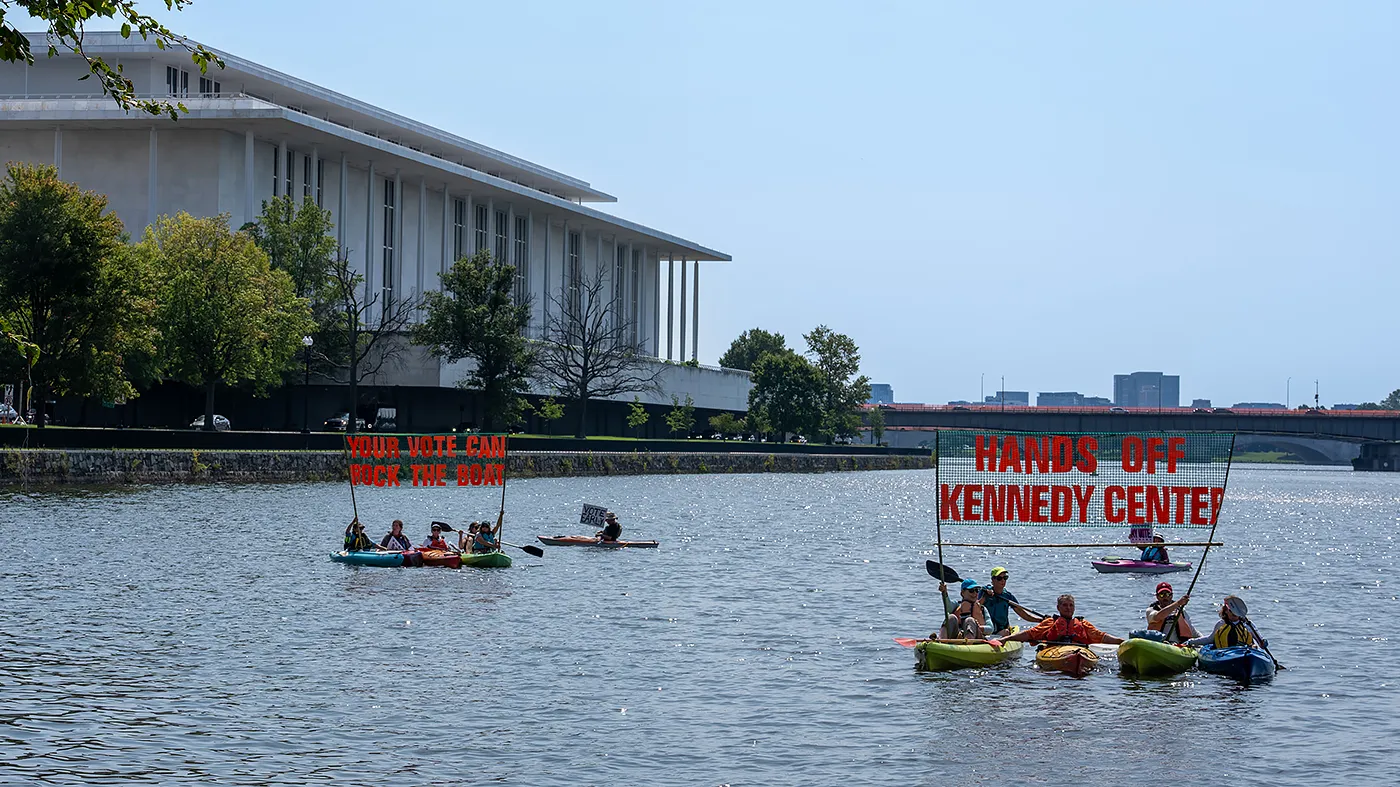
President Trump is doubling down on his insistence that he needs “recognition” from the Kennedy Center in return for planned renovations .
Trump’s assertion Friday afternoon seems to mean he is holding fast to his demand that his name should be added to the center in some shape or form — even though a court ruled against him on that score this past week.
“If we’re going to save the Kennedy Center, I think the Trump administration should be given recognition for doing so,” the president told reporters during an Oval Office encounter that was otherwise dominated by his declaration that he would ban three news organizations — CNN, MS NOW and Politico — from the White House.
The furor over the Kennedy Center has consumed much of the week, with developments coming thick and fast.
First, a judge reaffirmed that Trump’s name cannot be added to the performing arts center unless Congress were to approve such a change.
The legislation that created the Kennedy Center characterizes it as a “living memorial” to President John F. Kennedy, assassinated in Dallas in 1963. Therefore, the courts have taken the view that a decision made by Congress can only be amended by Congress — not by a vote of the Trump-friendly board of the center nor by fiat by the president himself.
Following that court decision, the board announced the center’s closure in a move ostensibly prompted by a need for repairs and by fragile finances. It’s widely accepted that some renovations are necessary, but Trump’s opponents on the issue have contended repairs could be made in stages while the center remains open.
Trump himself then raised the specter of the Kennedy Center, which officially opened in 1971, being demolished — or “ripped down,” as he put it. This in turn appears to have spurred a judge on Thursday to stipulate that 30 days’ notice would be required before any significant changes — including demolition — could be made to the building.
U.S. District Judge Christopher Cooper said he was making the ruling in part to “avoid any confusion on that score given more recent events.”
At Friday’s appearance in the Oval Office, Trump attacked Cooper as “conflicted” and “very hostile.”
He also assailed the congresswoman who has become his nemesis on the issue, Rep. Joyce Beatty (D-Ohio), as “a person that never did a thing in her life, frankly — never did anything constructive. All she does is complain.”
Beatty is an ex officio member of the Kennedy Center board, and she has led the legal challenges to Trump’s plans — with significant success so far.
By Beatty’s account, she and Trump had a fiery argument during a virtual meeting of the board earlier this week. Beatty told Luke Russert of MS NOW’s “The Weeknight” that the president was “unhinged … hollering and screaming” during the exchange, which she said went on “for a good eight or nine minutes.”
In any event, Trump did not explicitly repeat his threat to demolish the Kennedy Center during his Oval Office remarks Friday.
Norm Eisen of Democracy Defenders Action was co-counsel for Beatty along with the Washington Litigation Group in this week’s action.
Eisen told this column he did not expect Trump to press ahead with a demolition — a scenario that he contrasted with the ongoing work to create a new ballroom at the White House.
“I think the restriction will hold,” Eisen said. “There was no court order in place when the East Wing was destroyed. Here, we have a court order, and it’s one that has been affirmed. The Trump administration will follow court orders if you reiterate them often enough.”
Eisen also contended that Trump had behaved counterproductively for his own interests.
“He said the quiet part out loud, which was very unfortunate for his case — essentially, ‘If it can’t be named for me, I’m going to blow it up.’”
Trump has fought a long battle to have his influence embedded into to the famous arts center.
Early in his second term, he fired several board members including the chair, appointed loyalists as new board members and said he would be made chair — which he was.
The board late last year voted to amend the institution’s name to “The Donald J. Trump and The John F. Kennedy Center for the Performing Arts” and signage was affixed reflecting the change.
A judge ruled against the change in May, and Trump’s name was removed the following month — though tarp has been erected around the lettering ever since, seemingly to conceal evidence of a presidential defeat.
The whole episode has drawn enormous media attention. The question of how much it will matter politically, especially with the midterm elections little more than six weeks away, is hotly debated.
Republicans argue that, for all the sound and fury, it’s not going to be a major issue.
“It matters a lot in D.C. to people who love the Kennedy Center, and it appears to matter a lot to bookers for CNN and [MS NOW],” said Republican strategist Matt Mackowiak. “It’s not clear to me it matters to voters. I think most people don’t know what the Kennedy Center is.”
Mackowiak did — sparingly — acknowledge that there could be some impact if the controversy fuels the idea that Trump is overly fixated on himself rather than on issues more pertinent to voters’ lives.
“The only way they would care is if the president is devoting too much time to an issue like that, which appears trivial to most Americans,” he said. “But the idea that gas prices would be lower if he didn’t take try to take over the Kennedy Center is absurd.”
Democrats, naturally, see it very differently.
“Insisting his name be imposed on a living memorial to a dead president who was assassinated is really going to upset a lot of people, including some who might otherwise support some of his policies,” said Democratic strategist Tad Devine.
Devine acknowledged the issue would not be the be-all and end-all for the election.
But he linked it to Trump’s other efforts in Washington — including the Reflecting Pool at the Lincoln Memorial and a proposed arch, as well as the White House ballroom. He argued that such matters can resonate, in part because they are so different from orthodox political topics.
“He’s taking the nation’s capital and trying to turn it into his own advertising scheme,” Devine argued. “This isn’t going to drive the election, but I do think it really cuts through.”
He added: “People understand what he’s trying to do and they don’t like it.”
The Memo is a reported column by Niall Stanage.
Topics in this story
Gathered from external sources. Rights to this text belong to whoever originally published it.