Republican losses cloud Washington career path for conservative students
The new Congress, with its wide blue margins, is set to be a boon for Democratic staffers, liberal policy experts and interns seeking opportunities in Washington next year. But the next generation of conservative aides is looking warily at a Beltway job market already squeezed by economic pressures — and now further tightened by the…
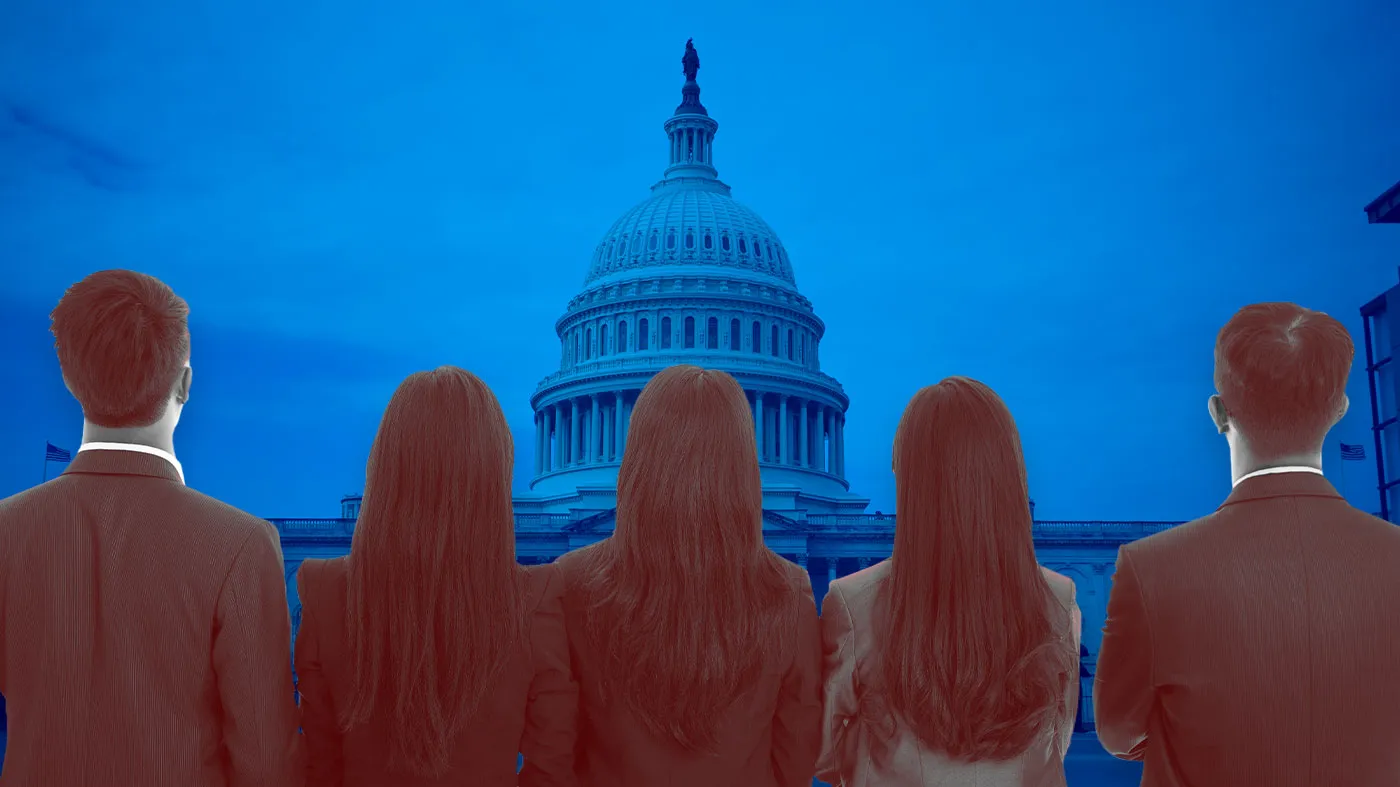
The new Congress, with its wide blue margins, is set to be a boon for Democratic staffers, liberal policy experts and interns seeking opportunities in Washington next year. But the next generation of conservative aides is looking warily at a Beltway job market already squeezed by economic pressures — and now further tightened by the decimation of Republicans across the Capitol and an unpopular outgoing president.
Students and staff at the Republican Party’s traditional feeder institutions around the country say the election results were not all that surprising, but the margins have left their Washington-based job prospects looking more murky than before.
Matthew Purucker , a junior at Grove City College, a Christian liberal arts college in Pennsylvania that sends many students to D.C. as Republican staff and interns, said that while the election result was not unexpected to many on the staunchly conservative campus, the Democratic landslide may make it tougher for political science graduates to find a job they want, let alone one that will recognize their alma mater.
“I think Grove City is a pretty strong college for political science, but only for Republicans,” said Purucker, who is also the editor in chief of the student paper, the Collegian.
He emphasized, though, that students he talks to know politics is fickle and temporary, and the 2028 presidential and congressional elections have the potential to reshuffle job prospects back in their favor. But in the short term, the midterm result could sway some students to plan a future outside Washington.
“I’m sure seniors will be disappointed,” Purucker said. “If you’re hoping to work in D.C. with Republicans in leadership potentially, if you’re lucky enough to be able to get a job in that position, it’s definitely disappointing.”
Plus, D.C. is a city of connections and politics is a world of who you know. Small schools with deep Republican connections like Grove City and its counterparts around the country, like Hillsdale College in Michigan and Patrick Henry College in Virginia, are less likely to open doors in Democratic circles.
Ben Hodge , internship director at Patrick Henry, said he’s talking with students since the midterms about “different avenues to accomplish the same thing” in their careers, while encouraging them to be flexible in their future plans.
“We have students who then are just looking for other congressmen or senators, or think tanks, or maybe changing tactics a little bit to say, ‘Okay, I’m going to go work for a nonprofit or something,’” Hodge said. “Maybe they were going to work for a pro-life congressman, but now they’ll go work for a pro-life nonprofit because that’s an issue that they really care about.”
Patrick Henry, despite being an hour outside of D.C., doesn’t have the name recognition of, say, the University of Virginia or Georgetown. It also doesn’t have the relative neutrality: it regularly tops lists of the most conservative colleges in the U.S. and has been given high marks for its structure and leanings by groups like the Heritage Foundation .
Hodge said he’s found lots of success placing Patrick Henry students in internships, as many recruiters now are looking for what they call “mission fit” rather than a college’s name brand.
“There’s this perception that Trump Part One kind of took off the bench,” Hodge said. “And I think that at least the perception there is that that didn’t work out as well for him in his first administration, and that in the second administration, and for those types of things — and it filtered down to congressmen and women and senators’ offices — is that they’re looking much less for name brand and much more for mission fit. And I think that for those places where our students’ bona fides overlap, that’s actually worked out well for our students.”
Nonetheless, college students have plenty of reasons to be anxious about the job market in D.C, blue wave or not. One Hillsdale student said she hadn’t heard any concerns about the midterms affecting job prospects, but that the cost of living in D.C., Maryland and Virginia — and the general competitiveness of Beltway jobs — seem to be stronger worries for the many Hillsdale undergrads looking for their next steps.
“Hearing that there’s going to be fewer positions available, or that this application is going to be more competitive this year, something like that, I really just don’t think is going to discourage students from putting their best foot forward and trying, because we are a pretty competitive student body,” the student said.
It’s also possible that the resounding defeat of Trump-aligned candidates — and the loss of Republican power more generally — could embolden conservative donors and organizations, creating more opportunities for young talent who are tired of the Republican status quo.
Paul Glader , director of leadership programs at Advancing American Freedom, said he’s heard from college students on campuses around the country who are excited about a chance for the GOP to return to some form of traditional Reaganite conservatism, the philosophy that AAF espouses. Glader is leading AAF’s campus outreach and fellowship programs, hoping to bring even more young conservatives into the fold.
“You read these stories in Semafor, Politico about ‘groypers’ and people connecting to the new right or whatnot,” Glader said. “But from my vantage point, I’m meeting a lot of young people at colleges and in D.C. and beyond who want to connect to different principles, they want to connect to our brand of conservatism, which harkens back to Ronald Reagan, William F. Buckley, and others. They want to read Russell Kirk, and they want to hear from [former Vice President] Pence.”
Glader was at Grove City with Pence just last week, and he said he saw this kind of energy from students there.
“I think people are finally now starting to realize, well, two years from now is going to go very quickly, and the Republican Party and the conservative movement needs to really look and think about what just happened at the midterms,” Glader added. “I think there’s a real eagerness among younger generations to move beyond this era in Republican politics.”
Welcome to The Movement , a weekly newsletter looking at the influences and debates on the right in Washington. I’m Helen Huiskes, Senate reporter.
Send me tips, comments, and suggestions: hhuiskes@thehill.com
As the conservative movement and Republican Party examine their way forward in a post-Trump Washington, those on the center-right who felt sidelined by Trump’s rise are looking for a new champion. Some think they may have found one in retiring Rep. Don Bacon (R-Neb.).
Bacon, who has been a congressman since 2017, and before that was a brigadier general in the Air Force, has said he is considering a run. At a recent gathering of “never-Trumper” groups in D.C., there was a lot of buzz about a potential Bacon candidacy, according to Chris Vance , executive director of Our Republican Legacy.
Bacon sent a prerecorded video to the gathering, and won over many of those present, including some people from Principles First, another center-right group. They like his background as a five-term congressman from a competitive district in the heartland, as a Bronze Star general, as well as his policy approaches.
“He might not run, and there might be other legacy Republicans who run, maybe, I don’t know. But he is exactly what our wing of the party wants to see in a presidential candidate,” Vance said. “I mean, he is absolutely opposed to the tariffs, absolutely opposed to appeasing Russia and Putin. He’s got the moral courage to speak out for a traditional Republican position on immigration, on other issues. I mean, right down the line, he’s with us.”
Vance said the midterm election’s “blue wave” means Republicans will be looking for a new way forward, which, he said, could be an opening for many in the party who have never liked Trump.
“I just think you’re going to see millions of Republicans snap back to what they were pre-Trump. I have never bought into this nonsense that the changes in the Republican Party are permanent. Nothing on this earth is permanent, particularly politics,” Vance said. “I think you’re going to see maybe everybody who runs try and move back towards a more Reaganite message.”
Bacon, for his part, told The Hill he’s “been talking” with the groups about a run, although he has yet to decide or announce anything.
“I have a message I’m passionate about, but I didn’t want it to be about me,” Bacon said. “I’m all about the message and vision. But it is possible I’ll be the only guy with a unifying message that we’ll need in 2028, and I should be prepared.”
Speaking of Republican presidential contenders, Sen. Josh Hawley (R-Mo.) keeps getting the question, and is making more noise. He has recently said he’s giving it “serious thought,” and he has also said his wife, Erin, is “trying to discourage it.” More here .
Several anti-abortion groups, including Americans United for Life, March for Life Action and Family Research Council, are out with a letter urging Trump to veto any legislation in the next Congress that restores Roe v. Wade or changes restrictions on federal funding for abortions. More here .
House Speaker Mike Johnson (R-La.) had to ask Republicans to show up for work after a string of absences derailed last week’s legislative agenda. Republicans have only a few more weeks in power, and the margins are so slim that Johnson needs virtually every Republican to be present to move bills. More here .
Olga Khazan in The Atlantic: The Big Reason Florida Is Still Red
Topics in this story
Gathered from external sources. Rights to this text belong to whoever originally published it.