Donald Trump joins well-trodden presidential path to the Emerald Isle
In recent decades, Ireland has become a particularly frequent fixture for US presidential trips.
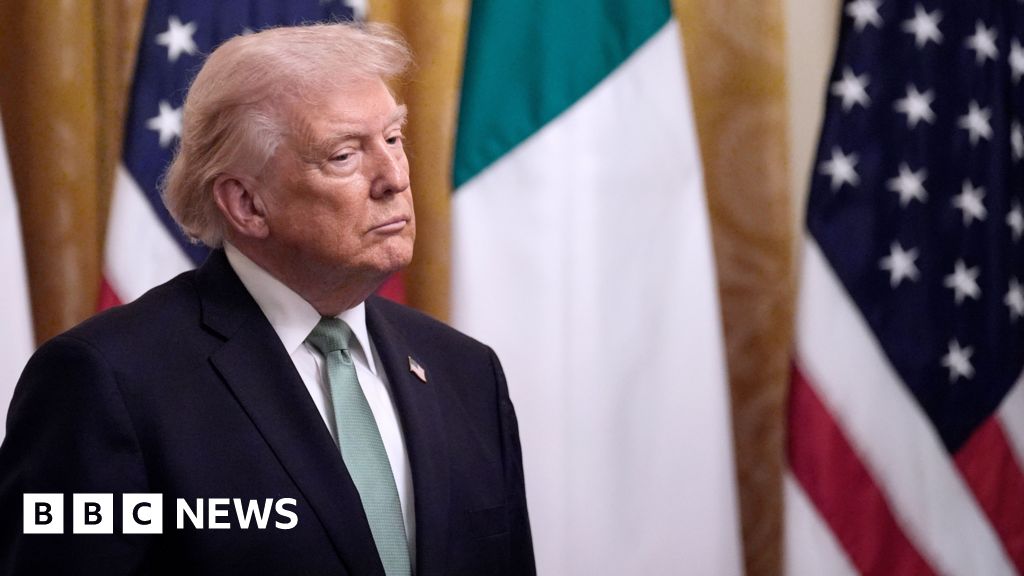
When Donald Trump lands in Dublin on Saturday, he will be on a well-trodden international path.
In recent decades, Ireland has become a particularly frequent fixture for US presidential trips.
It stands out among small countries as hosting a high number of visits.
The bond between the two nations was forged by emigration, deepened by economic ties, and cemented by the Northern Ireland peace process – in which Washington played a major role.
Historians generally estimate that around five million people left Ireland for the US in the 19th and early 20th centuries.
Dr Peter McLoughlin, who teaches history and politics at Queen's University Belfast, said that created an "enormous ethnic link".
In 2024, census data found that 32.4 million Americans claimed Irish ancestry – almost one in ten of the population.
That means several presidents have seen political advantage in being seen to explore their heritage.
John F Kennedy was the first president to go to Ireland while in office.
In June 1963, he visited his ancestral homestead in County Wexford, from where his great-grandfather had left during the Irish potato famine in 1848.
In his address to the Irish Parliament, he said: "This has never been a rich or powerful country, and yet, since earliest times, its influence on the world has been rich and powerful."
In the years since, Ireland has become rich by many global measures, with some of the US's biggest firms driving its economic growth.
Tech and pharmaceutical firms - such as Apple, Pfizer and Meta - have key European bases in Ireland.
The rapid expansion of US investment in Ireland in the 1990s coincided with the development of the peace process in Northern Ireland.
Bill Clinton's three visits to the island took in both sides of the border , and he was strongly involved in the Good Friday Agreement in 1998, which largely ended the conflict in Northern Ireland after three decades.
McLoughlin, who has researched America's role, said: "It's one of the examples where you can see US power being used in a successful way to get a peaceful settlement.
"After Clinton, George W Bush was maybe not such a hands-on president as regards Northern Ireland, but his White House was important in making sure the Good Friday Agreement was implemented."
Politicians, civic leaders and business figures from Belfast and Dublin are hosted in Washington each year on Ireland's national holiday, St Patrick's Day.
The taoiseach (Irish prime minister) traditionally presents the president with a bowl of shamrock, the plant which is a symbol of Ireland.
Dan Mulhall, who was Ireland's Ambassador to Washington from 2017-22, said the yearly access to the White House was "pretty unique".
"I remember some of my European colleagues were kind of puzzled as to how Ireland had pulled this off, given that some of them also have large diaspora communities in the US, but they don't seem to have the same impact or lasting connection with their ancestral homeland as the Irish Americans undoubtedly have."
Barack Obama paid homage to his heritage in 2011 , when he visited his great-great-great grandfather's home village of Moneygall in County Offaly.
In a speech in Dublin, he joked: "I've come home to find the apostrophe that we lost somewhere along the way."
Joe Biden described Ireland as "part of his soul" on his trip in 2023 , which was the last US presidential visit.
He went to his ancestral counties of Mayo and Louth and marked the 25th anniversary of the Good Friday Agreement.
Donald Trump's visit will be different in content and tone.
His focus will be on golf rather than genealogy, as he will watch the Irish Open played at his resort in Doonbeg in County Clare.
In Dublin, he will meet the Taoiseach Micheàl Martin and the Irish President Catherine Connolly.
Connolly has a largely ceremonial role as head-of-state, but she has previously been a staunch critic of US foreign policy, particularly in the Middle East.
Earlier this year Trump referred to Connolly as "he" when responding to criticisms she made about the US attack on Iran being "a brutal assault on international law".
The US Embassy in Dublin criticised a law passed by the Irish Parliament this year to ban the importation of goods from Israeli settlements in occupied Palestinian territory.
The Embassy said the legislation "risked real unintended consequences, particularly for nearly 1000 US companies and the hundreds of thousands of Irish jobs tied to them".
US actions abroad will be the focus of protests in Dublin and County Clare this weekend.
On Thursday a large sand artwork appeared on a beach in Dublin Bay.
The campaign group Uplift carved the words 'No kings - Gaza Iran Ice' into the sand.
Washington's trade policy has been another prominent issue in Ireland, as Trump has expressed unhappiness at the scale of US pharmaceutical manufacturing in the country.
However, tariffs have mostly not been imposed on the sector.
Mullhall, the former Ireland Ambassador to Washington said the economic relationship was "as strong as it's ever been".
He thinks the Irish government will approach Trump's visit with "prudent realism".
"It's not possible to expect that a small country, any country in fact, can deflect Donald Trump from any of his purposes or policies.
"Most countries have adopted the strategy of simply trying to ride out the Trump term and hope for more predictable days ahead.
"So I think the government will play it safe and will be above all else, be wanting to avoid any kind of tension or difficulty between themselves and Donald Trump."
McLoughlin, of Queen's University, sees parallels between Trump's visit and that of Ronald Reagan in 1984, when there was opposition over US foreign policy in Latin America.
The Catholic church was very influential in Ireland at that time and McLoughlin pointed out that senior clergy did not meet Reagan.
"This was a time when many people would have members of the family who were in Latin America as a nun or a priest, and were bringing back first-hand reports of how there were controversial associations with US policy, with right-wing paramilitaries who were engaged in the Cold War struggle."
But he said that amidst the criticism of the visit, the Irish government wanted to "court" Reagan, for "economic reasons, and political reasons involving Northern Ireland".
He added that pictures of Reagan exploring his ancestry, in County Tipperary, helped make the visit "successful" from Dublin and Washington's point of view.
Ireland is more used than most countries to hosting the holder of the most powerful office in the world and the diplomatic delicacies around Trump's visit are another episode in a story dating back many decades.
Donald Trump to meet Irish president on two day visit
Trump planning to visit Irish Open at Doonbeg
Topics in this story
Gathered from external sources. Rights to this text belong to whoever originally published it.