Gen Z men split from GOP in midterms, broke hard for Democrats
Tuesday was a big night for Democrats, and Generation Z was a big reason why. Young voters aged 18-29 broke hard for Democrats, including young men, who had been an important constituency for President Trump in 2024. The voters were also a big part of the winning formula for the party in Texas, where some…
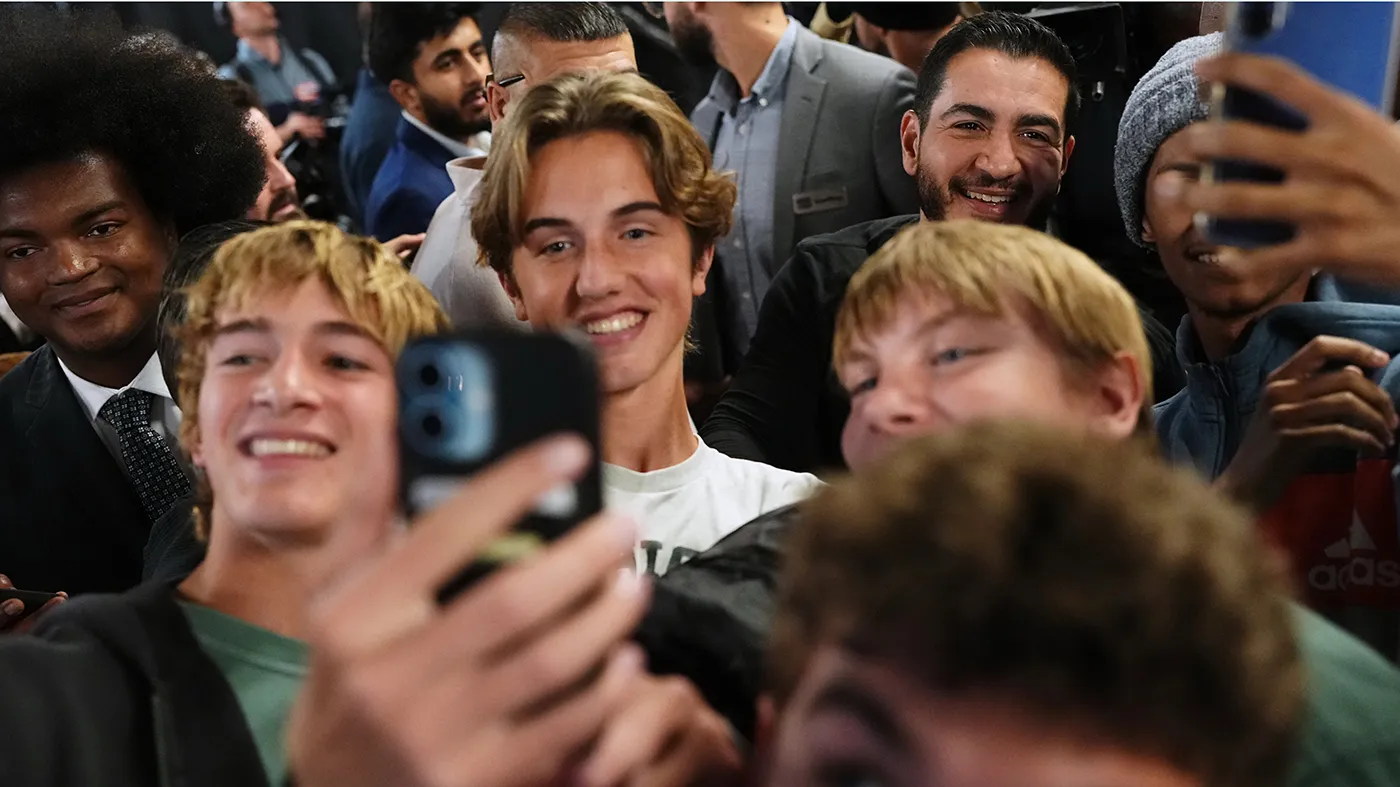
Tuesday was a big night for Democrats, and Generation Z was a big reason why.
Young voters aged 18-29 broke hard for Democrats, including young men, who had been an important constituency for President Trump in 2024.
The voters were also a big part of the winning formula for the party in Texas, where some of the biggest wins of the night were recorded.
Trump won 56 percent of Gen Z men in 2024, per AP VoteCast data. But in 2026, Democrats pulled them across the aisle.
Fifty-nine percent of white men aged 18-29 voted Democratic on Tuesday, according to an analysis from Tufts University’s Center for Information and Research on Civic Learning and Engagement (CIRCLE).
“The number one force driving young men to vote for Trump and Republicans in 2024 were promises about an improved economy. Most Americans, including Gen Z men, feel that the economy is now worse,” said Tyler Daniel, an assistant professor of political science at Roanoke University.
This doesn’t necessarily mean that young men have had a significant change in politics. It seems more like negative partisanship, or the concept of voting against, rather than for, a candidate or party.
Daniel, however, had expected them to sit out of the midterms. “This is an abnormal reaction from this age cohort when they feel disenfranchised by the political system,” he said.
Adam Pennings, executive director of Run Gen Z, an organization that recruits and mentors young conservative candidates, said the young voters who came to Trump in 2024 are the same ones who left in 2026.
“Gen Z is the cost of living generation, and they voted like it,” Pennings added. “A lot of Republicans didn’t realize how pessimistic young people were, specifically.”
The data shows it — the Harvard Youth Poll reported that only 9 percent of young adults said the country was headed in the right direction. For the first time in its history, the poll said that more respondents expected to be financially worse off than their parents, not better, at 27 percent and 25 percent, respectively.
While Democrats hammered messages on affordability, Republicans spoke of the culture war, which led young men to vote for the candidates who campaigned on lowering prices.
“Under the first Trump administration, the economy was better. Younger voters, especially younger men, may have been more likely to give Republicans a chance again in 2024,” said Melissa Deckman, CEO of the Public Religion Research Institute. While cultural issues were still relevant in the previous election, Gen Z men mostly voted by looking at their wallets.
“There’s a sense that the American dream is out of reach,” Deckman added.
Now, Democrats face pressure to deliver on their campaign promises.
“This is not a generation of folks who will acquiesce to transactional interactions. There’s a desire for candidates to show up with authenticity,” said Leela Strong, a director at CIRCLE.
Looking toward 2028, Daniel expects that the GOP will prepare to lead the America First movement that is currently splintering within the party. He pointed to podcasters Tucker Carlson and Nick Fuentes, both of whom are trying to capitalize on points that the MAGA movement originally made with Gen Z men.
“We will have to see whether or not MAGA can exist without Trump guiding politics,” Daniel said. “The Republican Party is going through a broader identity crisis, one that will only worsen once Trump leaves power in 2029, and it is too early to see where Gen Z men will fall into the mix.”
Gen Z made up 12 percent the midterm vote
Data from The New York Times found that 70 percent of voters aged 18-29 cast their ballots for Democrats, a 33-point shift from 2024.
The red-blue divide was striking in some reliably Republican states like Texas and Alabama, where 70 percent and 63 percent, respectively, backed Democratic candidates.
Only in South Dakota and West Virginia did a majority of Gen Z voters support the Republican candidate. And the margins were slim, with the GOP reaching just a 2-point and 3-point lead in South Dakota and West Virginia, respectively.
President Trump led former Vice President Kamala Harris by 30 points is South Dakota and 42 points in West Virginia among voters aged 18-29, according to exit polls.
Those figures were similar to the vote in the 2020 presidential election , where Trump led former President Biden by 18 points in South Dakota and 32 points in West Virginia.
Exit polling from The Associated Press found that across all generations, the economy remained voters’ top priority. But Gen Zers were most likely to say they cast their vote as a rejection of Trump, in line with earlier reporting that younger Americans were more likely to say they regretted voting for the current president.
Kimberly McGuire, the executive director at URGE, a reproductive justice organization that partnered with HIT Strategies for a national survey of young voters , said the cost of living drove Tuesday’s results and that neither party should take Gen Z for granted.
“I think there is so much to learn from this election about how Gen Z has really found their feet politically,” McGuire told The Hill. “Some of the things that are rising to the top are the way in which Gen Z voters should not be taken for granted and should be treated in many ways as a swing constituency.”
Going into Tuesday’s midterm elections, all eyes were on Texas.
State Rep. James Talarico (D) and Texas Attorney General Ken Paxton (R) were locked in a highly contested battle for Sen. John Cornyn’s (R-Texas) Senate seat, while State Rep. Gina Hinojosa (D) looked to unseat Gov. Greg Abbott (R).
Both races ultimately swung in the Democrats’ favor in historic wins for the party, and Democrats believe young voters played a huge role.
An exit poll from The New York Times found that 74 percent of people aged 18-29 voted for Talarico in this year’s Texas Senate race — a 49 point boost for Democrats compared to the 2024 election.
Kendall Scudder, chair of the Texas Democratic Party, noted that Gen Z “was a huge part of our coalition,” but there was no one group of Texans that drove Talarico’s and Hinojosa’s wins.
“What we did see consistently were people with low propensity, people who didn’t vote very often, maybe hadn’t voted before, showing up in much larger numbers than you would expect for a midterm,” Scudder said.
Texas has historically ranked 49th in the country for voter turnout, making it a big deal that younger generations flocked to the polls.
Talarico’s and Hinojosa’s campaign strategies to increase voter turnout targeted Gen Z, using tech-savvy, snappier techniques that Scudder believes worked in their favor.
“They weren’t necessarily just leaning on legacy media to get their messaging. You saw them running strong social media plans across different platforms, they had very functional TikToks, very functional Instagrams,” Scudder said. “It allowed them to reach people, get their message across and express the urgency — meeting people where they are.”
The Feed is a weekly scoop on Generation Z put together by three Generation Z editors at The Hill. We’re working to understand the ins and outs of our generation’s politics. Send tips or comments to awalker@thehill.com, jfeldstein@thehill.com or cleibowitz@thehill.com.
Gathered from external sources. Rights to this text belong to whoever originally published it.