Trump’s approval ratings endure a cruel summer
President Trump is enduring a difficult summer in public opinion polls, with his falling approval rating deepening concerns for Republicans that they could lose the House and Senate majorities this fall. Trump has hit record lows in various polls, including a 33 percent approval rating in a Reuters/Ipsos poll this week. In the latest Economist/YouGov…
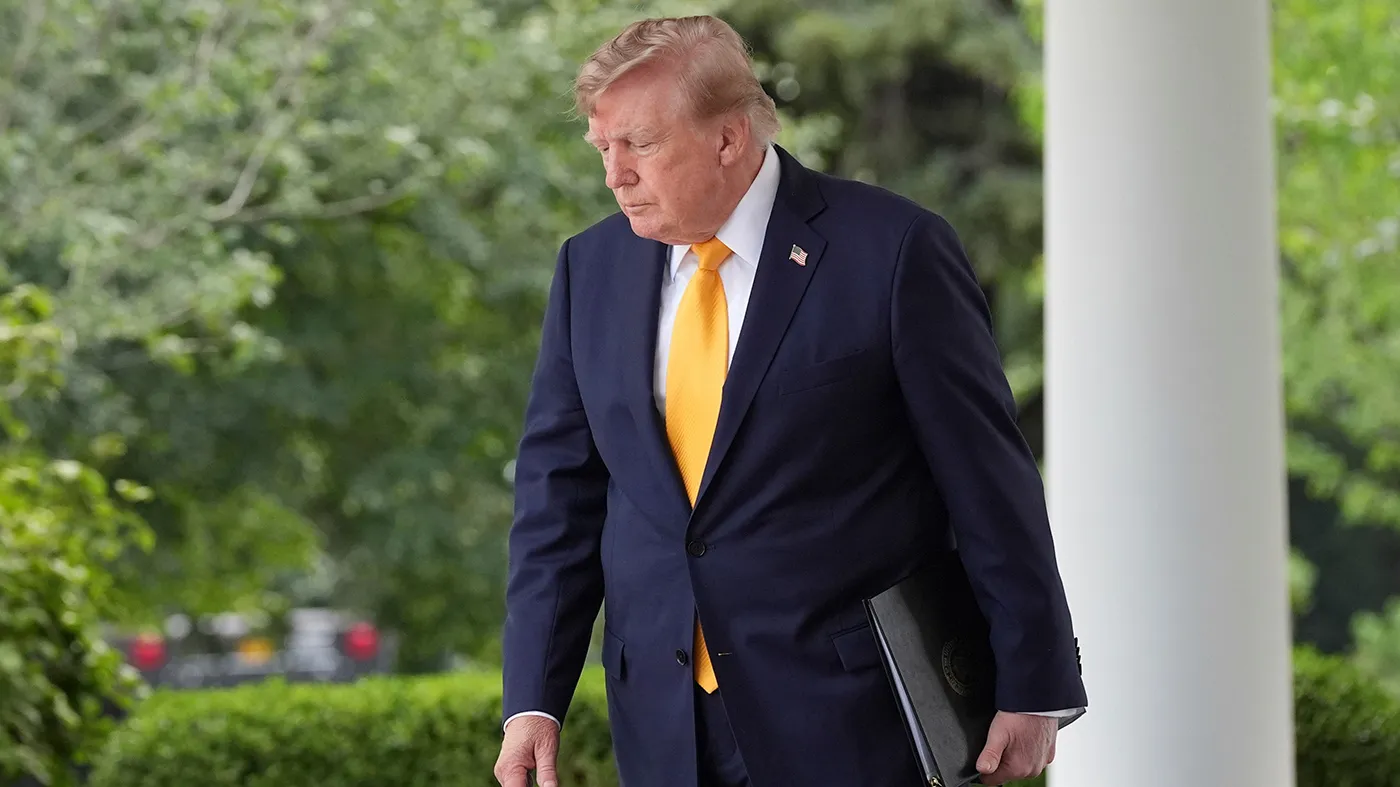
President Trump is enduring a difficult summer in public opinion polls, with his falling approval rating deepening concerns for Republicans that they could lose the House and Senate majorities this fall.
Trump has hit record lows in various polls, including a 33 percent approval rating in a Reuters/Ipsos poll this week.
In the latest Economist/YouGov survey, Trump is exiting August with a 33 percent approval rating, a new low for him in that poll.
Trump’s polling in the Decision Desk HQ (DDHQ) average did see a slight increase Thursday, reaching 39.2 percent.
Still, this average marked the second-lowest released by DDHQ since May, when Trump averaged 38 percent. The polling average also found that 57.5 percent disapproved of the president.
DDHQ chief elections analyst Geoffrey Skelley told The Hill that Trump’s low polling across the board is largely due to his handling of the economy, which had been among his strongest issues entering both terms, and the unpopularity of the Iran war.
“That to me looms as a big problem, not because it’s foreign policy necessarily,” Skelley said. “It’s because of the domestic impact and how it connects to people’s economic frustrations, and the fact that’s playing into that is, I think, the big concern on that front.”
That is a problem for GOP candidates on the ballot for the House and the Senate this year.
DDHQ is projecting that Democrats will retake the House majority in November, putting the odds at 67 percent. The GOP has a 52 percent chance of retaining the Senate majority despite Trump’s poor numbers, per DDHQ.
Democrats would need to gain four seats to win back the Senate, which seemed like a tall order at the beginning of the year. Now. Democrats think the majority is in reach, in large part because of the lack of wind in Trump’s sails as reflected in public opinion polls.
Skelley noted the Democratic optimism in his comments, saying Democrats are “extremely animated.” He said the figures have Democrats thinking their voters will be more motivated to come out and vote this fall in midterm elections that generally have a lower turnout than presidential years.
“So they’re looking very enthusiastic to turn out, and the midterms have lower turnout,” he said.
Republicans, on the other hand, have reason to worry their voters will come out in droves given that Trump is less popular and is not on the ballot.
Skelley said the two big problems for Trump and the GOP are” whether or not turnout is going to be decent enough among the base, or people just so dissatisfied and frustrated with the status quo that some of them don’t turn out.”
He also said the GOP has to worry about losing the swing voters that can decide a close election.
Trump’s numbers are lower than they were in his first term.
Trump’s approval rating from Gallup, which no longer measures presidential approval ratings, at the end of his first term was 34 percent . That left him averaging a 41 percent job approval during his first term.
The last time Trump’s approval rating wasn’t underwater was March 3, 2025, when DDHQ found his average approval to be at 48.1 percent compared with a disapproval of 47.7 percent.
When asked by The Hill to comment on the president’s approval rating, a White House official referred to Trump’s Truth Social post on Monday, when he accused Democrats of “going CRAZY with Fake Polls.”
“They’re putting them out at levels never seen before,” Trump wrote.
In that post, Trump also argued that real polls show him with stronger numbers, but he did not point to any specific polls showing him with stronger numbers.
“They’re called, ‘Demoralization Operations,’ where they try to demoralize Republicans so that they don’t go out and vote — But the actual Polls are tremendous, and the Spirit in our Country has never been higher,” Trump wrote. “We’re winning against EVERYONE, including Iran, whose Country is in Economic and Military Death Spiral.”
Trump’s numbers heading into the 2026 midterm elections are lower than they were at the same point in his term in 2018, when they typically stood around 40 percent. They reached their highest point at the start of the pandemic, at 49 percent in April and May 2020, according to Gallup.
In the 2018 midterms, the GOP ended up losing the House majority, but it gained two seats in the Senate.
Polling conducted by Reuters/Ipsos released in mid-August 2018 found Trump’s approval rating was at 41 percent among all Americans, with 53 percent saying they disapproved. Eight years later and Trump’s approval, based on data from the same polling partners , is 8 points below that, at 33 percent.
Trump’s most recent numbers are also lower than former President Biden’s in August 2022, when Reuters/Ipsos found Biden had an approval rating of 40 percent, its highest point since it dipped to 36 percent in May 2022.
The GOP won back the House majority in the 2022 midterms but did not win back the Senate majority. Its gains in the House were also not as high as many in the GOP had forecast at the time.
Skelley said Democrats were helped that year by voters who “somewhat” disapproved of Biden in polls.
“One of the reasons why things didn’t go as badly for Democrats, even though Joe Biden’s approval rating was bad, is that people who somewhat disapproved of Biden did not vote very strongly,” Skelley said. “In fact, they went narrowly for Democrats, according to the exit poll. It was close to 50-50, and that was a change because, historically, voters who somewhat disapproved voted for the out party by a pretty strong margin.”
Trump’s second-term approval rating is low by the standards of his other predecessors since former President Reagan, according to Gallup . Most of these presidents saw declining approval ratings during the first years of their presidencies, but Reagan and former Presidents Clinton and Obama all had higher approval ratings compared with Trump’s between late July and early August of the second year of each term.
Obama, for example, had a 47 percent approval rating in August 2010 and 44 percent in July 2014. Reagan’s and Clinton’s are more comparable with similar approval ratings in July 1982 and July 1994, respectively, and the same 63 percent approval rating in July 1986 for Reagan and early August 1998 for Clinton.
Father-and-son former presidents George H.W. Bush and George W. Bush both saw their approval ratings plunge later in their presidencies. But George W. Bush’s was lower than his father’s, entering the 2006 midterms with a 36 percent approval rating, compared with 65 percent ahead of the 2002 midterms.
The younger Bush left office with a 34 percent approval rating, but not before it hit 25 percent, the third-lowest Gallup job approval since former President Truman’s 22 percent in February 1952 and former President Nixon’s 24 percent in July and August 1974, just ahead of his resignation.
Skelley said Trump is facing an unpopular war, as were Truman, Nixon and George W. Bush toward the end of their presidencies, but the country is far more polarized than it was in the 1950s, 1970s and 2000s. He is skeptical, however, that Trump’s approval rating will sink below 30 percent.
“There are just more people who may be committed to sticking with a president of either party than they would have been in the past, so that makes it harder for me to imagine. I think, really, in this day and age, what it would take is something akin to what we saw in 2008,” Skelley said, referring to the Great Recession.
Skelley said Trump could turn things around and see his approval rise if the Iranian conflict sees a conclusion before the midterms and economic conditions improve as a result. But the president has a shrinking window of time to see that turnaround.
“You’re running out of time for things to notably change,” he said. “And that’s, to me, the main problem, and if some underlying conditions start to change, they have to be felt. And so there’s always a delay in how things are felt in terms of economic conditions or other, you know, other things of that nature.”
Topics in this story
Gathered from external sources. Rights to this text belong to whoever originally published it.