Germany's AfD Is Not 'Far Right'
Germany's AfD Is Not 'Far Right'
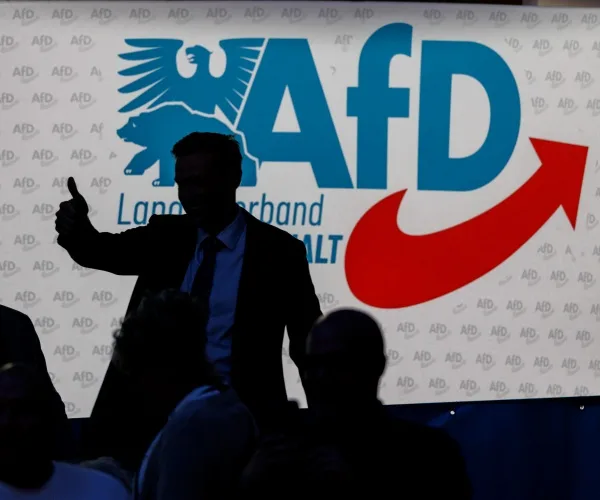
Germany's Alternative for Germany (AfD) party has seen significant electoral success, winning 44% of the vote in the recent state election in Saxony-Anhalt.
The AfD's policy positions include advocating for stricter immigration controls, a rollback of European integration, and a return to nuclear power in Germany.
The party's rise is attributed to dissatisfaction with left-wing policies, particularly in areas such as energy, climate, and immigration, and it has become the second-largest parliamentary bloc in the Bundestag.
This week I predicted that Germany's Alternative for Germany would likely win Sunday's state election in Saxony-Anhalt, a development I called "earth-shattering."
The AfD has now moved from a protest party on the margins to one capable of winning elections outright.
It is important to note that the party is not "far right" — as much of the European and international press labels it.
Such labels have been a clever way for the left-wing press, which itself has become increasingly radically left (think claims there are more than biological sexes), to redefine the center in its favor.
With Germany's press largely on the left and without an outlet comparable to Newsmax or Fox, the AfD's success is even more significant.
The public is seeing through the media manipulation.
The AfD is clearly conservative and rightist, but also populist and nationalist.
Founded in 2013 primarily as a Eurosceptic response to the eurozone crisis, the AfD shifted substantially toward nationalism, immigration, and cultural issues during and after the 2015 refugee crisis.
All of these are reasonable political positions to hold.
Europe just 10 years ago had 24% of the world's GDP. Today, it has just 16%.
This is an economic catastrophe brought about by left-wing socialism that embraced climate change and "net zero" policies that destroyed economic growth.
Germany has particularly suffered. Notably, then-Chancellor Angela Merkel accelerated Germany's nuclear phaseout after the Fukushima disaster.
In the February 2025 federal election, the AfD won 20.8% of the party-list vote, roughly double its 2021 result.
It secured 152 of the Bundestag's 630 seats, up from 83, making it the second-largest parliamentary bloc behind the CDU/CSU.
The party remains significantly stronger in the former East Germany. Recent polling had it around 40% in several eastern states, including about 41% in Saxony-Anhalt.
Today's Saxony-Anhalt election represents a new breakthrough. Early projections put the AfD at more than 44%.
The AfD's policy positions are conservative and, again, reasonable. Here is a rundown of its key positions:
Immigration and asylum are probably the party's defining issues.
Its 2025 federal platform calls for permanent border controls, turning away unauthorized entrants, processing asylum applications outside Germany, and what it calls the "remigration" of people without a legal right to remain.
It also advocates German withdrawal from the U.N. migration and refugee compacts.
On the European Union, the AfD wants a fundamental rollback of European integration.
Its 2025 program calls for replacing today's increasingly integrated EU with a looser association of sovereign nations and an economic community.
It opposes the EU Green Deal, fiscal transfers, and a digital euro. The party's underlying principle is that substantially more authority should return from Brussels to national governments.
On Russia and Ukraine, it diverges sharply from Germany's mainstream parties. The AfD calls for ending economic sanctions against Russia, restoring normal trade, and repairing the Nord Stream pipelines.
Its federal manifesto says Ukraine should remain outside both NATO and the European Union as a neutral state.
This makes an AfD breakthrough relevant beyond German domestic politics: A national government dependent on the party could substantially alter Berlin's approach toward Ukraine, Russia, NATO, and European security.
Energy and climate policy are another major dividing line.
The AfD wants Germany to return to nuclear power, expand or retain coal generation, eliminate the CO2 levy, and end renewable-energy subsidies.
It portrays Germany's energy transition and EU climate regulation as threats to industrial competitiveness and household living standards.
Economically, the party mixes market-oriented policies with economic nationalism.
It favors lower taxes, deregulation, simplification of the tax system, abolition of the solidarity surcharge, and policies designed to strengthen small and medium-sized German businesses.
Its economic message increasingly links taxation, energy prices, EU regulation, and immigration to the broader claim that established governments have undermined German prosperity.
On social and family policy, the AfD favors a more traditional conception of family. Its federal program advocates family income splitting for taxation, allowances for parents caring for young children, and other financial incentives intended to increase Germany's birth rate.
On crime and policing, it calls for more police personnel and equipment, tougher penalties and investigative powers against terrorism, extremism, gangs, and organized crime, and greater confiscation of criminal assets. These positions are closely integrated with its immigration message.
On media and political institutions, the party advocates a major overhaul of Germany's public broadcasting system, arguing that it should become considerably smaller and focus on information and culture.
It also has a longstanding commitment to more Swiss-style direct democracy and national referendums.
The AfD's rise has entered a new phase — from disrupting Germany's party system to potentially governing parts of it.
Today's election in Saxony-Anhalt shows again that nothing is more powerful than an idea — or a party — whose time has come.
John Gizzi is chief political columnist and White House correspondent for Newsmax. For more of his reports, Go Here Now.
Topics in this story
Gathered from external sources. Rights to this text belong to whoever originally published it.