Map Shows Senate Battlegrounds Hit Hardest by Canada Tariffs
Canada announced retaliatory tariffs on U.S. goods Tuesday after its negotiations with Washington collapsed.
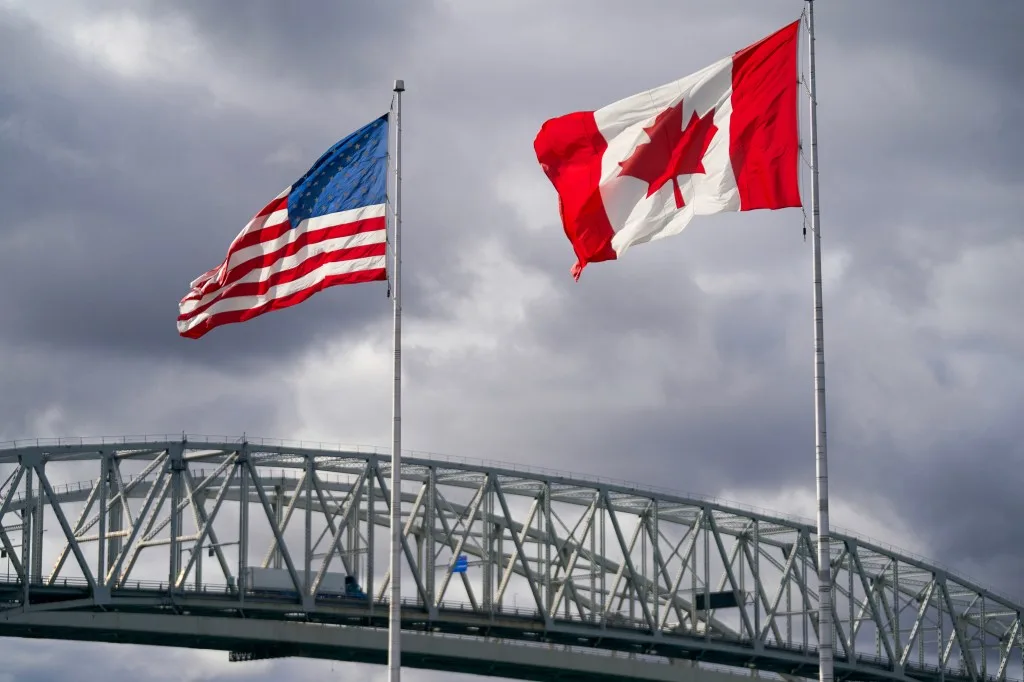
President Donald Trump's trade war with Canada has created a new political challenge for Republican candidates in several of the year's most closely watched Senate races.
Canada announced retaliatory tariffs on U.S. goods Tuesday after its negotiations with Washington collapsed, following the administration's decision to raise tariffs on roughly $20 billion in Canadian imports.
Economists have warned this is likely to raise costs and disrupt supply chains, especially in several competitive Senate battleground states that may decide control of the chamber in November's midterm elections.
"With this latest round of tariffs being imposed on Canada, focus will once again shift to the effects of them on Americans' wallets, especially in states like Michigan, Ohio, and Alaska, where Canada remains a pivotal trading partner," Alex Beene, a financial literacy instructor for the University of Tennessee at Martin, told Newsweek .
Democrats' path to reclaiming the Senate runs through a mix of traditional battlegrounds and Republican-held states including Alaska, Iowa, Ohio and Texas, while Michigan is one of the most competitive open-seat races in the country. Maine is also one of Democrats' best pickup opportunities.
The U.S. and Canada have one of the world's largest trading relationships, supporting auto and agriculture industries as well as seafood, forestry and energy.
Many of the states with competitive Senate contests are particularly exposed because Canada is a major export market or a critical supplier of raw materials and components for their region.
Any prolonged tariff standoff could affect jobs and consumer prices right before voters head to the polls.
Senate Battleground States Most Exposed to Canada Tariffs
The Senate battleground states that are most exposed to the impact of Canada tariffs include:
"Nationally, the main issue, as is the case in most elections, comes down to one word: cost," Kevin Thompson, the CEO of 9i Capital Group and the host of the 9innings podcast, told Newsweek . "No one wants to pay more for goods and services, yet that is exactly what is happening."
Michigan: Auto Industry in the Crosshairs
Michigan is perhaps the clearest example of a state caught between economics and politics.
The state sends roughly one-third of its exports to Canada, and its automotive sector depends on supply chains that routinely cross the border multiple times before a vehicle is assembled.
Canada also targeted products tied to steel, aluminum and manufacturing in its tariff retaliation.
"We often hide behind the word 'inflation,' but that does not tell the entire story. If tariffs become the norm, prices will continue to rise as those additional costs are passed on to the end consumer in the form of higher prices," Thompson said.
The state's open Senate race is one of the nation's most competitive following the retirement of Democratic Senator Gary Peters. Democratic nominee Abdul El-Sayed has already sought to make tariffs a campaign issue.
"Trump is escalating a trade war with Canada for his own vanity," El-Sayed said on social media, while criticizing Republican opponent Mike Rogers.
Ohio: Manufacturing and Agriculture at Risk
Ohio exported approximately $21.8 billion worth of goods to Canada, making its northern neighbor the state's largest international trading partner, experts say.
"The reality is if residents of these states start to see the ramifications of these tariffs in the coming months, it absolutely could sway some of their votes," Beene said.
Right now, Ohio faces exposure through its manufacturing, steel, aluminum and industrial supply chains, and agricultural producers could also be affected if the retaliatory tariffs persist.
The Senate contest between Republican incumbent Jon Husted and Democrat Sherrod Brown has been viewed as one of Democrats' best opportunities in Trump country. Moving forward, tariffs could become a particularly sensitive issue in industrial communities where businesses rely on Canadian customers or imports.
Iowa: Farmer and Farm Equipment Pressure
Iowa's economy is also deeply connected to North American trade through agriculture and farm manufacturing.
The Canadian tariff retaliation has targeted products such as farm equipment and dairy-related goods, and Iowa sends a substantial amount of its exports to Canada and Mexico.
Amid the tariffs, the Senate race between Republican Representative Ashley Hinson and Democratic challenger Josh Turek has become increasingly competitive.
Few Senate candidates have been more outspoken about the tariffs than Maine Republican Senator Susan Collins.
"Imposing new tariffs on Canada is a mistake," Collins said while campaigning Monday, warning that Maine industries including lobster, blueberries and lumber could suffer.
Maine's economy is uniquely tied to Canada through forestry, seafood, tourism and agriculture.
Collins is facing one of the toughest reelection campaigns of her career against Democrat Troy Jackson as many Democrats view this race as their top pickup opportunity.
Canada is a major market for Alaska seafood products, and retaliatory tariffs targeting fish and seafood could create challenges for exporters already dealing with broader industry pressures.
Democratic former Representative Mary Peltola is currently attempting to unseat Republican Senator Dan Sullivan in one of the country's most competitive races.
This could cause Alaska to emerge as an unexpected battleground despite Trump's strong 2024 performance there, and the trade dispute could become a major talking point if seafood processors experience slowing demand.
Texas may have the largest absolute economic exposure because of its enormous trade volume, even if Canada accounts for a smaller share of the state's economy than in Maine or Michigan.
So far, the Senate race between Republican Ken Paxton and Democrat James Talarico has become far more competitive than many commentators expected. Several forecasters have even shifted the race toward a toss-up status as Democrats attempt to move even traditionally Republican states.
If the trade dispute begins affecting jobs or consumer prices, Democrats could argue that the tariffs are worsening economic pressures already facing households.
Canada's retaliatory tariffs are scheduled to take effect September 8, so businesses and consumers could begin feeling the impact just weeks before voters cast ballots.
With Senate control potentially coming down to a handful of races in Michigan, Ohio, Iowa, Maine, Alaska and Texas, the economic consequences of the Canada tariff battle may soon become a major campaign issue.
"The reality is that politics has become increasingly ideological. For some voters, those cost increases may not matter because the policy aligns with who or what they support. For others, however, cost will be a major concern when they go to the polls," Thompson said.
"And tariffs increase costs. That is simply Econ 101."
Contact Newsweek editors on this story: Jason Lemon and Gray R. Thomas
Map Shows Congressional Races Now Toss-Ups in Districts Trump Won
Poll Gives Ken Paxton 4 Warning Signs in Texas Race Against James Talarico
Trump Approval Rating as Consumer Confidence Drops 70 Days Before Midterm
Topics in this story
Gathered from external sources. Rights to this text belong to whoever originally published it.