Warsh’s credibility rises on Wall Street as Bessent’s slips
It stems from differences in how they conduct policies and in the way they interact with Donald Trump.
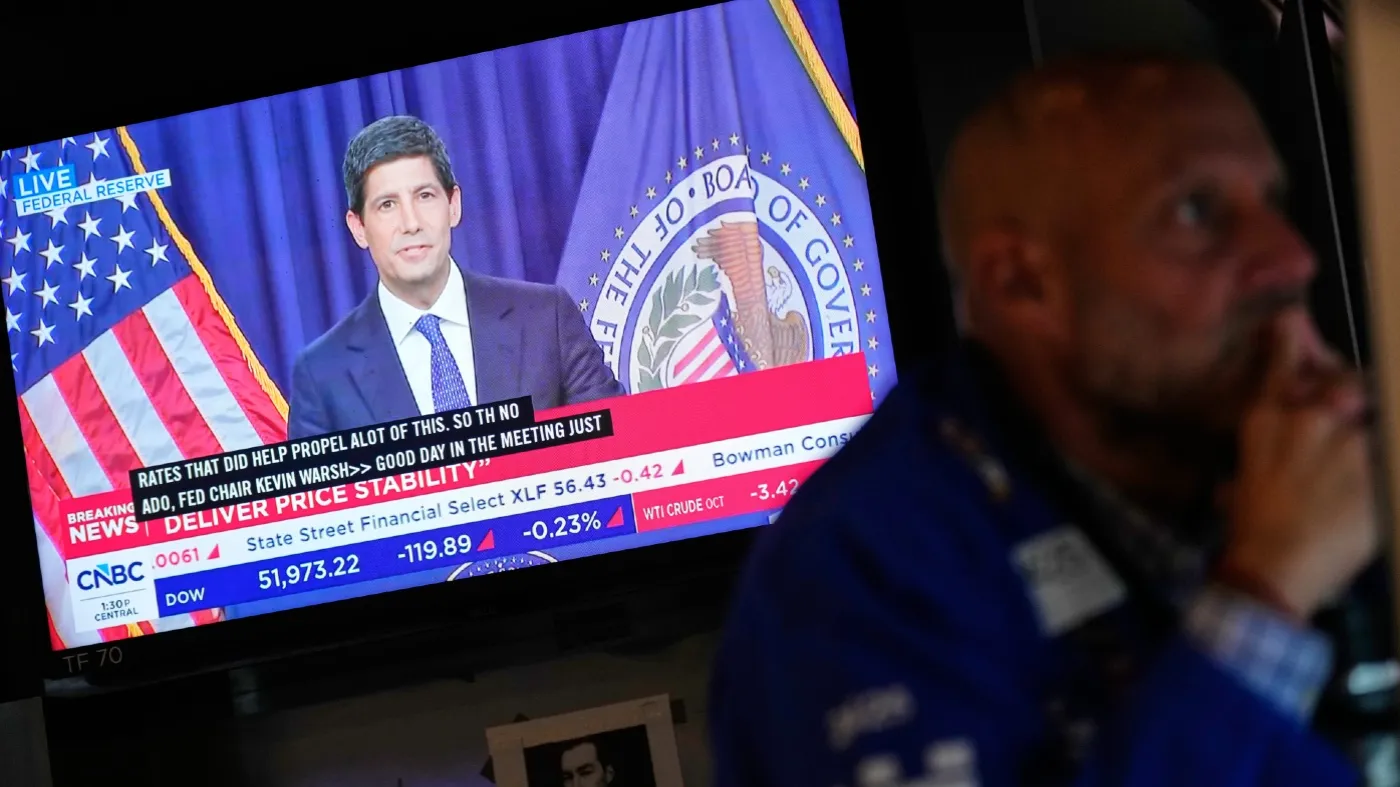
There has been a noteworthy change recently in the way investors perceive President Trump’s two most important economic appointments — Treasury Secretary Scott Bessent and Fed Chair Kevin Warsh. It stems from differences in how they conduct policies and in the way they interact with Trump.
On the positive side, Warsh has been able to establish his credibility as an inflation fighter after a shaky start.
Warsh laid out principles about how to achieve the Fed’s dual mandate of high employment and low inflation in his Jackson Hole speech . His message was reinforced by the Federal Reserve’s action to boost the federal funds rate by a quarter point at the September Federal Open Market Committee meeting. Warsh was resolute that the Fed’s top priority was to bring inflation under control, and bond market participants reacted by raising their expectations of future Fed rate hikes.
On the negative side, Bessent has been criticized for the way he has tried to influence Treasury bond yields.
He did so initially by intervening to support the yen so the Japanese authorities would not have to sell Treasuries. Then, in mid-August, Bessent announced that the U.S. Treasury would increase its long-dated bond buybacks. Since then, however, Treasury yields have surged to two-decade highs, and the market this week experienced its worst one-day selloff since Trump’s “Liberation Day” announcement.
Investor Stanley Druckenmillker, who mentored Bessent, criticized the decision arguing that the government cannot buy its way out of massive structural deficits. He also warned that fighting market fundamentals would erode the U.S. Treasury’s credibility. Bessent’s response was that his job is to make sure that the market is looking at fundamentals and that the market does not dictate policy.
While some commentators have claimed that Bessent was undermining the Fed’s independence, Warsh and Bessent are both aligned in favoring growth-oriented, pro-market policies. They are also critical of the massive government bond purchases the Fed undertook after the 2008 Financial Crisis. Where they differ is Warsh favors market-driven price discovery of bond yields, whereas Bessent wants to mitigate the U.S. government’s rising debt service costs.
Beyond this, there are also important differences in the way that Warsh and Bessent base their policy decisions.
As Mickey Levy of the Hoover Institution observes, Warsh’s Jackson Hole speech highlights how he is developing a new way for the Fed to think about its dual mandate . Warsh indicated that the Fed’s role is to align aggregate demand with supply, but he does not believe that wage growth has been a reliable indicator of future inflation, as the Fed’s models presume. He has also commissioned five independent task forces to restructure and modernize monetary policy operations.
In comparison, Bessent has not articulated his principles for overseeing the size of the federal budget deficit. When he assumed office, Bessent laid out a trio of objectives in which he targeted a budget deficit of 3 percent of GDP or less, real GDP growth of 3 percent or more and a 3 million barrel increase in daily domestic oil production.
However, these objectives have not been met thus far, and the federal budget deficit remains just below 6 percent of GDP . Bessent has stated that the best way for lowering the ratio would be for the U.S. economy to grow faster than the rate of federal debt accumulation. But he has not spelled out the need to shrink the size of the deficit.
One area where Bessent received high marks from investors was in his handling of negotiations with U.S. trade partners. When it appeared that President Trump’s tariff increases could lead to a full-blown trade war with China last year, Bessent negotiated a truce expeditiously . He also became a key negotiator in resolving other trade disputes, although his recent involvement in the U.S.-Canada impasse has been criticized .
Finally, Warsh and Bessent differ in how they interact with President Trump.
Warsh has surprised many observers in the way he has managed Trump’s expectations thus far. When he became Fed chair, many worried that the Fed’s independence would be compromised. However, Warsh garnered a unanimous vote to raise interest rates without to raise interest rates without incurring Trump’s wrath. This was partly because he consulted Trump in advance about the likely outcome.
Bessent’s approach has been to acquiesce to Trump on issues relating to tariffs and the budget imbalance without confronting him about their economic impact. In a Financial Times piece Edward Luce asserts that Bessent’s recent behavior has also “turned noticeably adolescent,” and that Bessent’s erratic actions of late indicate that he is seeking to please one man.
My hope early on was that Bessent would capitalize on his success in trade negotiations to gain Trump’s confidence and to speak frankly with him behind the scenes. My worry now is that if he opts to be a cheerleader for Trump’s economic policies rather than a trusted advisor, his stature as Treasury secretary could fall further.
Nicholas Sargen, Ph.D., is an economic consultant who is affiliated with the Darden Business School. He has authored three books including “ Investing in the Trump Era .”
Topics in this story
Gathered from external sources. Rights to this text belong to whoever originally published it.