Trump’s unprecedented intervention for Jensen Huang crosses a dangerous line
Since when did the president of the United States become an unofficial member of the board of directors of a publicly traded corporation?
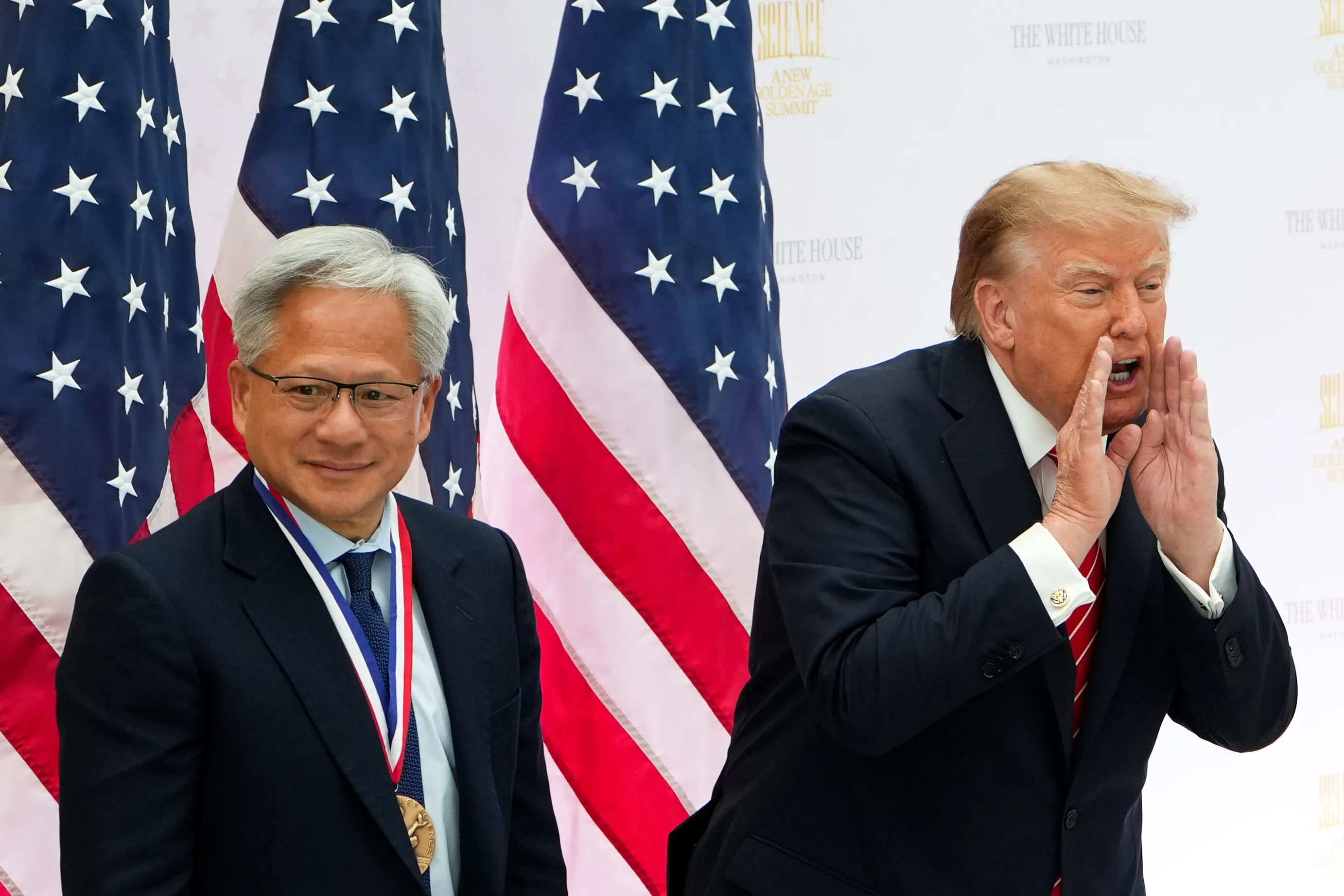
I have no idea whether Jensen Huang should be running Nvidia. Neither, I suspect, do most of the people who spent Monday morning either celebrating or bemoaning his unexpected return as CEO .
The allegations against him are dark. Affairs with employees, including a reported relationship with a woman suspected of spying for China , are not exactly minor concerns for the chief executive of a company whose technology is central to America’s national security.
On the other hand, Huang founded Nvidia more than three decades ago and turned it into one of the most valuable companies on earth . The idea that he might be uniquely qualified to lead it is hardly unreasonable. Plenty of brilliant entrepreneurs are deeply flawed human beings.
But I don’t particularly care whether Huang deserved to get his job back. That’s Nvidia’s problem.
What I do care about is a Semafor report published Monday morning that President Trump personally called into a meeting of Nvidia’s board to argue for Huang’s reinstatement. Hours later, the board announced that Huang was back.
I’m sorry, but since when did the president of the United States become an unofficial member of the board of directors of a publicly traded corporation?
At the time I’m writing this, roughly 80 minutes after the news broke, Nvidia’s stock is up around 30 percent on the day. That’s an almost incomprehensible increase in market value for a company of its size. Investors are clearly thrilled, and I understand why.
But imagine the share price had fallen 30 percent instead. Would the president’s involvement suddenly become more troubling? Would we be asking whether he had interfered in a decision that should have been left to the company’s directors?
I would hope we’d be asking those questions regardless of what happened on Wall Street.
A corporate board isn’t an elected legislature, and its members don’t have to be insulated from outside opinions. Directors consult lawyers, bankers, regulators, investors and other executives all the time. But they’re also expected to exercise their own judgment. That’s rather central to the whole concept of having a board.
Nvidia’s directors have fiduciary obligations that don’t extend to pleasing the president. They are not obliged to accept his preferred CEO, no matter how enthusiastically he makes the case.
I can understand the White House wanting to know whether the allegations surrounding Huang raised genuine national security concerns. Nvidia’s chips sit at the heart of an international struggle over artificial intelligence, advanced computing and military technology. If American intelligence officials concluded that Huang posed no security risk, the directors absolutely should have been told.
But according to Semafor, Trump didn’t simply authorize officials to communicate a national security assessment. He personally advocated for Huang’s return.
Those are two very different things from where I sit.
Consider a director who doesn’t want Huang back. Perhaps that director believes the allegations reveal serious weaknesses in his judgment. Perhaps there are questions about the company’s culture or the message reinstatement sends to employees.
Now imagine the president gets on the phone and makes it clear that he wants Huang running Nvidia. How much does that change the conversation?
We don’t know. The fact that Trump advocated for reinstatement doesn’t establish that he pressured anyone or caused directors to change their votes. They might have been moving toward the same decision already. But the question of influence doesn’t disappear simply because the outcome might have been identical without the call.
Presidents have always dealt with business leaders, sometimes aggressively. John F. Kennedy’s confrontation with the steel industry is one example. The federal government’s involvement in the automobile industry during the 2008 financial crisis is another, although the circumstances were obviously different.
I’m not suggesting there’s some absolute constitutional prohibition against a president speaking to corporate directors about their executives. There isn’t.
Suppose a future Democratic president personally contacts the board of a major technology company and urges directors to remove a CEO who’s publicly criticizing the administration. Or suppose a Republican president wants an executive reinstated because that person is politically loyal.
That’s a miserable way to think about the separation between political power and private enterprise.
Corporate boards should be free to make decisions without wondering whether disappointing the president will have consequences for their businesses.
Of course, Nvidia has every reason to maintain a productive relationship with Washington. And if Trump sincerely believes Huang is indispensable to American technological leadership, why shouldn’t he express that view? Presidents aren’t expected to be indifferent to companies that matter enormously to the national economy.
But there’s a difference between expressing a view and entering a boardroom debate over who should hold the top job. The president carries the authority of his office into every conversation, whether he intends to or not.
Nvidia’s board initially decided Huang should go . Now, suddenly, it reversed itself. Maybe new information changed everything. Maybe directors misjudged the commercial consequences of his departure. Maybe they simply acted too hastily.
All are possible, and all are matters the board should be prepared to explain to shareholders.
But adding the president’s personal involvement makes an already unusual reversal harder to examine on its own merits. Because if the president gets to weigh in on who runs Nvidia, it’s reasonable to wonder which other corporate leadership decisions might eventually become matters of presidential interest.
I don’t especially like where that leads. And I doubt many Americans would either.
Aron Solomon is chief strategy officer for AMPLIFY and has taught entrepreneurship at McGill University and the University of Pennsylvania.
Topics in this story
Gathered from external sources. Rights to this text belong to whoever originally published it.