DDHQ shifts Senate odds to Democrats, then back to GOP: ‘A coin flip’
The election handicapper Decision Desk HQ on Wednesday briefly shifted its odds of the Democrats winning the Senate to 51 percent, underscoring the party’s growing momentum in the midterm elections. While DDHQ, a partner of The Hill, shifted its odds ever so slightly back in the GOP’s direction on Thursday, giving Republicans a 51 percent…
The election handicapper Decision Desk HQ on Wednesday briefly shifted its odds of the Democrats winning the Senate to 51 percent, underscoring the party’s growing momentum in the midterm elections.
While DDHQ, a partner of The Hill, shifted its odds ever so slightly back in the GOP’s direction on Thursday, giving Republicans a 51 percent chance of winning, it was a notable moment given that Republicans were seen as having a 60 percent chance by DDHQ of retaining the Senate just two months ago.
Since then, President Trump’s approval numbers have hit new lows as oil and gas prices have remained stubbornly high and unhappiness with the economy among voters has become a hallmark of the election season.
“The national environment is more favorable for Democrats, and then on top of that, you have polling data showing that a lot of the sort of must-win or must compete in Senate races for Democrats are pretty 50-50 now,” said Geoffrey Skelley, chief elections analyst at Decision Desk HQ. “When I look at our forecast, we have essentially four states now that are in our sort of toss-up range, but they all have a very very slight Democratic lean.”
All but one state’s primaries are over, meaning all the competitive general election matchups are decided, and polling shows a number of Republican-held seats in serious play for Democrats. Skelley named Maine, Ohio, Texas and Alaska as examples. Iowa is also increasingly thought to be a toss-up, and the Democratic candidate has been leading in the polls to claim the open Senate seat in North Carolina.
Heading into 2026, the Senate was widely seen as likely to remain in GOP hands even if the margins narrowed. Decision Desk HQ had kept an optimistic rating for Republicans throughout much of the summer. As of mid-July, the odds of Republicans keeping the Senate were 60 percent. But that gap has closed significantly, becoming a toss-up around late August and, in recent days, flip-flopping between a slight Republican lean and slight Democrat lean.
Skelley said it’s essentially “a coin flip.”
Other election analysts have similarly determined the Senate majority to be a toss-up: Kyle Kondik at Sabato’s Crystal Ball, an election data tracker out of the University of Virginia, wrote on Sept. 2 that the Senate “is much closer to being a toss-up than the House is” and that while their analysis still favored the GOP’s odds, “that assessment has gotten harder to defend over the course of the summer.”
The nonpartisan Cook Political Report has six Senate seats in its “toss-up” column, five of which are held by Republicans, as well as a GOP-held seat it rates “lean Democratic.”
It’s still early, though. Election analysts at this point in 2024 showed a toss-up or former Vice President Kamala Harris with a slight lead, which did not materialize.
“I do think that, because the Senate map is so favorable for Republicans at sort of baseline, I do think if President Trump were to get his approval rating back up a couple points, that would probably be helpful to the GOP,” said Skelley. “I don’t know if it would change the House dramatically. Democrats are more favored there, but you know, the Senate, because you’re talking about all these red-leaning states where Democrats have to really outperform the 2024 numbers, there is time for some subtle changes that could matter to what’s going on.”
It’s a reality that Senate Majority Leader John Thune (R-S.D.) nodded to last week when he told a local television station that he worried about losing control of the Senate.
“I worry about that, for sure,” he told South Dakota’s KELOLAND News . “I’m a realist, and I just think you, I don’t ever try and sugarcoat things. I think it’s a competitive environment right now. I think we got the highest-quality candidates.”
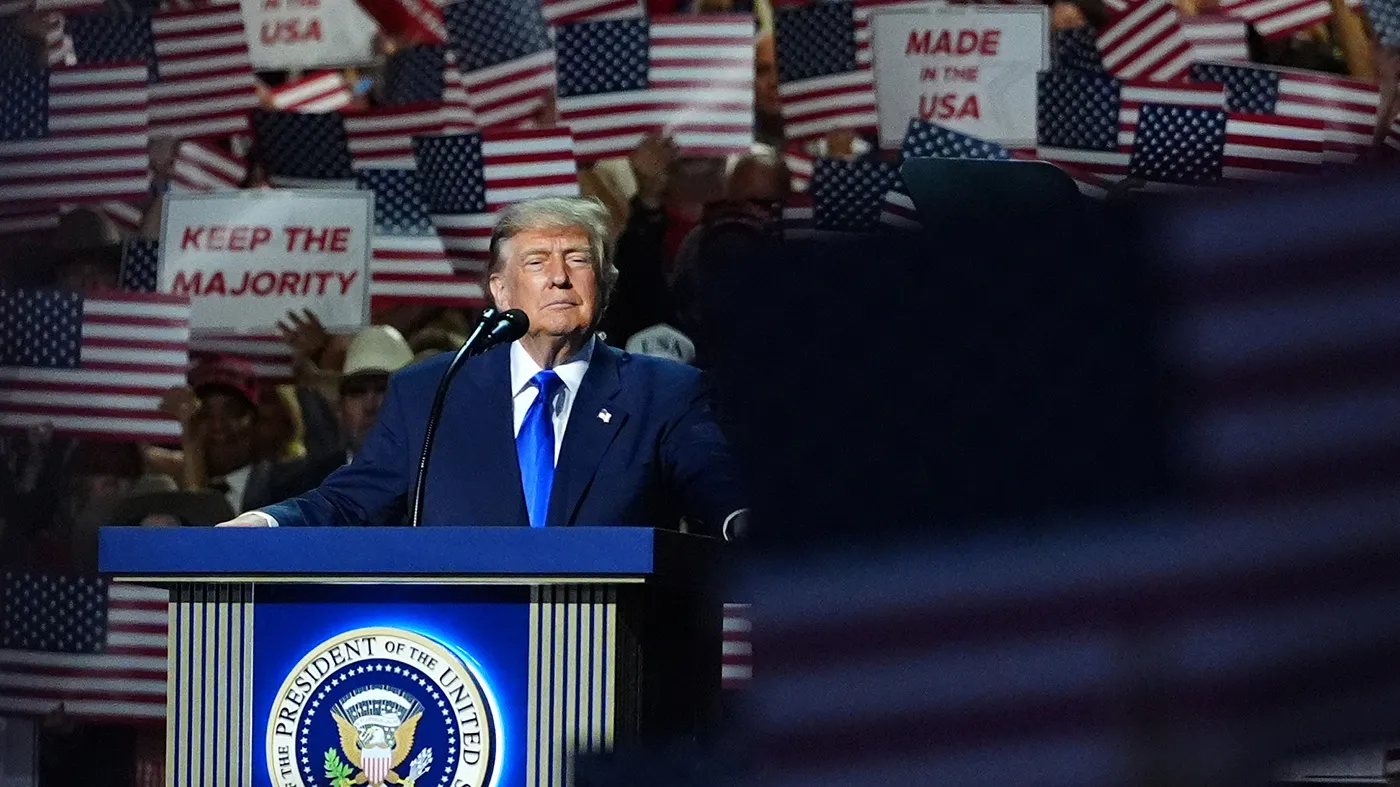
Republicans and Trump are now pulling out all the messaging stops to rally Republican voters and independents to vote for their local Senate Republican candidate on Nov. 3. At the Republican’s unusual midterm convention in Dallas, Senate leaders lambasted Democrats and described them as “radical” and “dangerous” as much as possible.
Sen. Tim Scott (R-S.C.), chair of the National Republican Senatorial Committee which fundraises for and backs Republican candidates, and Republican Whip John Barrasso (Wyo.) both pitched the battle for the Senate as essential to enacting Trump’s agenda and made the case that the Democratic Senate hopefuls would not support that effort.
Scott ran through a roll call of Democratic candidates in the most competitive Senate races, calling out each over their support of controversial positions like transgender athletes in women’s and girls’ sports.
“The only way to keep dangerous, radical, weird out of the Senate is a united Republican party standing with our President Donald J. Trump,” Scott thundered from the stage.
Trump, in his own speech at the convention, repeated his call for Republicans to “pretend like I’m on the ballot” and promised to give $5,000 to every American adult if Republicans win the House and Senate.
“All they know is poverty and how to ruin our country,” Trump said of Democrats. “But we’re making a fortune. So if the Republicans win, you win with us.”
Gathered from external sources. Rights to this text belong to whoever originally published it.