Thune elected Senate GOP leader after bruising showdown with critics
Sen. John Thune (S.D.) won reelection to serve another term as Senate Republican leader Tuesday after a bruising showdown with conservative critics in the Senate Republican conference. A Senate GOP aide announced late in the afternoon that Thune had been reelected as leader “by acclamation,” despite objections raised by a handful of GOP senators over…
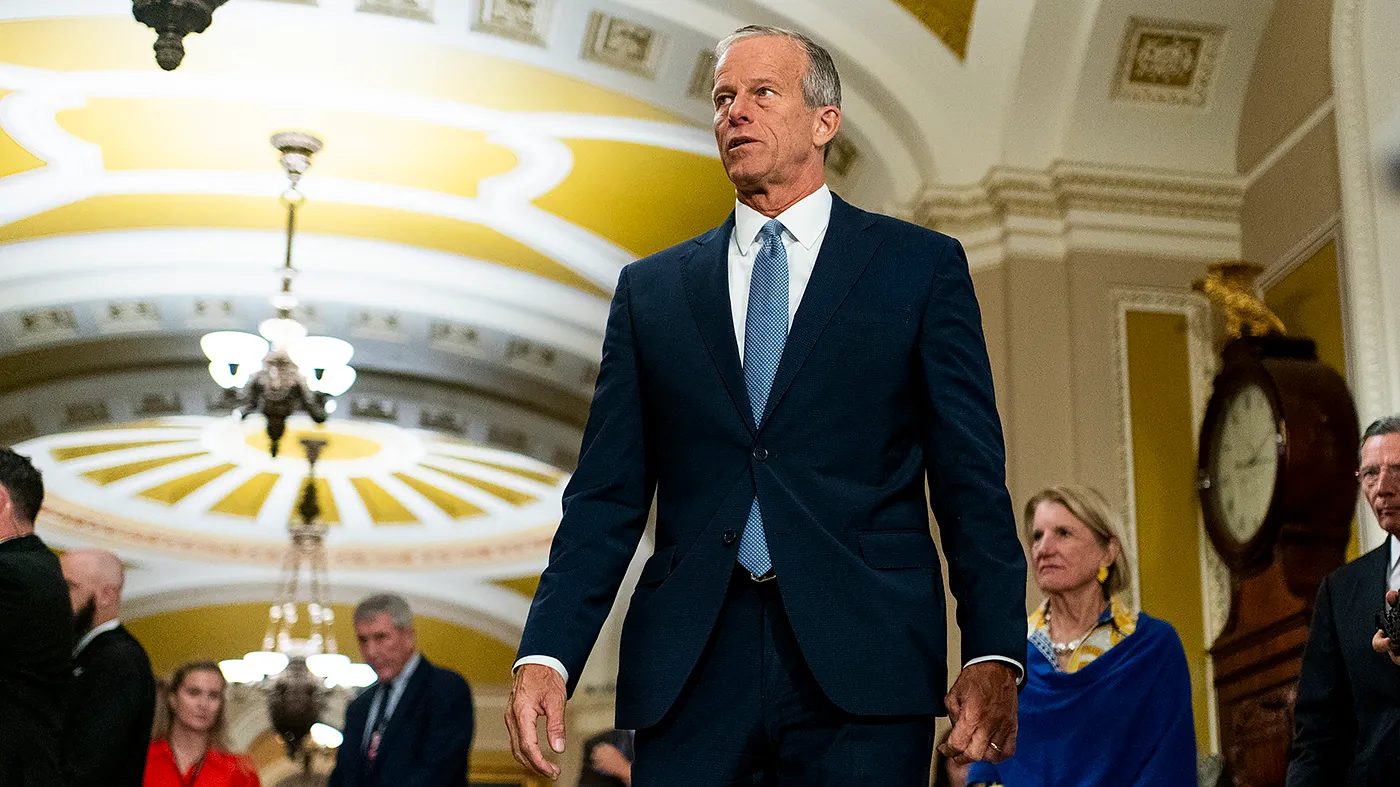
Sen. John Thune (S.D.) won reelection to serve another term as Senate Republican leader Tuesday after a bruising showdown with conservative critics in the Senate Republican conference.
A Senate GOP aide announced late in the afternoon that Thune had been reelected as leader “by acclamation,” despite objections raised by a handful of GOP senators over proceeding with the vote this week.
A Republican conference meeting that was initially expected to last a few hours turned into an all-day affair after Senate Budget Committee Chair Ron Johnson (R-Wis.) threatened to walk out of the meeting if a vote on the new leadership team was held immediately.
Johnson, who has clashed with Thune over advancing a third budget reconciliation bill to fund the Defense Department, demanded a delay of the leadership election. He picked up the support of more than a dozen colleagues angry over the huge Republican losses in last week’s election.
Fifteen Republican senators voted to delay Thune’s reelection — roughly a third of the next Senate GOP conference.
Johnson walked out of the meeting right after Republican colleagues voted to proceed, following through on his boycott threat. He and several other GOP senators, including Senate Steering Committee Chair Rick Scott (Fla.) and Sen. Mike Lee (Utah), demanded that Thune lay out a plan for how he would manage the lame-duck session.
They pressed Thune to commit to bring a budget reconciliation package to the Senate floor during the lame-duck session and use it as a vehicle to pass the Safeguard American Voter Eligibility (SAVE America) Act, a package of election security rules requiring people to show proof of citizenship when registering to vote and present photo ID when casting a ballot.
The conservatives lobbied Thune to cancel the weeklong Thanksgiving recess to allow for more time to pass a budget resolution and follow-up reconciliation bill to fund the Defense Department over Democratic objections.
Thune gave some ground by floating the possibility of keeping the Senate in session the rest of the week to work on President Trump’s agenda. Senators were scheduled to be on recess until next Monday in observance of Veterans Day.
“We’ll see,” Thune said when asked about working through Veterans Day.
He defended his record over the past two years, arguing that Senate Republicans passed one of “the most consequential” bills of his career when it approved the One Big Beautiful Bill Act last summer.
“As I look back on the last couple of years, my question is what would you have me do differently?” the Senate leader asked.
“I think we came out of it as well as could have been expected and got a lot of stuff done. Last summer, that bill — in my view, in my time in Congress — is the most consequential piece of legislation I’ve worked on that had a lot of new ideas,” he said, citing new tax policy and fiscal reform.
Thune agreed to a conference-wide statement pledging to make every effort to advance a budget resolution and budget reconciliation package to fund the Defense Department in the lame-duck session, according to GOP sources familiar with the meeting.
GOP senators also pledged to make every effort to confirm Trump’s judicial and executive branch nominees before Jan. 1.
Thune said that Republicans fared poorly in last week’s election because of political headwinds created by factors “out of our control.”
“If you believe the exit polls, it was the war, it was the economy, it was inflation, it was fuel prices, and I think that’s what the election was about,” he said. “I wasn’t apologizing for anything that we did. And I think on the political side, I don’t know what else more I could have done. The amount of money we raised was record.”
Sen. Josh Hawley (R-Mo.) joined the calls to postpone Thune’s reelection as leader.
He criticized Republican leaders in Congress for failing to advance legislation to address high gas prices and high healthcare costs before the midterm election.
“If you don’t think after losing seven Senate seats, minimum, that we need to change course, I don’t know what planet you’re on,” Hawley said. “It’s easy to blame other people but we need to look at what happened here.
“What did we to get the price of gas down? Nothing. What did we do to get the price of healthcare down? Nothing,” he said.
Sen. Dave McCormick (R-Pa.), a moderate who represents an important swing state, also favored delaying the election.
But they were outvoted by GOP colleagues who wanted to end the intraparty squabbling as soon as possible and move forward on the lame-duck agenda without having to worry about the distraction of a leadership fight.
After hours of contentious discussion, no Republican senator stood up to challenge Thune, who was elected majority leader two years ago.
Many GOP senators blame last week’s midterms wipeout on Trump’s unpopularity.
Sen. John Cornyn (R-Texas), Thune’s one-time rival to become Republican leader, blamed Trump’s unpopularity and voter anger over “corruption” for Democrat James Talarico’s victory over Republican state Attorney General Ken Paxton in the Texas Senate race.
“Corruption was an issue not only at the local level or the state level but also at the national level, too. And I think that contributed to the landslide that swept almost everybody in the process,” the outgoing Texas senator told reporters Monday.
Thune acknowledged after the meeting that voters’ concerns about corruption in Washington was a factor in Republican losses and pledged to push legislation to ban stock trading by members of Congress next year.
“Clearly the Democrats tried to make that issue in a lot of states,” he said. “It had some resonance out there, which is, again, why I think it’s important that as we move forward, we’re looking for ways to differentiate and distinguish what we’re for,” referring to bills to ban stock trading by lawmakers.
Gathered from external sources. Rights to this text belong to whoever originally published it.