Knowledge is power: Why America needs economic security intelligence
To counter economic coercion from China and other authoritarian states, the authors propose that the State Department establish annual Economic Security Intelligence Reports to help the United States identify and mitigate systemic economic risks.
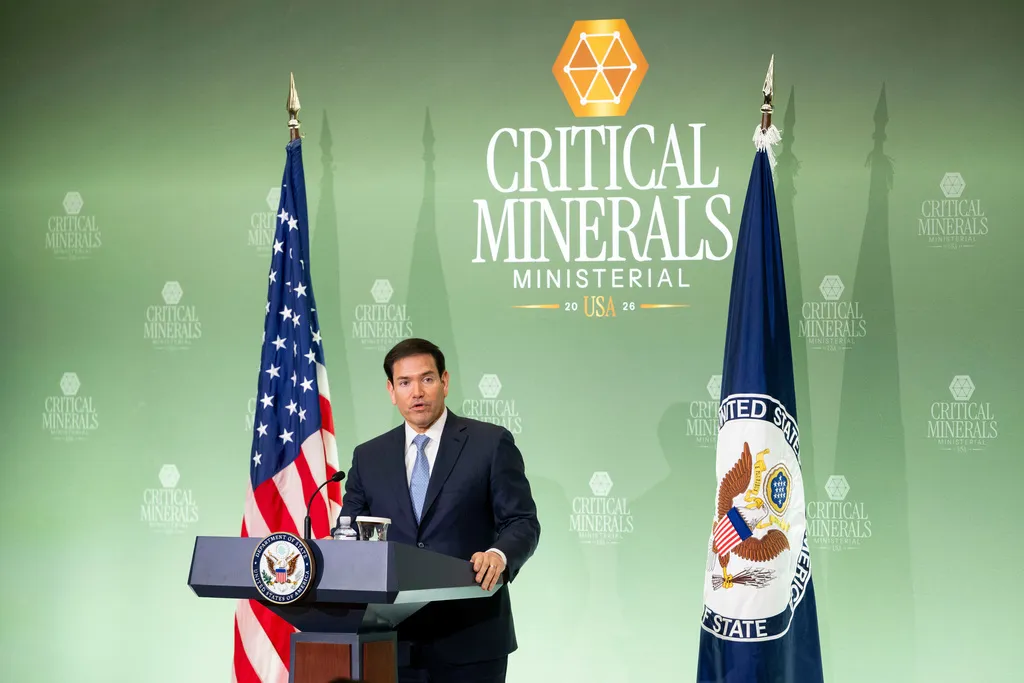
America was unprepared for its trade war with China, but it shouldn’t have been. As Beijing cut off access to critical minerals, the United States had no response but a quiet retreat. The Trump administration’s recent push to rebuild mining and processing capacity is welcome, but it comes more than a decade late. Strategic surprises of this kind are avoidable—but only if the United States systematically monitors economic security risks before they become crises. A new system of country-level Economic Security Intelligence Reports should become a cornerstone of American economic statecraft .
In 2010, China put the world on notice, weaponizing supply chains by cutting off rare earth exports to Japan during a territorial dispute. For 15 years, Washington stood idle as China deepened its dominance across critical minerals, batteries, shipping and industrial inputs essential to American manufacturing. Today, China produces 98 percent of the eight heavy rare earth elements, and once again is restricting access for both Japan and the United States.
Beijing is making the most of its economic leverage to weaken American competitors, imposing additional rare earth restrictions on key U.S. customers just this June. The International Energy Agency now estimates that full implementation of China’s rare earth export controls could put an annual $6.5 trillion in downstream production at risk—7 percent of global GDP excluding China.
The surprise is not China’s behavior but America’s failure to anticipate it. A key constraint is Washington’s lack of a systematic framework for identifying and monitoring emerging economic security risks. That gap is increasingly untenable.
China’s mineral monopolies were not the inevitable product of superior geology — China dominates the market for processed cobalt, copper and lithium even though it is dependent on imports for the raw form of those minerals. Instead, Beijing has built dominance through state intervention: massive subsidies, chronic overcapacity, price manipulation, and lax labor and environmental standards — letting unprofitable firms undercut and drive out Western competitors. These practices also discourage the long-term investment needed to develop alternatives, making diversification economically irrational even when it is strategically essential.
Western firms cannot indefinitely sustain losses in pursuit of geopolitical influence. With Beijing’s finger on the scale, Chinese companies can — and often do.
Subsidies create monopolies, monopolies provide leverage, leverage enables coercion, and coercion reinforces monopolies. This self-sustaining cycle is swallowing an increasing share of global manufacturing, with China on pace to account for 45 percent of the world’s industrial production by 2030.
China’s predation is only one manifestation of a broader challenge posed by authoritarian economics — from Iran’s chokehold on the Strait of Hormuz to Russia’s weaponization of European gas dependence. If the United States intends to place economic security at the center of trade policy, it cannot keep treating fundamentally different economic systems as though they play by the same rules.
What is needed is what we have called a “ Near-Global Economy ”: a framework that deepens integration among trusted market economies while reducing dependence on state-driven competitors.
Any such response to authoritarian economics, however, will require a new form of intelligence — the rigorous and comprehensive assessment of the economic security posture of allies, partners, rivals and rogues.
For U.S. policymakers to assess the risks posed by America’s major trading partners, the executive branch needs the capacity to systematically collect and analyze this information. One solution: an annual, country-by-country Economic Security Intelligence Report created by the State Department — leveraging America’s diplomatic missions to map each nation’s economic security vulnerability, opportunity and strategic reliability.
The value of such a report would not lie in compiling statistics but in answering practical questions: Which partners are quietly serving as pass-throughs for adversary capital? Which possess strong legal authorities but weak enforcement? Which are becoming more trustworthy over time and which less so?
Reliable partners should demonstrate commitment to market-oriented policies, protect intellectual property, limit market-distorting subsidies, and enforce baseline labor, environmental, and antitrust standards. Washington should also evaluate whether partners have the legal authorities, institutional capacity, and political will to support U.S. sanctions, export controls, and anti-money-laundering laws. Partners should meet baseline standards for beneficial ownership registries and investment screening mechanisms. Partners need to prevent transshipment and enforce rules of origin .
The goal is not more reports or more bureaucrats — it is actionable intelligence to inform trade, investment and national security policy. Its findings could justify corrective tariffs, guide financing by the Development Finance Corporation and Export-Import Bank, and set prerequisites for defense-industrial cooperation and trusted technology initiatives. Secretary of State Marco Rubio’s reorganization of the State Department has placed economic statecraft at the center of American diplomacy; the Economic Security Intelligence Report would give this effort an operational backbone.
The United States should not only grade others — it should apply the same framework to itself. Anonymous shell companies, trusts and opaque legal structures let hostile actors disguise themselves as American businesses, undermining sanctions, anti-money laundering efforts, and ultimately, national security. Applying honest standards at home would strengthen both the report’s credibility and America’s own resilience.
The United States would never enter a military alliance without understanding its allies’ capabilities and vulnerabilities. It should be no less careful building the economic alliances that will define the next international order. Strategic surprise in the economic domain is not inevitable, but avoiding it requires treating economic intelligence as a core instrument of national power. To avoid strategic surprise tomorrow, America must monitor economic security risks today.
Josh Birenbaum is the deputy director of the Center on Economic and Financial Power (CEFP) at the Foundation for Defense of Democracies. Antonia-Laura Pup is a PhD researcher at the European University Institute and former CEFP intern.
Topics in this story
Gathered from external sources. Rights to this text belong to whoever originally published it.