Trump’s radical plan is to make the postal service an election gatekeeper
The potential to interfere with voters’ ability to vote by mail is not a bug but a feature of a system designed to restrict a practice that Democrats have used more often than Republicans in recent elections.
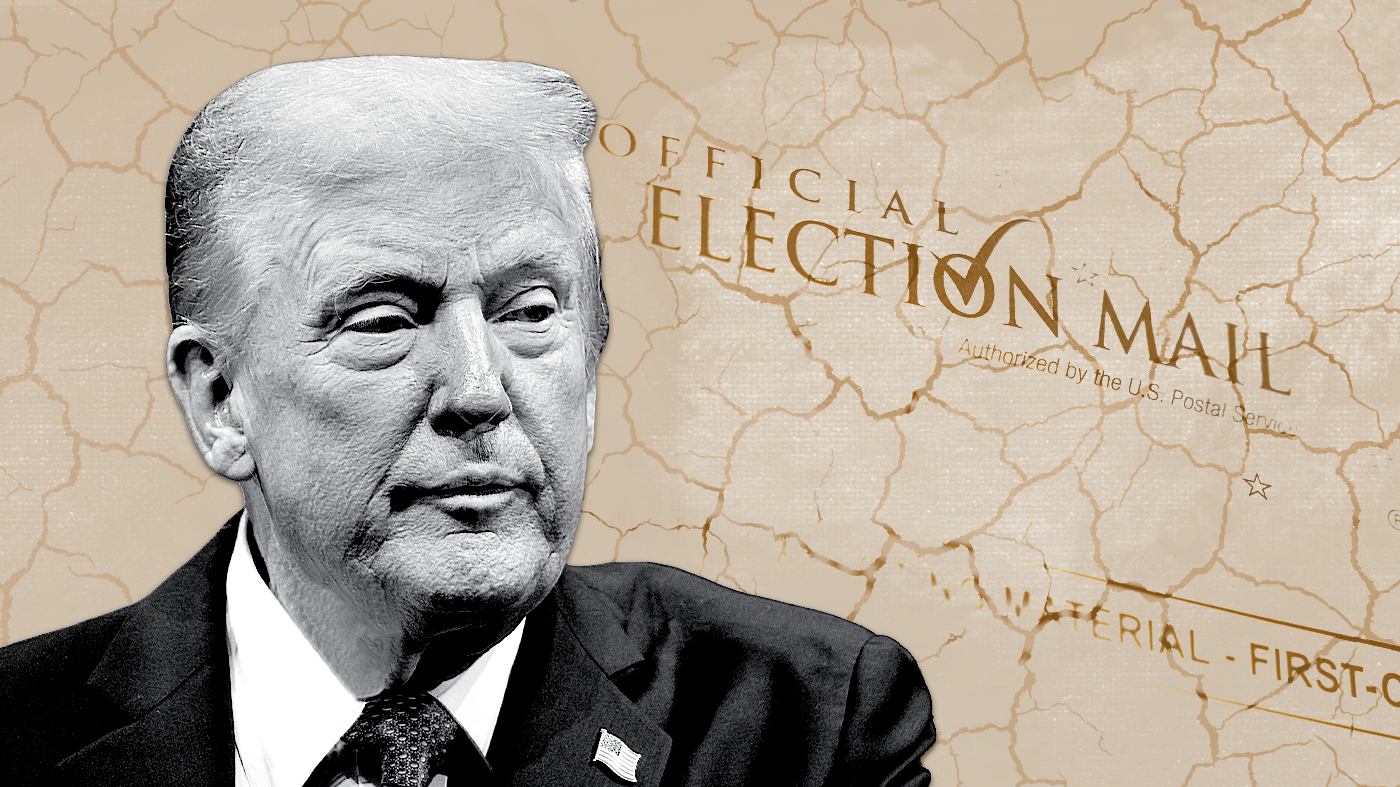
The Trump administration has filed its third emergency appeal to the U.S. Supreme Court, asking to lift a district court injunction that blocked President Trump’s U.S. Postal Service regulations imposing strict formatting and data-submission requirements on states’ mail-in ballots. A whistleblower has warned that these regulations could cause many ballots to arrive late or not at all ahead of the November midterm elections.
Plaintiffs have argued that these requirements violate the constitutional provisions that restrict election administration to the states and Congress, with no role for the executive. Equally important, and overlooked, is that the administration’s scarcely disguised partisan regulations violate a nearly 60-year American tradition of insulating the postal service from politics.
The potential to interfere with voters’ ability to vote by mail is not a bug but a feature of a system designed to restrict a practice that Democrats have used more often than Republicans in recent elections.
Trump has made no secret of his longstanding hostility to voting by mail and objective of controlling voting nationally. “Republicans should fight very hard when it comes to statewide mail-in voting,” he declared in 2020 , because “for whatever reason, [it] doesn’t work out well for Republicans .” This year, in February, he said , “The Republicans should say, ‘We want to take over.’ … The Republicans ought to nationalize the voting.”
His administration now officially describes its sweeping new postal service restrictions on mail ballots as election-integrity measures, not partisan ones. However, it has provided no proof of the alleged widespread fraud that the regulations would allegedly deter.
The rule doesn’t just put occasional errors at risk. It is designed so that a single failure can void an entire jurisdiction’s mailing. Even before finalizing the rule, internal postal service officials warned that if even one ballot’s barcode in a bulk mailing fails to scan properly during verification, this policy would reject and return the entire batch.
Thus, disrupting an election doesn’t require any bad actor at the local level; it only requires ordinary human error, which is guaranteed at scale, colliding with zero tolerance. The regulations would likely upend voting in the eight states where voting is conducted almost entirely by mail, like Washington and Oregon. Seven of these states, with the exception of Utah , lean Democratic.
Washington, which automatically mails ballots to more than 5 million registered voters, says compliance could require destroying and replacing more than 5 million envelopes already printed for November. It would mean fundamentally reworking procedures only weeks before voting begins. The errors that would surely arise in such a rushed process could jeopardize the entire election process of mail-in states.
Similar disruptions would also occur in states like Arizona that rely heavily but not strictly on mail-in voting. In Maricopa County, Ariz., which mails more than 2 million ballots in its initial run, a single misprinted barcode could delay the delivery of every ballot to every voter in the county.
In addition, the Postmaster General has admitted that the U.S. Postal Service will withhold delivery from any state that refuses to hand over its voter manifest. The rule therefore gives partisan opponents of mail-in voting two independent levers, one technical and one administrative, capable of stopping ballots before they reach voters.
The postal apparatus itself embodies a civic lineage older than the Constitution . In 1775, guided by Benjamin Franklin, the first Postmaster General , the Second Continental Congress established the postal service. And as with today’s mail-in voting process, the early postal service facilitated democracy.
The mail served as an egalitarian highway of democratic debate, intended to distribute independent newspapers and correspondence without royal or partisan interference. The U.S. Postal Service was designed to serve as a neutral common carrier, not an executive gatekeeper or a roving board of canvassers.
“The country may not even have come into existence but for the postal service,” said historian Stephen Allen Kochersperger. Through the material it disseminated, “people were reading, getting ideas of what it would be like to be an independent country.”
In the late 20th century, reformers from both parties worried that partisan politics had infected the postal service. With overwhelming bipartisan support, Congress enacted the landmark Postal Reorganization Act of 1970 . A central purpose was to insulate the mail from presidential and partisan political control. Upon signing the bill, President Nixon noted that his Democratic and Republican postmasters general agreed on one point: “There is no Republican way or Democratic way to deliver the mail. There is only the right way.”
The act converted the postal service into an independent public corporation with a bipartisan Board of Governors — no more than five of the nine members can belong to the same party — and gave that board, not the president, the power to appoint and remove the postmaster general. By asking the Supreme Court to lift the Boston court’s injunction , the administration seeks to invert the purpose of the postal service, turning an independent carrier into an instrument of executive election policing for partisan gain.
Benjamin Franklin would be turning in his grave.
Allan J. Lichtman is Distinguished Professor of History at American University, co-host of “Lichtman Live,” and author of 15 books, most recently “Great American Presidents: The Twelve Who Transformed the Nation. “
Topics in this story
Gathered from external sources. Rights to this text belong to whoever originally published it.