German AfD youth group eyes euro stance at congress ahead of key polls
The youth wing of the Alternative for Germany party met for a national congress on Saturday, ahead of a key election in the eastern state of Saxony-Anhalt th...
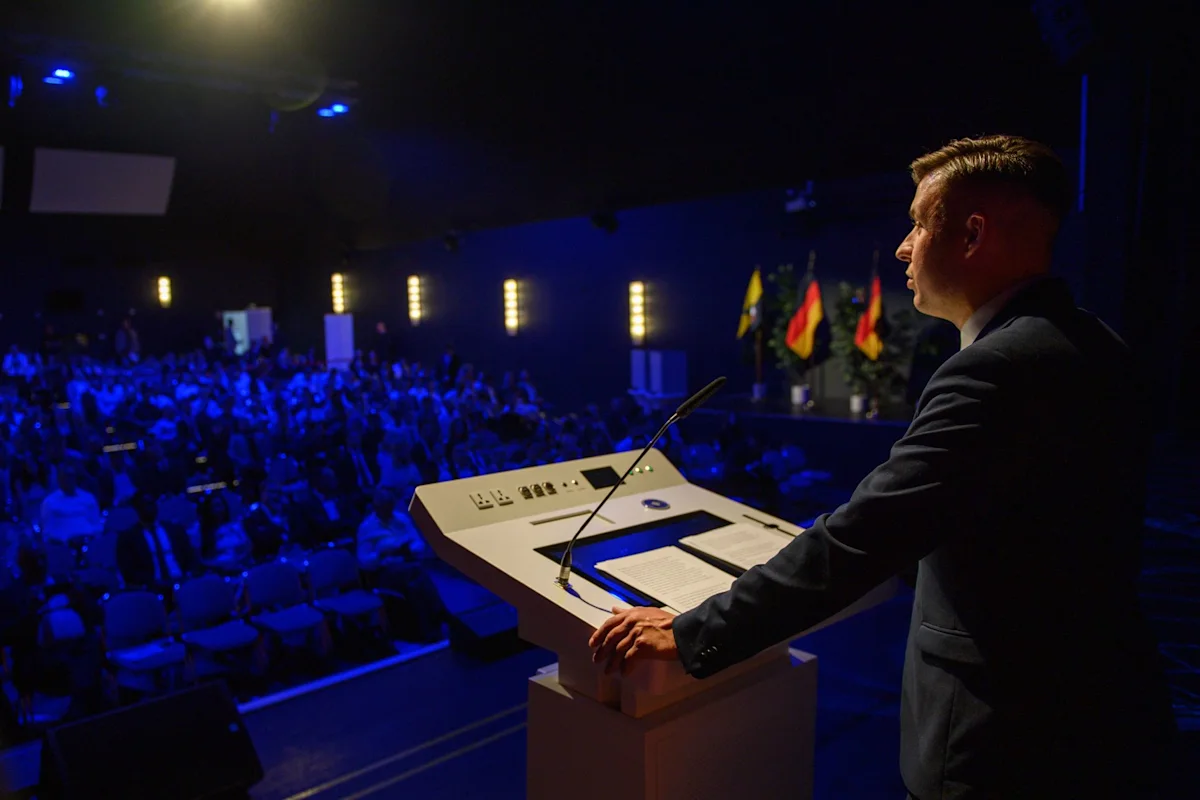
The youth wing of the Alternative for Germany party met for a national congress on Saturday, ahead of a key election in the eastern state of Saxony-Anhalt that could see the far-right AfD take power for the first time.
At the event in the eastern city of Magdeburg, the Generation Deutschland (GD) youth organization discussed its stance on European policy, aiming to distance itself from the main party's line.
Its lead candidate for the Saxony-Anhalt election, Ulrich Siegmund, was met with energetic approval by the delegates.
The approximately 300 participants discussed a statement at the 'Altes Theater' theatre in Magdeburg.
A draft of the statement, which had been made public beforehand, stated that the euro had strengthened the single market but had significant structural flaws. For this reason, they were open to proposals for reform. There is no talk of leaving the euro.
GD leader Jean-Pascal Hohm said that he personally was firmly convinced that Germany should not leave the euro.
However, Hohm ultimately withdrew the relevant motion put forward by the GD leadership after it became clear from speeches that there was significant resistance within the AfD Youth to such a stance.
The AfD was founded in 2013 as a Eurosceptic party. In its 2025 Bundestag election manifesto, it had reaffirmed that "Germany must leave the euro system."
Hohm justified his stance by referring to the way of life of young people, who are used to no longer having to show a passport at borders or convert currencies, he said in remarks to dpa.
'Millions must leave this country again'
At its meeting, the GD appeared extremely self-assured and reiterated calls for mass deportations. "Germany must remain the land of the Germans. This principle is non-negotiable," Hohm asserted. Millions had entered the country, he claimed. "Millions must leave this country again."
Hohm also called on members to defend themselves physically in the event of physical attacks by political opponents.
He does not expect anyone to allow themselves to be "beaten up by violence-seeking anti-fascists or chased through the city" because of their political convictions.
Anyone who defends themselves in a situation of self-defence has the backing of the GD and the parent party. "We are not victims, and we will not allow ourselves to be made into victims."
The GD, which is closely linked to its parent party, was newly founded in Giessen last year after the former AfD youth organization, the Junge Alternative (JA), had been dissolved. The JA was a largely independent association over which the AfD had only limited control.
The meeting was heavily influenced by the election campaign. Referring to the upcoming state election on September 6, Hohm said that history could be made in Saxony-Anhalt next week.
Siegmund, who arrived in the afternoon, was celebrated like a pop star. "The people are on our side," he called out to the participants.
He said he had often heard the word "hope" in recent weeks. "We will make history here in Saxony-Anhalt one way or another."
Siegmund emphasized that he remained optimistic even if the AfD were to fall short of the absolute majority it was aiming for. "Then it'll work out soon in Thuringia, then in Brandenburg, then in Saxony," he called out to the cheering hall.
According to a spokesman, 480 participants, guests and journalists were invited to GD's second national congress.
The police put the number of the group's own participants at 300, while counter-demonstrations on Saturday remained limited in scale, with the police citing around 250 participants before the start of the event.
There were no significant counterdemonstrations of the sort that took place when the GD was founded last year in Giessen.
According to the police, a total of around 600 people took part in demonstrations and rallies against the Federal Congress, the AfD and racism throughout the day at various locations across the city. From the police's point of view, everything remained peaceful.
Due to their anti-constitutional views, the AfD chapters in Saxony-Anhalt and three other eastern states - Thuringia, Saxony and Brandenburg - are classified as "confirmed" right-wing extremist movements by intelligence agencies, allowing for the party to be monitored by authorities.
Nevertheless, the party has soared in popularity in recent years, benefiting from discontent with the political establishment in Berlin, and it is polling above 40% in Saxony-Anhalt ahead of the vote on September 6.
All mainstream parties refuse to work with the AfD, a policy famously known as the "firewall," but successive governments have rejected calls for the party to be banned due to its extremist positions.
Topics in this story
Gathered from external sources. Rights to this text belong to whoever originally published it.