Trump says US considering renaming Lake Ontario as Lake America
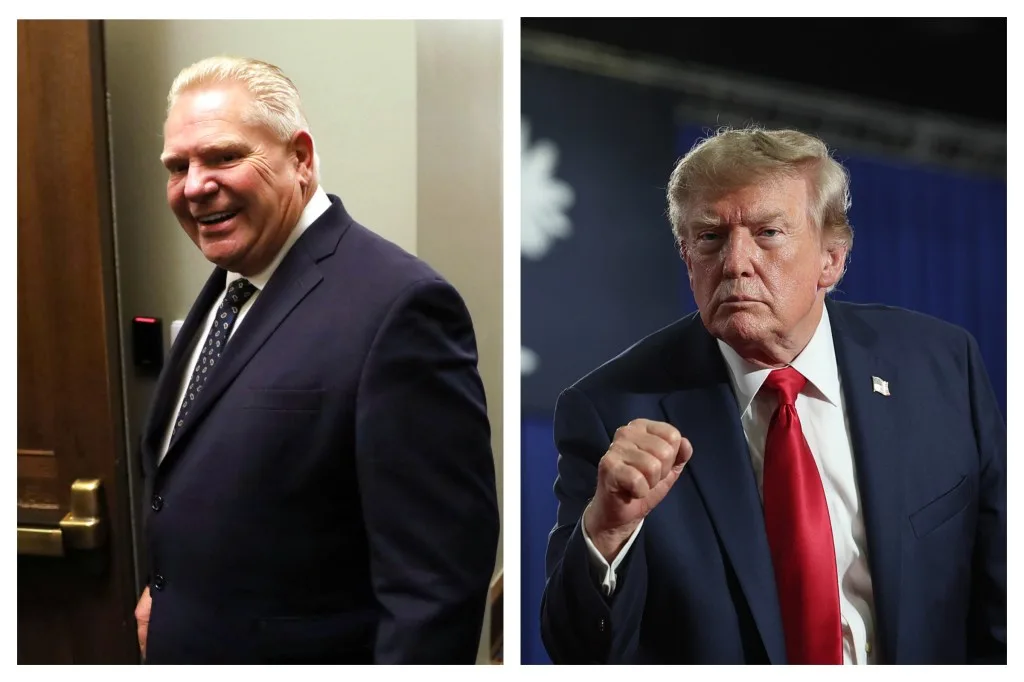
Trump's remarks come amid a deepening cross-border trade feud that has increasingly centered on Ontario Premier Doug Ford.
Minister of Industry of Canada, Mélanie Joly, has responded to President Donald Trump's comments that the United States is giving "serious consideration" to renaming Lake Ontario as "Lake America."
"We'll always call it Lake Ontario," Joly told reporters on Tuesday when asked about Trump's statement, the latest escalation in his increasingly bitter dispute with Canada as trade talks between the two countries remain stalled. "We're proud of the Great Lakes… and we'll stand up for what we have," she said. "I really think that, with all these shenanigans happening. We'll just be smart and we'll be strategic, and we'll fight back."
In a Tuesday post on Truth Social, Trump had suggested the move was under consideration because the U.S. did not expect to be "doing much business with Ontario any longer." The president later shared on his social-media platform a map of the lake with its current name crossed out and replaced with "Lake America." The proposal lands as relations between Washington and Ottawa are under fresh strain following the breakdown of trade talks and months of sparring between Trump and Ontario Premier Doug Ford.
"It is quite possible that Canadians could see the appropriation of Lake Ontario and its renaming as part of the larger effort on the part of the U.S. to exert its influence territorially," Derek Alderman, a cultural and historical geographer, told Newsweek . He added that the move seemed intended "to exert some advantage or strength in the trade war with Canada."
Meanwhile, Reuben Rose-Redwood, Professor of Geography at the University of Victoria, called it "pure rage bait" and a "well-worn move from the Trump playbook akin to calling Canada the '51st State' or renaming the Gulf of Mexico to capture media attention."
"Trump's threat to rename Lake Ontario is pure rage bait aimed at stoking anger among Canadians while distracting Americans from the fact that Trump overplayed his hand in the trade negotiations with Canada," he told Newsweek .
The official White House X account later shared a map of the United States, in the style of Lego, which labelled the lake which borders New York as "Lake America."
However, it appears that the map is incorrect with D.C. labeled as being located in North Carolina in the White House's map.
"How much drinking water did you idiots use up just to put DC and NJ in the wrong places?" The Lincoln Project asked in response to the post on X, referring to the assumption that the map was created via AI.
Minister of Industry of Canada Mélanie Joly says "we'll always call it Lake Ontario" in response to Trump's threat to rename it "Lake America" pic.twitter.com/Md9OH9hwNr — CSPAN (@cspan) August 25, 2026
Minister of Industry of Canada Mélanie Joly says "we'll always call it Lake Ontario" in response to Trump's threat to rename it "Lake America" pic.twitter.com/Md9OH9hwNr
Newsweek has contacted Ford's office and the office of Canadian Prime Minister Mark Carney for comment.
The White House referred Newsweek to Trump's Truth Social post when approached for clarification on his proposal.
The president's remarks come following the breakdown of trade talks between U.S. and Canadian negotiators on Friday.
Carney said last-minute changes by the American side were "unfair, uneconomic, and called into question the reliability of any deal," while U.S. Trade Representative Jamieson Greer blamed Canada for the breakdown and told CNBC's Squawk Box that Ottawa's negotiators sought their own 11th-hour additions.
The U.S. has now imposed 50 percent tariffs on hundreds of Canadian products —targeting certain motor vehicles, alcoholic beverages, and dairy, as well as a host of other goods together worth around $20 billion—and Trump has threatened the same duties on Canadian cars, automotive parts and steel.
Prime Minister Carney has said the country will match these "dollar for dollar," and Ottawa is preparing to announce a specific set of countermeasures as soon as Tuesday which will come into effect in September.
Ford has emerged as one of the most vocal opponents of the administration's Canada policies. Ford has previously threatened trade retaliation and restriction s affecting exports to the U.S., making Ontario a frequent focus of Trump's criticism as tensions between the neighboring countries intensify.
Ford has said that his country was prepared for "an economic war." He told the Associated Press that "everything was on the table" when it came to responding to the new tariffs, including limiting restricting electricity exports and critical mineral supplies from Ontario.
Ford made a similar threat early last year, shortly after Trump's return to office and following the announcement of tariffs on Canada, Mexico and China.
The cross-border trade feud between the historic allies has often centered on Ford, who on Monday called Trump a dictator and said during a news conference in Hamilton that the U.S. president could "kiss my a**."
📍 Lake America pic.twitter.com/zqDh8pXkoq — The White House (@WhiteHouse) August 25, 2026
📍 Lake America pic.twitter.com/zqDh8pXkoq
— The White House (@WhiteHouse) August 25, 2026
Lake Ontario is one of North America's five Great Lakes, sitting on the U.S.-Canada border between Ontario and New York. It is the smallest Great Lake by surface area but serves as a key shipping link between the Great Lakes region and the Atlantic Ocean through the St. Lawrence Seaway. Major cities on its shores include Toronto, Hamilton and Rochester.
The city derives its name from the lake, which got it from an indigenous word predating both Canada and the United States. It is usually traced to the Wyandot (Huron) word Ontarí'io or a related Iroquoian term, variously translated as "great" or "beautiful" water.
Rose-Redwood said that while the Trump administration can order the name to be changed on U.S. federal maps, it has no power over whether Canada or international map makers do so. The last time Trump announced he was altering the name of a location, the Gulf of Mexico to the Gulf of America, other countries failed to follow suit.
"Trump can certainly instruct the U.S. Department of the Interior and the U.S. Board on Geographic Names to rename Lake Ontario on U.S. federal maps, yet Canadian and international mapmakers are not obliged to comply with any decrees coming from the White House," Rose-Redwood told Newsweek .
"Although President Trump's threat of a name change is meant to exert some advantage or strength in the trade war with Canada that has ensued, it actually could backfire by further alienating the Canadian people," said Alderman, a former president of the American Association of Geographers. "Place names are quite important to people's identity as well as key resources in educating our youth and being key parts of treaties, policy documents and maps used for a variety of economic and political activities."
Alderman, now a professor in the University of Tennessee's Geography & Sustainability Department, told Newsweek that such a change would only exacerbate fears that Trump is hoping to turn the country into a "51st state," while also threatening Canadian identity.
"On a deeper level, the president's abrupt and unilateral threat to rename Lake Ontario, seemingly without proper public discussion or governmental deliberation, would say something negative about how the names on our maps, landscapes and bodies of water are being reduced to pawns and weapons in the latest battles over trade negotiation and insults traded between U.S. and Canadian leaders," he added.
The proposal would also create an unexpected classroom headache. Generations of students have memorized the Great Lakes using the acronym "HOMES" for Huron, Ontario, Michigan, Erie and Superior. A different name for Lake Ontario would render the mnemonic obsolete.
The name Lake Ontario predates both the United States and Canada and has Indigenous origins.
The name is generally traced to an Iroquoian term, often rendered as Ontarí'io or Ontario , which has been interpreted as meaning "great lake" or "beautiful water." The precise linguistic origin and meaning have been debated, but the name was in use long before European settlement and eventually became the name used for the lake and the province of Ontario.
That history gives the proposed name change an additional cultural dimension. Lake Ontario is not simply a label on a modern map: its name is connected to Indigenous languages and centuries of history in the Great Lakes region.
The lake's name was subsequently adopted by the province of Ontario, which was established as a British North American province in 1867 and later became Canada's most populous province.
A move by the U.S. to refer to the lake as "Lake America" on federal maps would therefore place a modern political label over a name with a much longer history.
Lake Ontario is the smallest of the five Great Lakes by surface area, but it is considerably deeper than its size might suggest.
The lake has an average depth of approximately 283 feet and reaches a maximum depth of about 802 feet. It covers roughly 7,340 square miles with about one-quarter of its surface area in the United States and the remainder in Canada.
Lake Ontario is also an important part of the Great Lakes–St. Lawrence waterway. Water from the other Great Lakes flows through Lake Ontario before continuing down the St. Lawrence River toward the Atlantic Ocean.
Its shores include major population centers including Toronto, Hamilton and Kingston in Ontario, as well as Rochester and Oswego in New York.
The lake's geography also underscores why a change to its name would have consequences beyond a map label. Lake Ontario is a major international waterway, forming part of the border between two countries and supporting shipping, tourism, fishing, industry and millions of people living around its shores.
List of Places Trump Has Renamed Since Returning to Office
Trump's suggestion that Lake Ontario could become "Lake America" would be the latest example of his efforts to rename or rebrand prominent geographic features since returning to office. In 2025, he ordered federal agencies to adopt the name "Gulf of America" in place of the Gulf of Mexico and restored Mount McKinley as the federal name for Alaska's Denali, reversing a 2015 Obama-era change.
The president has also shown a willingness to use provocative place-naming proposals as a political statement. Earlier this month, he shared an image on Truth Social depicting the Strait of Hormuz as "NEW U.S. Territory" and publicly entertained the idea of asserting U.S. control over the strategically important waterway.
While it remains unclear whether any formal effort will be made to rename Lake Ontario, the proposal fits a broader pattern of Trump using symbolic geographic branding to advance political messages, particularly in disputes involving trade, national identity and U.S. influence abroad.
Update 8/25/26, 9:57 a.m. ET: This article was updated with additional information and a response from the White House.
Lane Kiffin, LSU Could Face Major SEC Punishment for Playing NFLers
Poll Gives Ken Paxton 4 Warning Signs in Texas Race Against James Talarico
Dolly Parton's History With Donald Trump as President Praises Her
Topics in this story
Gathered from external sources. Rights to this text belong to whoever originally published it.