Why we should bring back the draft
University of Pennsylvania professor Jonathan Zimmerman argues that reinstating a military draft would encourage student activism against the ongoing war in Iran and ensure a more equitable distribution of national defense responsibilities.
Last week, as the war in Iran neared its six-month mark, President Trump said it would “ continue for as long as necessary. ” More than 750 American service members have been killed or wounded since the U.S. attacked Iran on Feb. 28. That is a tiny number compared to the Iranian casualty toll, which has topped 37,000 .
Our college campuses are silent . That’s not just because universities clamped down on protests following the burst of anti-Israel demonstrations in 2023 and 2024. It is also because our students know they won’t be sent to fight in the Middle East.
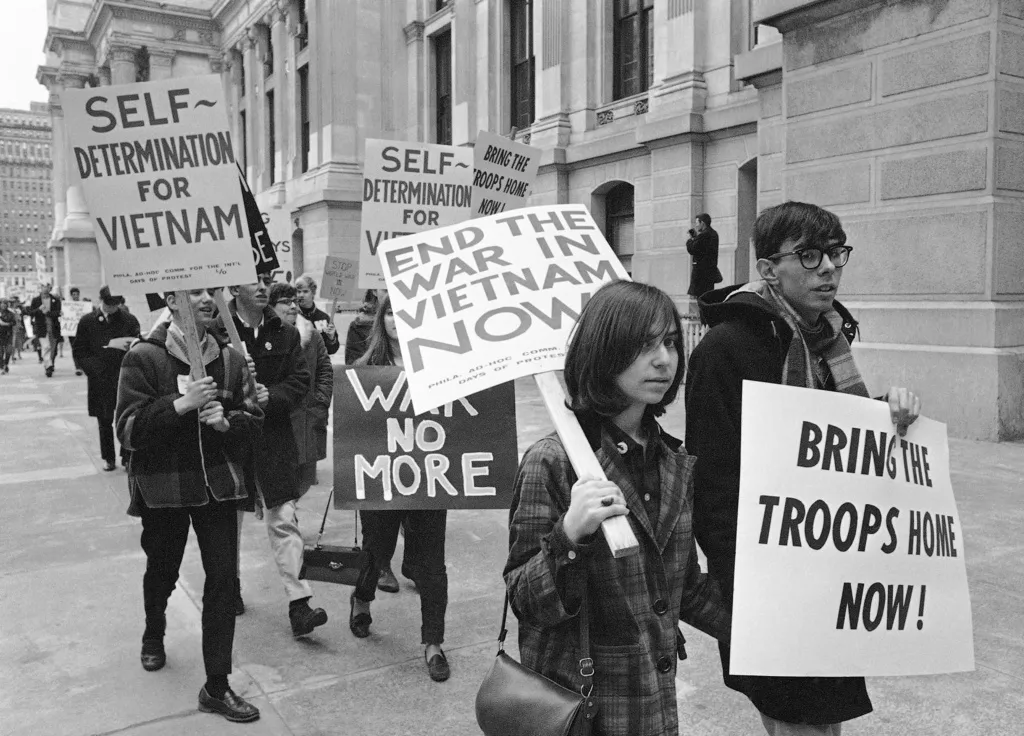
That is precisely why we need a military draft. Our colleges would explode with protest, just they did during America’s war in Vietnam. Everyone would learn more about the conflict in Iran. And maybe, just maybe, we could convince our leaders to end it.
Most students in the Vietnam era received draft deferments, which is why college attendance shot up . So did grade inflation : sympathetic professors knew that students could be conscripted if they flunked out, so they gave fewer D’s and F’s.
Student draft deferments ended in 1971 , except for people training in medicine and divinity. From the start of the war, though, every male student knew they could be drafted once they got their degree.
So college campuses were cauldrons of protest. At the University of Pennsylvania — where I teach — students staged a seven-hour sit-in in 1967 to condemn on-campus recruiting by Dow Chemical, which produced the napalm that killed and mutilated so many people in Vietnam. Three years later, when National Guardsmen gunned down four students at Kent State, 1,300 colleges and universities witnessed protests and 500 closed because of student and faculty strikes.
But I haven’t heard a peep of antiwar sentiment as students return this semester. They stride happily across our verdant quads, chatting about classes and internships and hookups.
I don’t know how many of them are aware of the proposed new speech restrictions at Penn, which ban “disruptive” protest (without defining that) and any demonstration where “health and safety is endangered” (ditto). But here’s what I do know: if there was a military draft, the restrictions wouldn’t matter. Students would raise their voices, ignoring our efforts to silence them.
And here’s another thing I know: a truly universal draft would make the United States a more equitable place. But the Vietnam-era draft was far from universal or equitable.
That’s because people with money and power could evade it. After receiving four student deferments, Trump obtained a medical exemption when a podiatrist — who was also a tenant of Trump’s father — certified that Trump had bone spurs in his heels.
George W. Bush’s father — in Congress at the time — reportedly pulled strings to get his son into a National Guard unit, which let members fulfill their military duty without going to Vietnam. Bill Clinton got a deferment during his Rhodes Scholarship in England and then told his local draft board that he was “too well educated” to serve as a soldier, the board’s secretary recalled .
Sadly, Clinton was correct. The war was fought mostly by working-class Americans without college degrees, who didn’t have the means or connections to buy their way out.
And in a democracy, the burden of national defense should be shared. That’s why Sen. Edward Kennedy (D-Mass.) and Rep. Charles Rangel (D-N.Y.) — two of the most liberal members of Congress — objected when Richard Nixon ended the draft in 1973. As Kennedy argued , an all-volunteer army would result in “poor people fighting a rich man’s war.” Rangel proposed a bill that would have required all Americans between 18 and 25 to serve for two years, either in the military or in a civilian capacity.
If it was truly universal, Rangel noted, the draft would bring together Americans from different backgrounds into a common national project. In a recent interview , likewise, California Gov. Gavin Newsom (D) suggested that compulsory national service could “knit this country back together.”
Trump isn’t having it. During the 2024 campaign, he warned — without evidence — that Democratic nominee Kamala Harris would bring back the draft . And when members of his own party — including JD Vance and Lindsey Graham — said they were open to the idea, he shot that down as well .
The Selective Service recently announced a new policy to automatically register eligible men, which fed internet rumors that another draft is imminent. So did comments by the recently departed White House press secretary Karoline Leavitt. Asked about a possible draft, Leavitt said President Trump “keeps his options on the table.”
But he wouldn’t want his own kid to get drafted, of course. That’s the point of the satirical “Draft Barron Trump” website produced by South Park screenwriter Toby Morton, urging Trump’s 20-year-old son to serve in Iran. Right-wing podcaster Theo Von also called on Barron Trump to enlist, noting that “elites and politicians that are leading us into these wars might make different choices if it was their children.”
Students at our colleges might make different choices, too, if their own lives were on the line. They would be storming the ramparts, demanding that our destructive gambit in Iran come to an end. That’s why they should be required to serve in the military. So should everybody else.
Jonathan Zimmerman teaches history and education at the University of Pennsylvania and serves on the advisory council of the Albert Lepage Center for History in the Public Interest .
Topics in this story
Gathered from external sources. Rights to this text belong to whoever originally published it.