Trump plan to raise borrowing limit on shaky ground as debt roils bond market
President Trump’s plan to raise the debt limit through the end of his presidency before Republicans likely lose control of Congress is on shaky ground because of rising concerns over the national debt — which has reached $40 trillion. The president is quietly pushing Senate Majority Leader John Thune (R-S.D.) and House Speaker Mike Johnson…
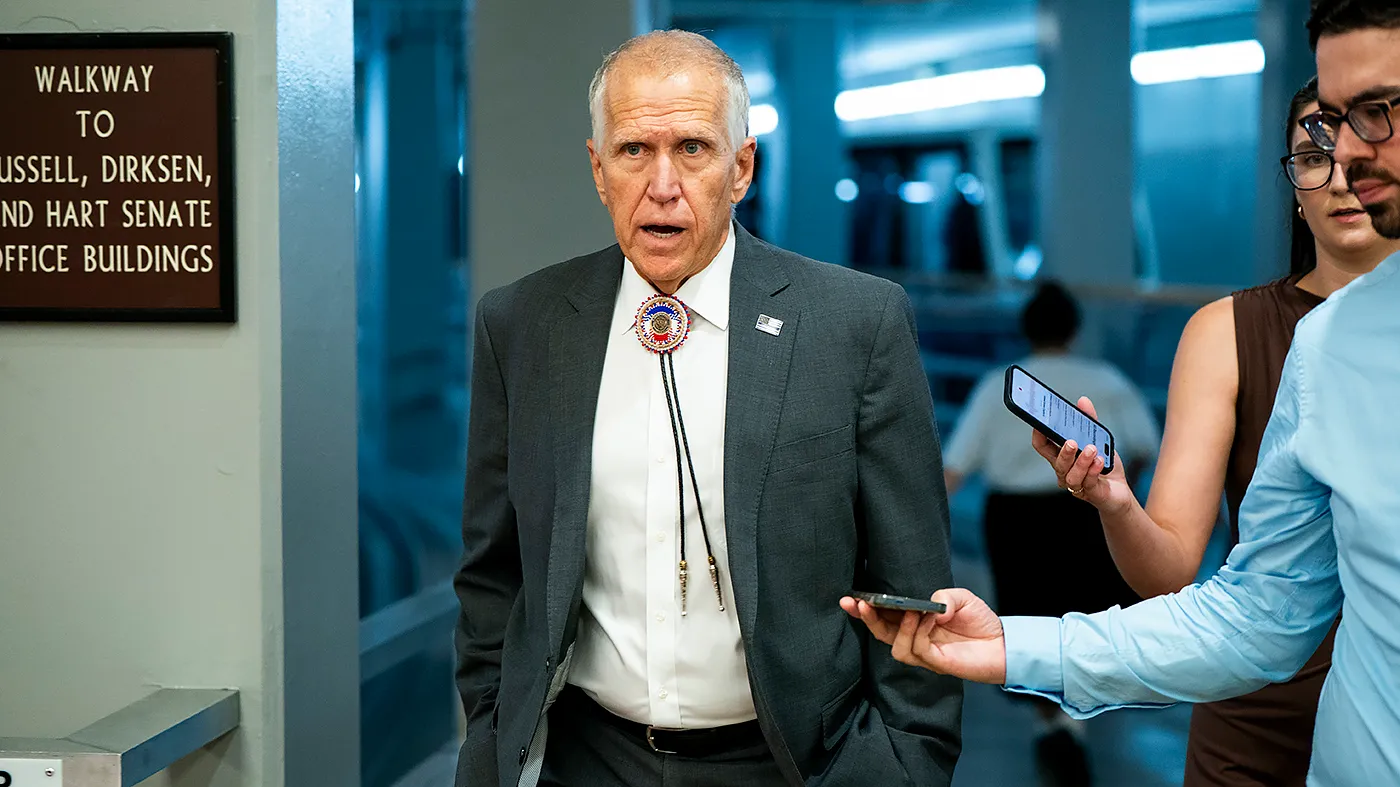
President Trump’s plan to raise the debt limit through the end of his presidency before Republicans likely lose control of Congress is on shaky ground because of rising concerns over the national debt — which has reached $40 trillion .
The president is quietly pushing Senate Majority Leader John Thune (R-S.D.) and House Speaker Mike Johnson (R-La.) to use a third budget reconciliation package to extend the debt limit through 2029 — the end of Trump’s term — to avoid the prospect of a difficult negotiation with Democrats next year if they win control of the House or both chambers of Congress.
Yet Trump’s desire to avoid a standoff with Democrats means getting almost all Senate and House Republicans on board with a plan to raise the nation’s borrowing authority by another $5 trillion — and some Republicans say that looks increasingly unlikely.
“If you’re really trying to curb the debt, you wouldn’t do a debt ceiling for two years. You’d try and use it as a lever to change things,” said Sen. Thom Tillis (R-N.C.), who warned that Social Security and Medicare will likely need to undergo significant reforms in the next few years to remain solvent.
“You just see interest rates, spending. Every indicator in my mind leads me to believe that before 2032 we’ll have to deal with at least one trust fund if not two that will be insolvent,” he said. “We’ll be incapable of writing a check so you’re going to be forced to do the cuts that we should have been doing the last 12 years.”
Social Security’s trustees warned in a June report that the popular entitlement program is on pace to become insolvent by the end of 2032, which could force as much as a 22 percent cut to benefits.
The program’s trustees moved up the date of insolvency by a year amid annual federal deficits of nearly $2 trillion.
Medicare’s hospital insurance trust fund is projected to become insolvent in 2033, according to the Medicare Trustees annual report from June.
Debt is becoming a bigger political problem as investors demand larger premiums to buy U.S. treasuries, which finance the debt. That in turn is pushing up the costs of mortgages and consumer debt.
The yield on the 30-year Treasury bond reached 5.3 percent last week — the highest level since 2007 — and the average 30-year fixed-rate mortgage hit 6.6 percent.
That spurred Treasury Secretary Scott Bessent to announce last week that the Treasury Department would double the limit on how much government debt it is allowed to buy back from investors.
The surprise move temporarily calmed the bond market, but the yield on the 30-year Treasury bond climbed back to 5.2 percent on Thursday and the yield on the 10-year Treasury bond reached 4.7 percent.
Tillis warned that raising the debt limit to cover the final two years of Trump’s presidency would only give both parties more time to ignore the mounting debt, at the risk of leaving Congress on the cusp of a crisis when Trump leaves office in 2029.
“If you do a debt increase of that magnitude, basically give about a 10 or 15 percent debt increase over the current debt level, and you give them two years to spend, it’s going to be a lot worse,” Tillis said.
“We’ll be at [$]45 [trillion] approaching $50 trillion,” he continued, noting that the country’s debt to gross domestic product ratios are “going to be exactly where most economists say the economy stops to function naturally.”
“All those things are additive, I think, to the ultimate economic problem,” the North Carolina senator concluded.
Conservatives in the upper chamber — such as Republican Sens. Rick Scott (Fla.) and Ron Johnson (Wis.), who also chairs the Senate Budget Committee — have argued that inflation is being fueled by excess government spending and persistently high deficits.
Fiscal hawks in Congress warn that Bessent won’t be able to protect long-term U.S. Treasuries and the broader economy from the impact of growing deficits, and they are calling for any debt limit increase to be offset with significant spending cuts.
But any budget reconciliation package with big spending cuts will have a tough time getting the support of 50 GOP senators and 218 House Republicans in the post-election lame-duck session.
This sets up an end-of-year clash between Trump and Republican lawmakers over the debt limit.
Thune says Trump is “keenly interested” in Republicans raising the debt limit again before they potentially lose control of the House after the midterm election.
Sen. Rand Paul (R-Ky.) is warning that he won’t vote for a budget reconciliation package that raises the debt limit without major spending reforms. He’s pushing his “Six Penny Plan,” which would cut 6 cents off every federal dollar projected to be spent over the next five years.
“We can’t wait any longer. We MUST address our deficit,” Paul recently wrote on social media.
Asked about raising the debt limit, Paul told The Hill: “I’m for less debt, not more.”
“Historically the conservative position has been we don’t vote for the spending that leads to the debt and consequently we also don’t vote for the debt ceiling. People who vote for the spending really need to be the people who vote to raise the debt ceiling,” he said.
Paul marveled that Republicans in Congress used the budget reconciliation process to raise the debt limit by $5 trillion in July 2025 as part of the One Big Beautiful Bill Act and may be asked to raise it again before the end of the year.
“If we’ve run out of $5 trillion in borrowing power in a year and a half … I don’t know how we got through $5 trillion in a year. That’s crazy,” he said.
Paul reposted on social media a Wall Street Journal op-ed penned by famed investor Stanley Druckenmiller urging the Treasury Department to let bond prices find their natural level.
Druckenmiller, who mentored Bessent early in his career, warned: “You can’t buy your way out of a solvency conversation with liquidity tools. You can only postpone the conversation and raise the eventual price.”
He predicted the Treasury Department would have to expand its bond-buying program substantially to keep yields in check and the expensive endeavor would only postpone the inevitable debt reckoning facing policymakers in Washington.
He argued that the president and lawmakers in Congress should listen to the warning the bond market is sounding over the rising debt.
“Every basis point of artificial yield suppression is a subsidy to procrastination. Suppressed long rates sugarcoat the interest-cost projections, shrink the apparent urgency, and let incumbents assure voters the debt is someone else’s problem,” Druckenmiller wrote.
Topics in this story
Gathered from external sources. Rights to this text belong to whoever originally published it.