Mullin, Clayton face bipartisan grilling over tech outages
Homeland Security Secretary Markwayne Mullin and Director of National Intelligence Jay Clayton said there was no evidence that tech outages hitting businesses across the country were the result of nefarious actions at a timely hearing Wednesday on worldwide threats facing the country. The series of tech disruptions, including communications failures that led to a Friday…
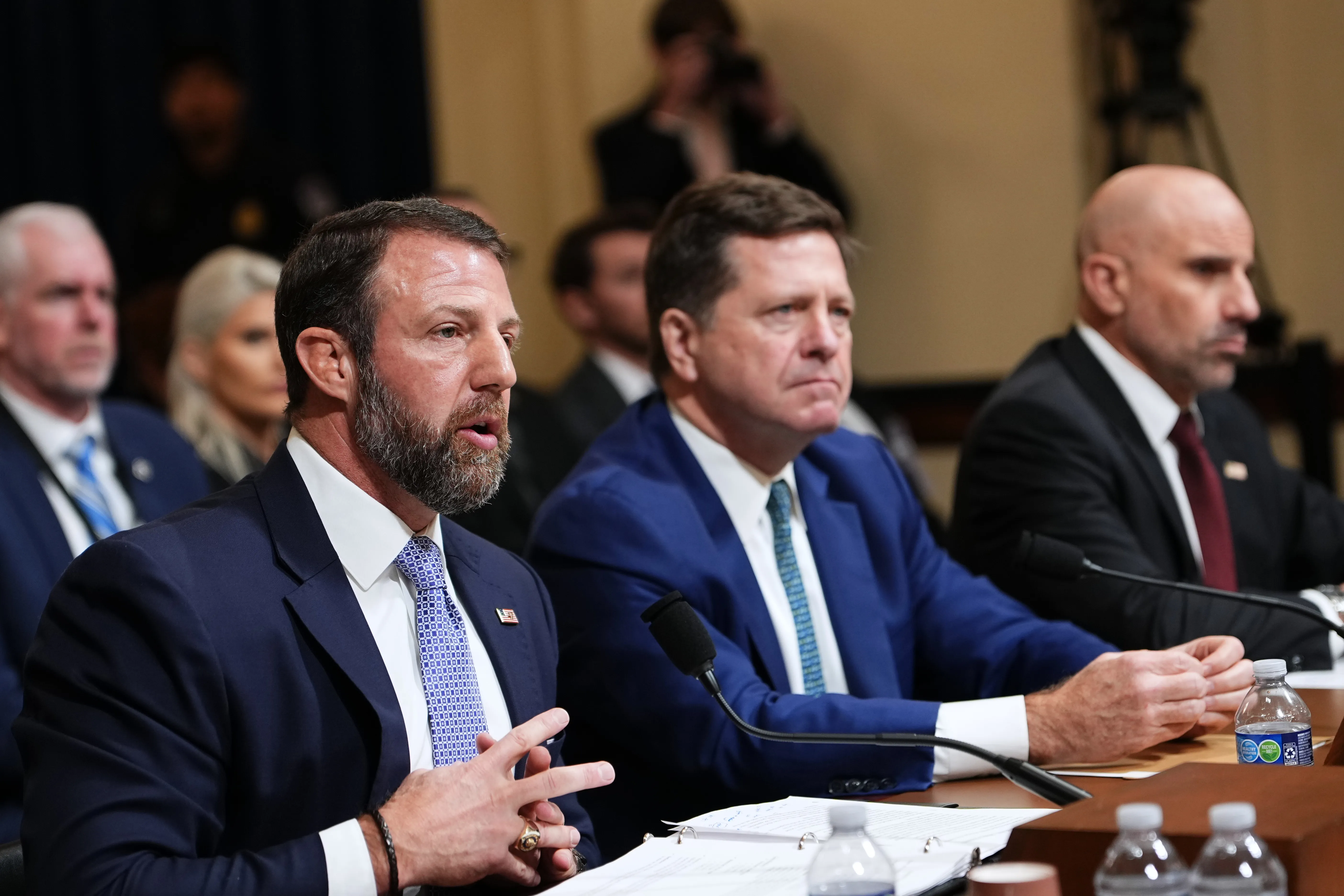
Homeland Security Secretary Markwayne Mullin and Director of National Intelligence Jay Clayton said there was no evidence that tech outages hitting businesses across the country were the result of nefarious actions at a timely hearing Wednesday on worldwide threats facing the country.
The series of tech disruptions, including communications failures that led to a Friday ground stop from the Federal Aviation Administration (FAA), have fueled questions from the public about whether there is reason for worry.
Fears have also been sparked by reports that Iran is developing plans to set off a dirty bomb in Washington.
Clayton said he understood why people were worried, and why it was raising questions.
“The American people should ask us these questions,” he told the House Homeland Security Committee. “But based on what we know today, after a great deal of diligence, these are separate service outages associated with maintenance and technical changes.”
“They are not a coordinated or state-sponsored attack,” Clayton said.
That answer was not fully satisfying to several Republicans as well as Democrats who expressed skepticism there was not a connection linking the various incidents.
“I’m getting a lot of text messages, phone calls about these issues, and I think one of the concerns is how quickly and how many of these outages we’ve seen … in a span of five days, when we’ve never seen that,” said Rep. Eli Crane (R-Ariz.).
Rep. Nick LaLota (R-N.Y.) asked Clayton if he believes in coincidences.
“I believe in exploring coincidences,” Clayton responded.
It was, LaLota acknowledged, a “good answer,” but the lawmaker said he still has concerns.
“I’m a little worried that what’s happened this last week are a little beyond coincidences,” he stated.
“Thursday, Microsoft 365 went down. Friday, a nationwide ground stop. Monday, United Airlines grounded flights. Also Monday, Chase and Wells Fargo experienced banking disruptions. And yesterday, we learned of a network disruption at the NSA [National Security Agency]. Five major disruptions in less than a week. Five different explanations,” he said, later asking Clayton if his “gut” tells him they still are a coincidence.
“It does, and let me tell you why,” Clayton responded. “It’s an informed opinion, and the reason it’s informed is we are engaged in a substantial increase in upgrades, the number of patches, the number of upgrades that we’re undertaking in the public and private,” Clayton said before explaining the review done by the government.
“We call it red teaming. We say, OK, let’s say we wanted to do this and not be detected, and make it look like it wasn’t coordinated, and try to establish all of that. That’s the kind of exercise that our experts at the FBI and the like will go on,” he said.
Democrats were quick to highlight President Trump’s response.
Rep. Bennie Thompson (Miss.), the top Democrat on the panel, held up a sign with a quote from Trump, who — when asked about the ground stop — said, “I don’t take any responsibility.”
Many Democrats cited the gutting of the Cybersecurity and Infrastructure Security Agency (CISA), which faced widespread firings under Trump and plays a critical role in battling tech vulnerabilities.
“All three of your agencies — perhaps not Mr. Clayton — have decimated the cybersecurity personnel that this administration entered office with. CISA is way down because the president didn’t want election fraud to be uncovered. The FBI has fired numerous cybersecurity agents because they may or may not have served a subpoena in the Mar-a-Lago case. You all have an obligation to restore that,” Rep. Dan Goldman (D-N.Y.) said.
Rep. James Walkinshaw (D-Va.) noted that CISA had 3,400 employees at the start of the Trump administration and pointed to June testimony from Mullin saying the agency was down to 2,200 employees but really needed 2,800.
“Let’s be clear about what happened. The Trump administration inherited a CISA workforce of 3,400 people. They fired and pushed out — more than 1,000 cyber defenders — at precisely the moment the cyber threat was exploding. You came before us and said correctly that you needed hundreds of those employees back,” Walkinshaw said.
“So I have a simple question for you: Was it a mistake in 2025 for those employees, the 1,000-plus CISA employees that you now need back? Was it a mistake for them to have been fired and pushed out?”
Mullin wouldn’t say that it was, saying it happened before his arrival.
“I didn’t say [we needed] those employees back. I said we’re hiring new people,” he countered.
The focus on cyber issues overshadowed other major developments that represent potential threats to the nation.
There were just a handful of questions about Iran’s plans for a “dirty bomb.”
Mullin said he did not believe Iran’s exploration of such a weapon constituted an imminent threat.
Clayton wouldn’t get into specifics but did repeatedly highlight the risk posed by Iran in his opening remarks and responses to questions.
“We do face a heightened threat from the Iranians – lethal plotting against our citizens at home and abroad,” he said.
Mullin did face several questions about immigration matters from both Democrats and Republicans during the hearing.
Rep. Carlos Gimenez (R-Fla.), a Cuban-born lawmaker in a heavily Hispanic district, told Mullin he thought the administration had strayed from going after criminals saying, “I just think you’ve gone a little bit too far.”
Roughly 70 percent of those in immigration detention have no criminal record, but Mullin asserted they did, even as the administration has come under fire for detaining those with lawful immigration status.
“Our policy right now is to go after the worst, the worst. But every time you go out for the worst, the worst, you also have what we call collateral criminals. So when we arrest someone that’s on a warrant, most of the time they’re not by themselves. There’ll be two or three individuals with them,” Mullin said.
He was later asked by Rep. LaMonica McIver (D-N.J.) if Mullin had “any regrets or reservations for the leading role you are playing in this administration’s immigration agenda” later added “about even killing people.”
Mullin disputed that he had, saying “We’re not killing people.”
That prompted Mullin to respond, “That’s your opinion.”
“No, no, you are killing people. The whole entire country watches you kill people,” McIver said as her time for questions ended.
FBI Director Kash Patel skipped the hearing and sent his deputy, bucking a decadelong tradition and garnering a stern rebuke from House Homeland Security Chair Andrew Garbarino (R-N.Y.).
Patel was roasted in absentia by members of both parties for his failure to appear.
“Today’s hearing date was first provided to Director Patel in August. There was no surprise or last-minute request, and despite repeated attempts over the span of several months between then and now to find any date when he could testify, the director made clear that he had no intention of appearing,” Garbarino said in his opening remarks.
“Director Patel’s refusal to testify marks a significant departure from well-established committee precedent.”
An FBI official said Patel was traveling to field offices this week.
Topics in this story
Gathered from external sources. Rights to this text belong to whoever originally published it.