How the shooting death of a Houston father is igniting Latino politics in Texas
HOUSTON — As the sun set on a late-September evening, a voice rose over the din of traffic at the roadside memorial for Lorenzo Salgado Araujo, the 52-year-old husband and father fatally shot here by immigration authorities three months ago.
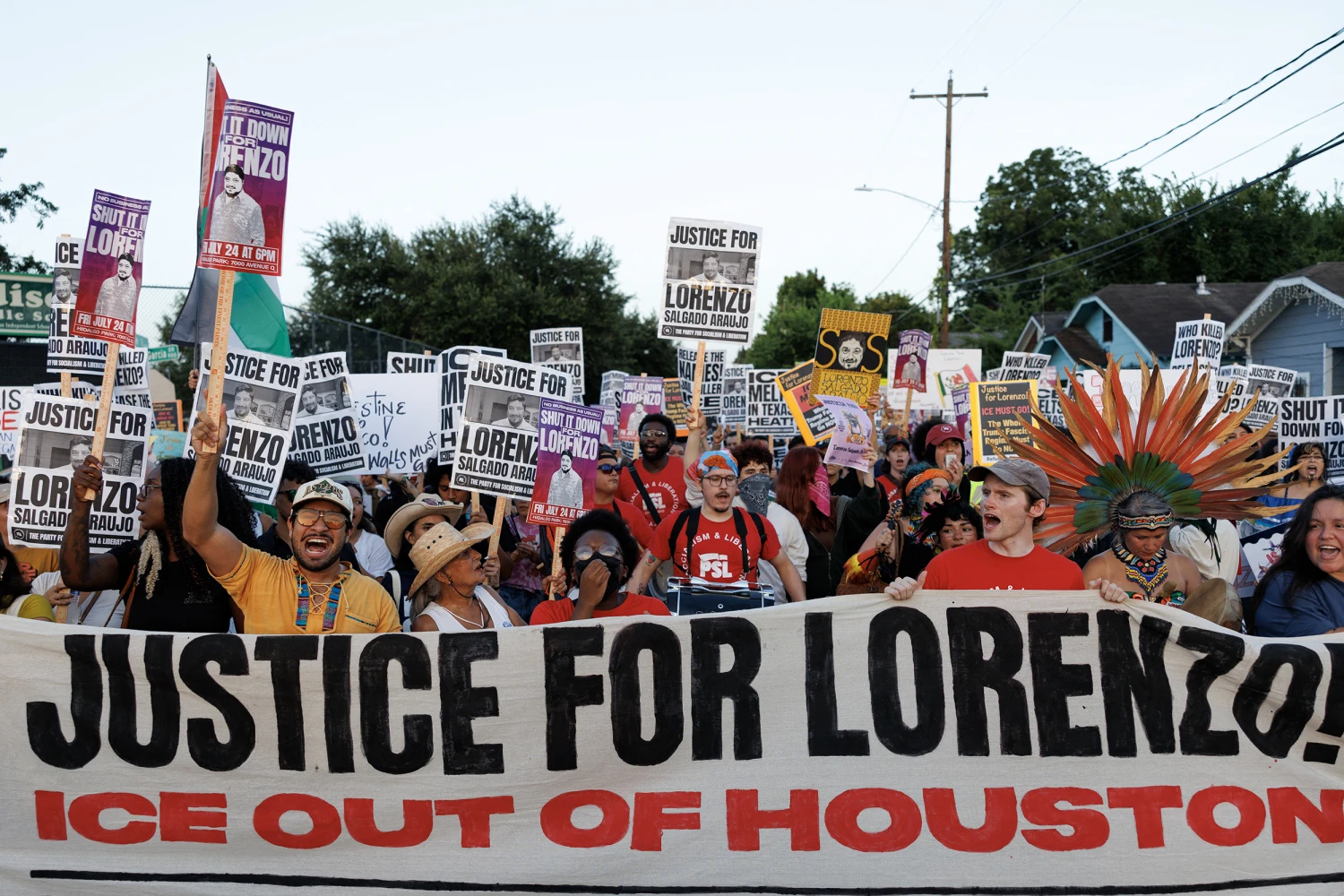
HOUSTON — As the sun set on a late-September evening, a voice rose over the din of traffic at the roadside memorial for Lorenzo Salgado Araujo, the 52-year-old husband and father fatally shot here by immigration authorities three months ago. Sitting on barbershop steps, Berta Lopez, a nearby resident, alternately sang, recited prayers and cried for a man she never met. “It was unjust — he was killed unjustly! The family is deeply hurt, his wife, his children. They are like family to us. And why don’t they show the people who did the killing? Why don’t they show them? Why don’t they release the names of the people who killed Lorenzo? Why don’t they expose them?” she said in Spanish. In tears, Lopez said that after more than a year of intensive operations by Immigration and Customs Enforcement, Salgado Araujo’s killing was a clarifying moment. The government, she said, saw those who weren’t U.S. citizens as less than nothing. She was tired of it. “Just because we’re Hispanic, shouldn’t we hold our heads high? No, God doesn’t want us hanging our heads in shame. He wants all of us, his children, to hold our heads up high,” Lopez said. “God doesn’t care about papers.” Lopez’s hurt and anger was reflected in NBC News interviews with more than three dozen Houston-area Latinos, elected officials, activists and political strategists. They reveal a distraught community whose members feel degraded by the messages they hear out of Washington, D.C., during President Donald Trump’s second term. They said they have been terrorized by the constant stories of those detained, many wrongly, and left to languish. They were aghast that the government was sending immigrants to countries they had never heard of. Many said Salgado Araujo’s shooting death crystallized their feelings of powerlessness. Most Latinos were better versed in the details of the incident than in the names and backgrounds of those running for some of the highest-profile offices in their state. Their refrains were in the same vein: That could have been my dad, my brother, my uncle, my son — or me. “They’re being unfair. They’ve lied about a lot of things. They’re killing innocent people, breaking families apart. It’s just not right. They have no sympathy for other people,” said Julio Roa, a Houston resident who lamented what he was seeing happen in his state. “I come from Mexican parents. I’m born a U.S. citizen, but I live it day by day when they’re scared to go to the corner store.” It all illustrates a political environment in which Republicans and Trump are bleeding support from Latinos. A new NBC News/Telemundo survey of 800 registered Latino voters nationally showed that fully 69% disapproved of the job Trump was doing as president, and 54% said they intended their midterm vote to be a signal of opposition to the president. The survey, carried out Sept. 21-28, had a margin of error of plus or minus 3.5 percentage points. Notably, immigration and border security did not score high among priorities in the survey, with 6% of Latino voters calling it a top issue. But it has hit a nerve: 67% of potential Latino voters said Trump’s immigration enforcement had gone too far. In an earlier NBC5 Dallas/Telemundo Station Group poll of Texas Latinos, respondents ranked immigration and border questions as the second highest priority behind economic factors. That survey showed a sizable swing. In 2024, 55% of Texas Latinos supported Trump, according to exit polls, but recent surveys show statewide Democrats garnering at least 55% of the Latino vote. That’s part of the reason Texas’ Senate race between Democrat James Talarico and Republican Ken Paxton has become a battleground contest and why Gov. Greg Abbott, a Republican, is facing perhaps his toughest-ever general election challenge, from Democrat Gina Hinojosa. One man who once held a deep allegiance to Trump said he could not explain the regret he felt. “I’m guilty as charged. I voted for Trump. But I never thought it was gonna happen the way that this happened,” said Albert Riseño, a plumber who works in the Houston area. Riseño is a three-time Trump voter. He described a fear that has settled over the Latino community since Trump’s second term in office. “There’s no words to describe what’s going on,” he said. “Everybody’s scared.” Pushing back Lorenzo Salgado Araujo woke before dawn on a hot Houston morning on July 7, as he did most days. He had lived in the U.S. for decades without legal status but was in the process of getting a work permit. He had no criminal record. He picked up workers in his white van and was driving to a jobsite when he was pursued by immigration agents in unmarked vehicles. An officer shot him, according to authorities, after they say he used his vehicle to ram them. It’s a story contradicted by witnesses in the van, but it’s one immigration authorities have told before in explaining how a traffic pursuit turned deadly. This time, though, the family wasn’t having it. Salgado Araujo’s eldest son stood before cameras and delivered an emotional testimonial to his father that went viral. “He was a hardworking family man who never wanted his name to be known by anyone outside of his family,” Ronaldo Salgado said at a news conference days after his father’s shooting, as his brother held up a photo of their father. Ronaldo Salgado stressed that the story of his dad ramming government vehicles could not be true. Their father had always taught his kids that if law enforcement attempted to pull them over, they were to pull off the road, hand over their license and registration and act respectfully. In the end, authorities admitted Salgado Araujo was not the intended target of the operation. In an interview with NBC News, Ronaldo Salgado said as immigration arrests became more prevalent in 2025, they talked to their father about the procedure if he had an encounter, including calling his family, and that they’d contact their attorneys. “Just remember, don’t sign anything. Call us,” Ronaldo Salgado said he told his father. Sitting at Las Perras Cafe in Houston, where a makeshift altar to his father sits in the corner, Ronaldo Salgado recited the names of those who had been killed by immigration officers, including Renee Good, Alex Pretti and Ruben Ray Martinez, saying the country is not now safe because of their deaths. “These are lives that are lost, and they need to be investigated, just like any other life lost. It needs to be investigated with the full cooperation of the agents involved and the agencies involved,” the son said. “All of this isn’t making us any safer. How is going after my dad going to work making the city safer?” Ronaldo Salgado said. “Criminals don’t wake up at 5 in the morning to pick up their crew and go to do a day of backbreaking labor. You don’t.” In an unusual move, federal officials made public an FBI search warrant to get inside Salgado Araujo’s van after his death. Then, federal officials released a stinging detail: The bureau sought entry to look at baggies with crystals that they said resembled meth. When he heard that, Ronaldo Salgado said he couldn’t help but break into a little smile: “Ohhh, they messed up.” He knew what it was. And it would only make things worse for federal authorities. It was a homemade electrolyte mixture, mainly of salt, that his father later mixed into Gatorade for himself and workers to combat the triple-digit Houston summer heat outside. The U.S. attorney’s office later confirmed that the mix was in fact not methamphetamine, surprising few who knew Salgado Araujo. Ronaldo Salgado felt it was an effort to sully his father’s reputation and dampen public outrage. The implication just added to community anger, viewed as a thinly veiled attempt at smearing the man immigration authorities killed. “It really shook the community,” said Jasmine Khadem González, an immigrant rights organizer with the Houston Democratic Socialists of America. “A lot of us who are Latino, we have somebody in our family: If it’s not our father then it’s our uncle who has a very similar job. … To see somebody like that be targeted for just being on his way to work or for the color of his skin or for the kind of truck that he’s driving — because it’s associated with Latino men — to see somebody like that be targeted for doing a very everyday thing. For just existing.” In the NBC News/Telemundo poll, 31% of Latino voters say they or someone close to them started carrying identification over concerns about ICE enforcement, while 27% say they know someone who has been deported or detained by ICE in the last two years. Amy Zachmeyer, the executive director of New Economy for Working Houston, a group that helped organize community vigils and demanded accountability and transparency in the probe, said the Salgado family’s high-profile pushback kept authorities in check. “They’ve shown incredible strength to be able to really defend their father,” she said. Zachmeyer grew emotional as she spoke about the sons. “They never let a narrative set in that he was anything but a loving father, a Houstonian, a Texan, a hard worker.” Anger reshapes local politics Adrian Garcia, a Harris County commissioner, said Latinos are “feeling a lot of attack and disrespect.” Over the last year, he’s worked to reach out to those who don’t vote often. From his view, people now are willing to walk across broken glass to send a message to the Trump administration. “The low-propensity voters that I’ve been speaking to absolutely have a great intensity to vote in this election, and they specifically speak to ICE enforcement. A lot of young kids: ‘I’m voting for my mom. I’m voting for my dad.’ I hear that a lot,” Garcia said. More Latino registered voters than ever — 72% — rated their interest in the upcoming election as 10 out of 10 in the NBC News/Telemundo poll. Garcia described the greater impact that fear of immigration enforcement has had across the Texas economy. “This is not what our community deserves, and it is also what is impacting the things that we care about the most, the business, the economy. They’re hurting the industry,” he said. “They’re hurting those who work hard and play by the rules.” Jareli Barrera, who works as a server at the popular Cielito Cafe in Houston, said she has never been so tuned into an election. Today, she said she’s helping others, including co-workers, to register to vote. She cannot stand seeing the level of fear in her community, including among those who are citizens but fear being separated from family or an aggressive encounter. “Republicans are probably going to lose. It’s not going to be the greatest thing for them at the end of the day,” Barrera said. “Most of these immigrants are the ones that are making the U.S. successful. They’re doing the hard work. … If everyone’s deported, who’s gonna do the hard labor? Who’s gonna construct? Who’s going to do all this cleaning that they don’t want to do.” Since 2025, local activist groups have tried to work with the city of Houston to better protect Latinos as they watched intense enforcement operations in cities like Minneapolis, Los Angeles and Chicago upend life for residents and lead to encounters with immigration authorities that turned violent or deadly. Jennefer Canales-Pelaez, a Houston-based senior policy attorney and strategist with the Immigrant Legal Resource Center, said Salgado Araujo’s death was a “culmination of years of Texas entrenching itself, entangling itself with ICE” and “illustrated to them the fear, the levels of persecution of justice that immigrant communities have been living with in Texas for a very long time.” Before Salgado Araujo’s death, Canales-Pelaez was among those who worked to deter cooperation between Houston police and federal police agencies and pushed for greater transparency into immigration operations. Abbott, the three-term governor and a staunch Trump ally who is up for re-election in November, threatened to block $200 million in grants to Houston and other major cities if they didn’t change local rules that directed police forces not to hold individuals they encounter for longer time periods to assist ICE. The cities, including Houston, reworded their ordinances. Houston Mayor John Whitmire, a centrist Democrat, told The New York Times last October that he kept his head down as other city and state leaders in the country grew combative with the White House over immigration operations. Whitmire said his city had avoided “turmoil” that others faced. Whitmire initially declared his hands were tied after the shooting; the Houston Police Department had no jurisdiction to conduct an independent investigation. After community uproar, the city changed course. Harris County District Attorney Sean Teare has now launched a probe, with the county government approving the $2.5 million request to fund it. “It ignited this flame and really showed other people that aren’t necessarily living this experience or working in this line of work, ‘Oh, this got to us,’” Canales-Pelaez said. “When the mayor told us that we weren’t going to be another Minneapolis, we weren’t going to be a Los Angeles, well, now we are. Someone’s dead. That really has sparked this rage, this collective, righteous anger.” Republican recalibration Abbott, who has long taken a hard-line stance on immigration, was silent on the Salgado Araujo shooting for a week but then ended up backing an independent investigation. “Immigration laws can be enforced, and stopping illegal immigration from coming across our border can be achieved, without shooting people,” Abbott said in mid-July. Paxton, the Republican state attorney general locked in a tight race with Talarico for the Senate seat, met with the U.S. Hispanic Business Council last week and made supportive statements about an immigration program designed to help industries in need of workers. Paxton has aggressively supported Trump’s immigration policies and in June boasted that his office had blocked public money to help pay for legal representation for immigrants facing deportation. Paxton had described the practice as “evil and wicked.” Last week, Paxton had a softer tone on another aspect of immigration. “Our birth population isn’t keeping up with demand, and so as long as we are doing this by the rule of law,” Paxton said, “I’m open to having help.” Ronaldo Salgado doesn’t rail against Republicans or Trump. He has stressed that the quest to investigate exactly what went wrong in a deadly encounter with law enforcement “should not be a partisan issue.” He also said those incensed by what they see should vote in November. “Immigrants’ rights shouldn’t be a partisan issue, and I just urge faithfully to look for and to vote for candidates who honor and respect the lives and rights of immigrants,” he said. “Every single elected official right now has immigrants living in their districts, in their states, their neighborhoods, and it’s their job to protect them. And if they’re not willing to protect them, then people should elect someone else that will.”
Topics in this story
Gathered from external sources. Rights to this text belong to whoever originally published it.