‘He’s a force’: Obama answers call to boost Democrats – and rattle Trump
Former president has given series of blistering speeches to help candidates in key races – and deployment has proved a hit with party’s progressive wing
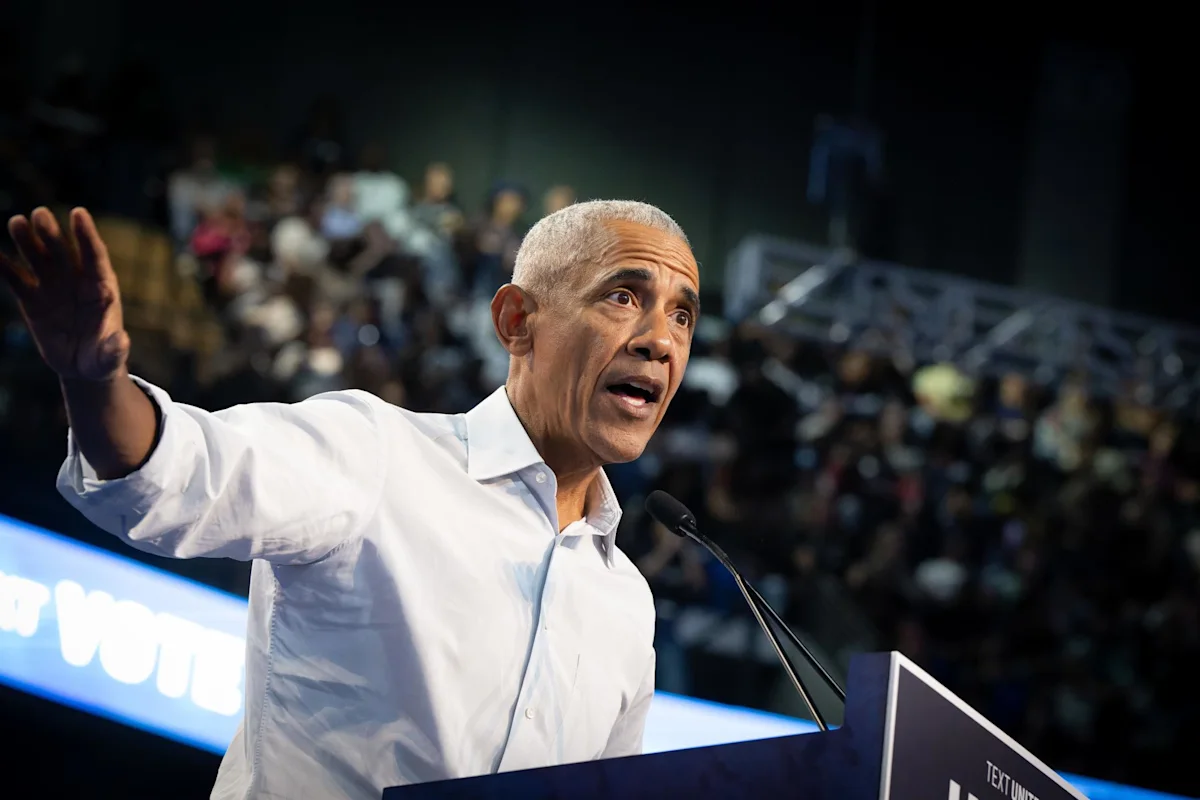
That could have been awkward. Barack Obama , campaigning for Senate candidate Abdul El-Sayed in Michigan, acknowledged that his fellow Democrat has criticised some aspects of the Obama presidency.
"Yeah, Abdul didn't agree with some things we wanted to do – that our administration was doing – when I was president," he told a rally in Detroit . "You know who else doesn't agree with everything I do? Michelle Obama." The crowd erupted in laughter. "I'd say about five times a day, she says, 'You knucklehead. Why you do that?'"
It was an elegant attempt to bridge the gap between the old Democratic party and the new. The US midterm elections have brought anti-incumbent sentiment to the fore. Some candidates have actively shrugged off their party labels , eager to cast themselves as outsiders running against the Washington establishment.
Against that backdrop, who wants a 65-year-old former president who left office nearly a decade ago with his promise of hope and change still only partly realised? It seems that Democrats do.
"Yes, we can!" chanted the crowd this week inside an arena in suburban Atlanta, Georgia, reviving the cadence of an Obama 2008 campaign that now feels like an artefact from a vanished age.
With days to go before midterm elections that will decide the balance of power in Congress for the remainder of Donald Trump's second term, Democrats have turned to their most formidable orator for a series of blistering speeches in the campaign's closing days.
America's first Black president has mercilessly mocked Trump's autocratic pretensions and derided his foreign policy misadventures in the Middle East.
"This election is our last, best chance of at least reining him in, reining in some of the foolishness of this administration," he said in Georgia. "It's the circuit-breaker in the system, and we need to flip it."
For party strategists, the decision to deploy Obama in the campaign's closing stretch was a calculated gamble. Unlike Trump, who has spent weeks staging grievance-filled rallies in traditional Republican strongholds, Obama maintained a selective public profile until the final weeks, allowing a new generation of Democratic candidates to establish their own identities before delivering a late burst of star power.
David Litt, a former Obama White House speechwriter, said: "What you're seeing is him coming in to support a new generation of Democratic leaders who have emerged organically, rather than trying to be involved from day one. He still has both a credibility and an ability to drive turnout that, if you're a candidate in a close race, you can absolutely benefit from – especially among young voters and Black voters."
The former president possesses a rare currency in modern US politics, according to Litt: the ability to command attention, and unnerve his successor.
"Obama is good at getting attention, and attention is hard to get these days," he continued. "The other thing is he continues to live in Trump's head rent-free. Donald Trump is out there on the stump, and in theory, he should be talking about his accomplishments. Instead he's relitigating his decisions involving ballroom renovations, because he can't help but get triggered by a single sentence from a former president."
That sentence came at a rally in Cleveland, Ohio, when Obama observed that Trump's gold-encrusted renovations have left the White House looking as if "Saddam Hussein opened a Cheesecake Factory".
The comment triggered a mini-culture war in rightwing media – not because Obama had invoked a murderous Iraqi dictator, but because he had dared to suggest that a popular restaurant chain was a symbol of vulgar excess.
Trump waved his arms to mimic a lettuce leaf, accused Obama of snobbery and said : "Every piece of lettuce he eats has to be perfect, and I'm not that choosy." He defended his gilded White House decor and claimed Obama had left the executive mansion "deteriorated".
Trump's treasury secretary, Scott Bessent, a wealthy former hedge fund manager, even staged a photo-op outside a Cheesecake Factory in Washington, ordering a french-dip cheeseburger in an apparent attempt to rebut accusations of elitism and urging "the Martha's Vineyard set" to sample the chain's multi-page menu.
To Obama, the outcry merely proved his case. In Atlanta, he said: "They mobilised a whole-of-government response to a joke, not to inflation, but to a joke. They don't have solutions to actual problems, so they'd rather have the media and you talking about the Cheesecake Factory."
For Litt, the Republican outrage betrayed a glaring double standard. "This is a party that spent years complaining, 'Oh, you're not allowed to say anything offensive any more,'" he said. "It turns out all these people who would die on the hill of allowing someone to use offensive language suddenly think [the] Cheesecake Factory is a line you just can't cross."
In rural east Tennessee, Corbin Trent, a media strategist and former communications director for Congresswoman Alexandria Ocasio-Cortez, scoffed at Republican attempts to portray Obama's remarks as elite condescension toward working people.
He said: "They thought they were going to do this liberal elite stuff. I live in rural America. You've got this guy, Donald Trump, who presents himself like a mafioso, running our country like a mob – how can he enrich himself? There's no accountability. You're reminded of it every time you go to the grocery store, fill up your gas tank, turn on the TV and see that we're bombing more places."
Democrats have also mobilised former vice-president Kamala Harris for their midterm effort, while ex-president Bill Clinton campaigned with David Jolly , who is running for governor of Florida. But Obama has been unusually active in presidential, congressional and gubernatorial elections since he left the White House.
In 2024 he backed Harris in the final stretch of the presidential race, which Trump ultimately won. When Obama opened his presidential centre in Chicago in June, all living former presidents were in attendance – but Trump was not.
Yet within the broader Democratic coalition, Obama's legacy remains complicated. For a younger generation of activists who came of age during Bernie Sanders' presidential campaigns and the rise of the Democratic Socialists of America (DSA), the former president is remembered as much for his institutional constraints and moderate compromises as for his inspirational rhetoric.
Norman Solomon , a co-founder of the progressive group RootsAction, said: "It's like a great oil painting. If you walk up to it and look real close, it's not going to look so great. If you look too close at Obama's record – the collapse on peacemaking in Palestine, tripling troops in Afghanistan, presiding over the greatest upward transfer of wealth in anybody's lifetime – it does not look so great.
"Then he leaves the White House and jets off to an island owned by a billionaire [the Obamas spent a post-presidency vacation on private islands owned by the British billionaire Sir Richard Branson in 2017]. That is not solidarity."
Solomon acknowledged, however, that in the immediate crisis of 2026, Obama's tactical value is undeniable. "Almost anybody is going to look great compared to Trump. In Michigan, where there's been resentment between African American and Arab American communities, it's helpful for Obama to present a wiser outlook on what's at stake."
Other progressives welcome Obama back on the campaign trail, seeing his involvement not as a concession to the old order, but as evidence that the former president recognises how far the party has moved to the left.
Joseph Geevarghese , executive director of Our Revolution, a group that grew out of Sanders' 2016 presidential campaign, said: "Obama hitting the campaign trail is a net positive because it's strategic. He helps pull in key demographics including African American voters.
"But more broadly, I interpret Obama being on the campaign trail as a validation of the progressive movement's momentum. He is the epitome of the establishment, and he is out there pounding the pavement for progressives, saying our agenda isn't radical – it's mainstream. It's an affirmation of how powerful our movement has become."
Geevarghese also highlighted Obama's ability to shield minority candidates from xenophobic attacks. "Obama represents a candidate who overcame the opposition's 'othering' – when they called him un-American and used his middle name, Hussein. In the case of Abdul El-Sayed in Michigan, who is weathering some of those same attacks, having Obama on the trail validates his candidacy and bolsters him within the American mainstream."
Since 2016, the DSA has grown from 6,000 members to over 130,000 nationwide, scoring high-profile mayoral victories with Zohran Mamdani in New York while looking to expand its congressional caucus.
Ashik Siddique , co-chair of the DSA, said: "Today, Obama appearing alongside progressive candidates shows where the decisive shift is happening. Voters want real results toward an alternative to the factors that produced Donald Trump. Barack Obama coming out and campaigning with candidates like Abdul El-Sayed in Michigan shows a recognition of where voters are."
Yet Obama, like Trump, remains a political unicorn: a figure who defies easy categorisation. That remains a strength. Nina Turner , a former Ohio state senator and prominent progressive voice, said: "President Obama, because of his uniqueness, transcends the anti-establishment movement."
"He is still an extraordinarily positive figure among the Democratic base," she added. "Even on the progressive side, for those of us who were disappointed with the ultimate analysis of his presidency – the drone wars, running on hope and change but not making a whole lot of change – he still has 'that thing.' He's a force."
"The critique of President Obama is he was very much establishment: he ran on hope and change, but didn't make a whole lot of change," said Turner. "People were hopeful, though, and it's the hopeful portion of his candidacy that still looms large – even as people critique his presidency, particularly on the progressive side of the ledger. Overall him being out there will be good for Democrats of all generations."
Topics in this story
Gathered from external sources. Rights to this text belong to whoever originally published it.