Haiti must not become a war lab for China’s autonomous robot dogs
Haiti should not be a testing ground or a shooting range; it is a real-world setting involving real lives.
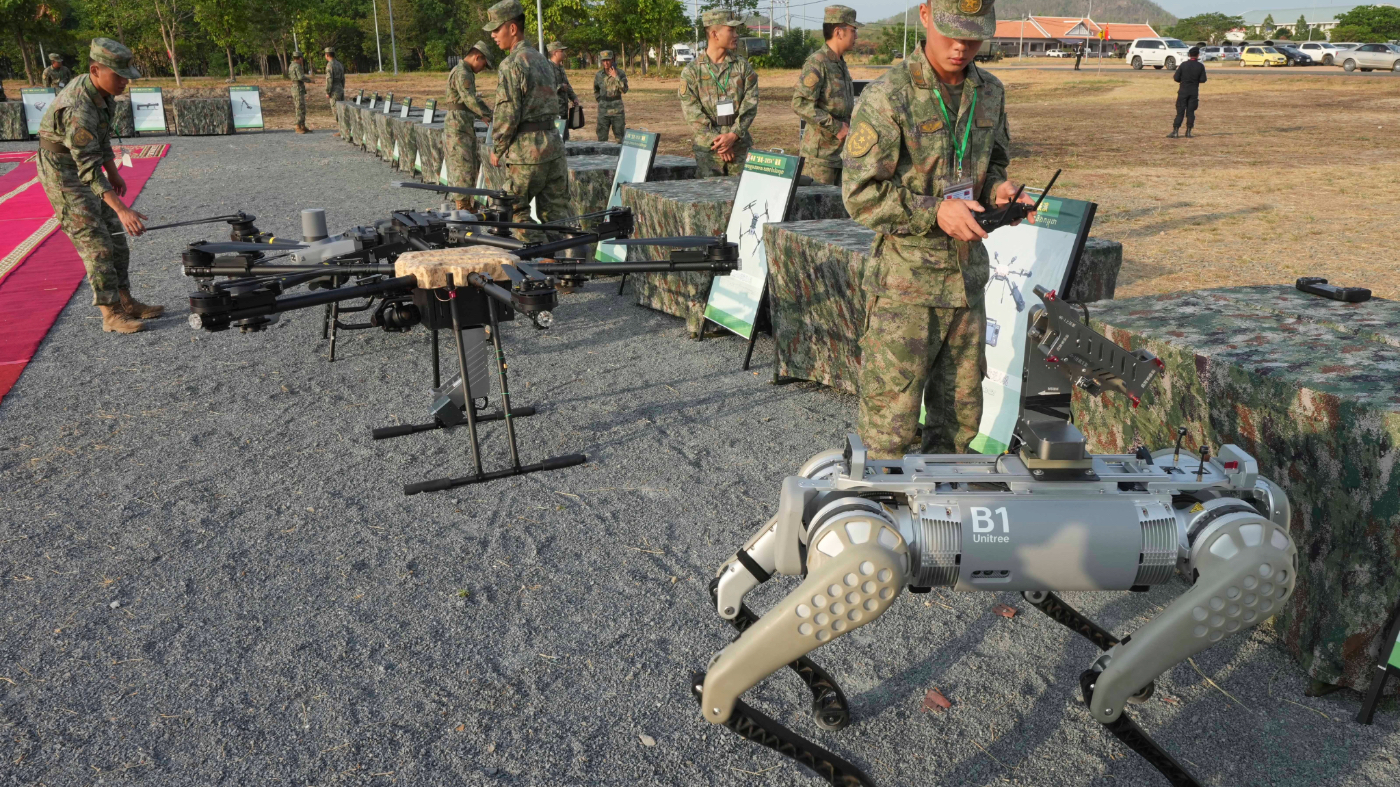
Last week, Salvadoran troops in Haiti conducted a military operation using robot dogs .
El Salvador’s President Nayib Bukele has not disclosed the robots’ manufacturer or their exact capabilities. However, artificial intelligence technology from the Chinese company Unitree , when used in conjunction with assault rifles, poses a potential danger to the civilian population. Such a development could effectively turn Haiti into a testing ground for Beijing’s warfare technology .
More than 270 non-governmental organizations across over 70 countries are promoting the Stop Killer Robots initiative, which seeks to ban — or at least regulate — autonomous systems. A machine should never have the power to decide whether a person lives or dies.
Artificial intelligence does not operate under ethical principles , and cannot distinguish between a child and a gang member, or between a weapon and a toy. Perhaps for this reason — and due to the inherent limitations and errors of AI — not many countries have deployed armed robotic dogs in actual combat against humans. They are usually implemented for exploration or rescue missions.
Communist China , which controls approximately 85 percent of the global production of AI-powered quadrupedal robots, conducted tests with armed units in Cambodia in 2024 and one simulating an invasion of Taiwan in 2025. Those were controlled exercises, not real-world conflicts involving actual human lives. In Haiti, the situation is entirely different.
In July , the Federal Communications Commission announced a ban on the importation of new humanoid and four-legged robots, citing concerns regarding cybersecurity and national security.
The Chinese government frequently subsidizes telecommunications and AI technologies, driving costs down to capture the global markets and boost technology, with both civil and military purposes.
Due to the challenges of robot technologies , armed robotic dogs in Haiti and other parts of the world could effectively become judge, jury and executioner. Transparency and temperance are required but currently are absent. Bukele’s propagandistic videos are not enough. No one knows whether the firing of weapons is controlled by the robot itself or by a human operator.
Haiti should not be a testing ground or a shooting range; it is a real-world setting involving real lives. It is a nation in crisis where gangs, self-defense groups, the United Nations, the Haitian military and police, international contractors, troops from El Salvador and civilians — all caught in the crossfire — operate. It serves as the most challenging and least regulated laboratory for testing AI-powered robots.
Haiti has welcomed Bukele’s soldiers with a mix of joy and anxiety. The man who succeeded in reducing homicide rates in what was once the most violent country in Latin America might also be able to save this failed Caribbean state — or so the hope goes.
Since late October, El Salvador has sent about 2,500 soldiers to Port-au-Prince to rescue four aviation technicians who were kidnapped by gangs. The operation received the green light from President Trump: “Do what you have to do.” However, Secretary of State Marco Rubio expressed a more cautious view, calling for strong coordination between the U.N. and Bukele’s soldiers to prevent a tragic incident of friendly fire or crossfire. Bukele has secured symbolic victories on the ground, but the primary battle is over control of the narrative.
In a matter of weeks, Bukele’s troops have recaptured the Sylvio Cator National Stadium — previously held by gangs since 2024. They have also struck the mansion headquarters of the 400 Mawozo gang. Mathias Saintil of the Boston gang has been eliminated . Wilson Joseph, the leader of 400 Mawozo, has appealed to the U.N. for help.
But while Bukele showcases his victories in Haiti on social media, no one is asking questions, providing answers, conducting investigations or raising concerns regarding the use of Chinese-made robots in Port-au-Prince.
Although the arrival of troops from El Salvador has generated hope and happiness among a desperate population, this Caribbean island must not become a testing ground for Chinese military technology. The end does not justify the means. Greater transparency and temperance are required to avert a larger tragedy.
Arturo McFields is an exiled journalist, former Nicaraguan ambassador to the Organization of American States, and a former member of the Norwegian Peace Corps. He is an alumnus of the National Defense University’s Security and Defense Seminar and the Harvard Leadership course.
Topics in this story
Gathered from external sources. Rights to this text belong to whoever originally published it.