Tiffany, Crowley tangle in only Wisconsin governor’s debate: 3 takeaways
Democrat David Crowley and Republican Tom Tiffany faced off in their first and only debate in the race to succeed retiring Wisconsin Gov. Tony Evers (D). Crowley, the Milwaukee County executive, and Tiffany, a House Republican, tangled on hot-button issues, including the 2020 election results and Democratic Socialists of America (DSA), in the debate hosted…
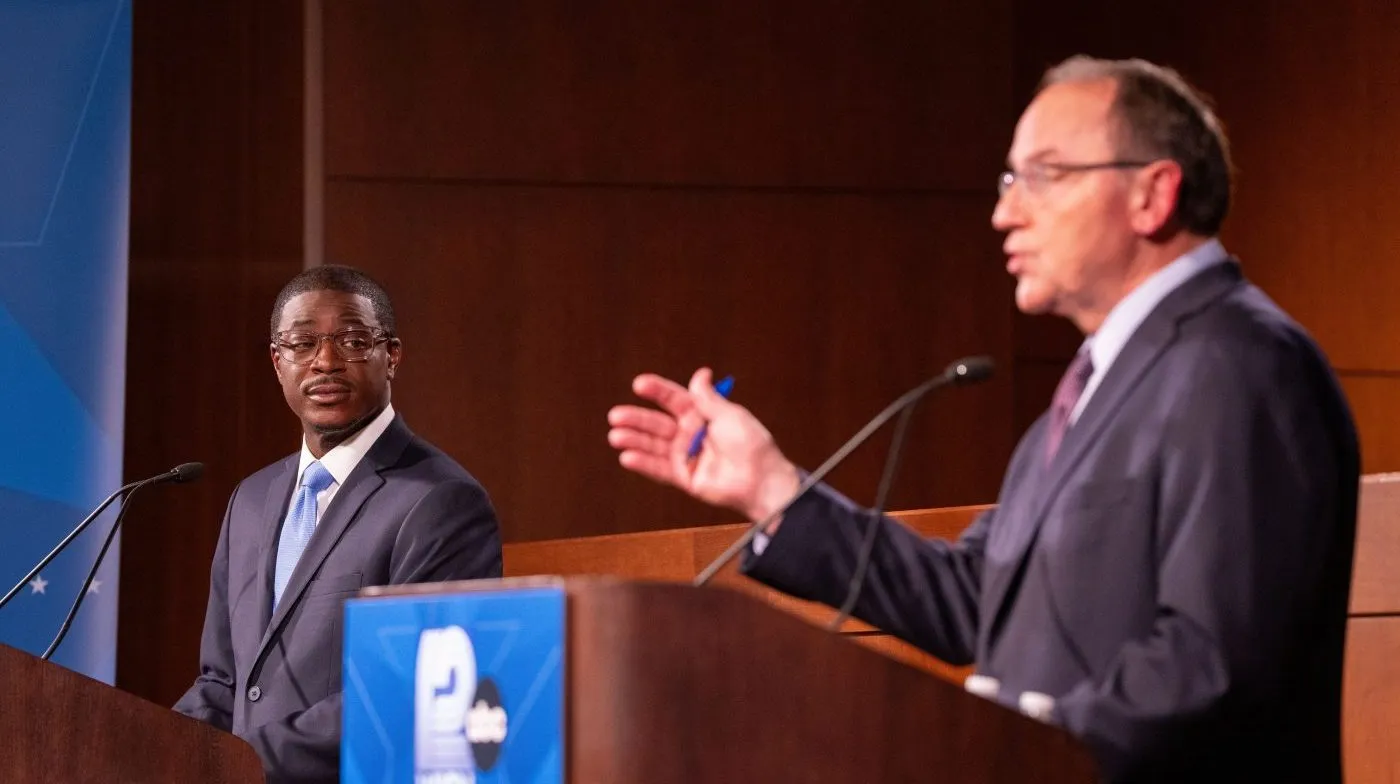
Democrat David Crowley and Republican Tom Tiffany faced off in their first and only debate in the race to succeed retiring Wisconsin Gov. Tony Evers (D).
Crowley, the Milwaukee County executive, and Tiffany, a House Republican, tangled on hot-button issues, including the 2020 election results and Democratic Socialists of America (DSA), in the debate hosted by WISN 12.
Recent public polling has been sparse, though earlier surveys have shown Crowley with a narrow lead. Nonpartisan election handicappers Cook Political Report and Inside Election have rated the race a “toss up,” while Decision Desk HQ rates it “lean Democrat.” Early voting began Tuesday.
Here’s three takeaways from the sole Wisconsin gubernatorial debate:
‘Zuckerbucks’ why Tiffany voted to overturn 2020 election
The congressman was pressed on why he voted against certifying the 2020 election — and he cited funds from Meta CEO Mark Zuckerburg
Tiffany initially sidestepped the question, seeking to shift focus to Crowley, but was pressed again and pointed to “Zuckerbucks.”
“We should not allow private money to go into what is a public process, our elections,” Tiffany said. “That’s why I objected because the people of the state of Wisconsin — they did not want that, and by the way, the people of the state of Wisconsin have voted to enshrine photo ID into our constitution.”
“Zuckerbucks” is a term that was coined by conservatives referring to funds that the Center for Tech and Civic Life issued as grants to localities to help facilitate the 2020 election during the pandemic, most of which came from Zuckerberg. Some have claimed the funds were used improperly and benefited Democrats.
Trump, who has endorsed Tiffany, has long claimed that the 2020 election was “stolen” and “rigged.” Nearly 150 Republican lawmakers — including Tiffany — voted against certifying elections in Pennsylvania and Arizona that year.
Election officials and multiple audits have shown there was no widespread fraud and that former President Biden won the election.
“We’ve always had free and fair elections. I believe in the integrity — that’s how I know that Donald Trump lost the race in 2020, and I can admit that while being on TV,” Crowley said.
Crowley ‘not familiar’ with DSA platform
Crowley sought distance from his Democratic primary opponent Francesca Hong — a DSA member — on Wednesday’s debate stage.
Over the summer, as Hong picked up steam in the polls, Crowely said that there weren’t “a lot of policies” they “differ” on, the Milwaukee Journal Sentinel reported at the time. But, on Wednesday, the Democrat struck a different tone.
“I’m not familiar with the DSA platform to be answering that question,” Crowley replied when asked about support for the group’s policy priorities.
Republicans have zeroed in on DSA on the campaign trail, seeking to cast Democrats as communists. Many Democrats in competitive or battleground states have distanced themselves from socialist candidates.
Both candidates appeared to moderate their stances on abortion — a key issue in the state after the Wisconsin Supreme Court ruled last year that the state’s 1849 abortion restrictions were not in effect after Roe v. Wade was overturned.
Tiffany was pressed several times on whether he would sign legislation that bans abortions after six weeks, referred to as “fetal heartbeat laws.” The congressman said he had previously supported the state’s 20-week abortion law when he was in the state legislature. He said he would “uphold it” if elected, telling moderators he would not sign a six-week abortion ban into law.
Crowley, meanwhile, dodged questions on whether he would sign legislation that allowed abortion with no gestational limits.
“These are decisions that need to be made between the patient and a healthcare provider. I don’t believe a law like that would ever actually reach my desk,” Crowley said.
Topics in this story
Gathered from external sources. Rights to this text belong to whoever originally published it.