Why Democrats are starting to feel bullish about a midterm wave
Democrats' wary optimism about the midterms gave way to growing confidence this week. The party has seen strong post-Labor Day polls in key battlegrounds - a...
Democrats' wary optimism about the midterms gave way to growing confidence this week.
The party has seen strong post-Labor Day polls in key battlegrounds - and even in traditionally red areas. Recent escalations in the war in Iran, including an attack on a major pipeline in Saudi Arabia, mean the rising gas prices bedeviling Republicans will not be going down anytime soon. Republicans have not been able to bring prices under control more generally. And President Donald Trump's unpopularity is at near-record levels.
Considering all this, Democrats now think conditions are right for the party to retake control of the House and possibly the Senate later this year.
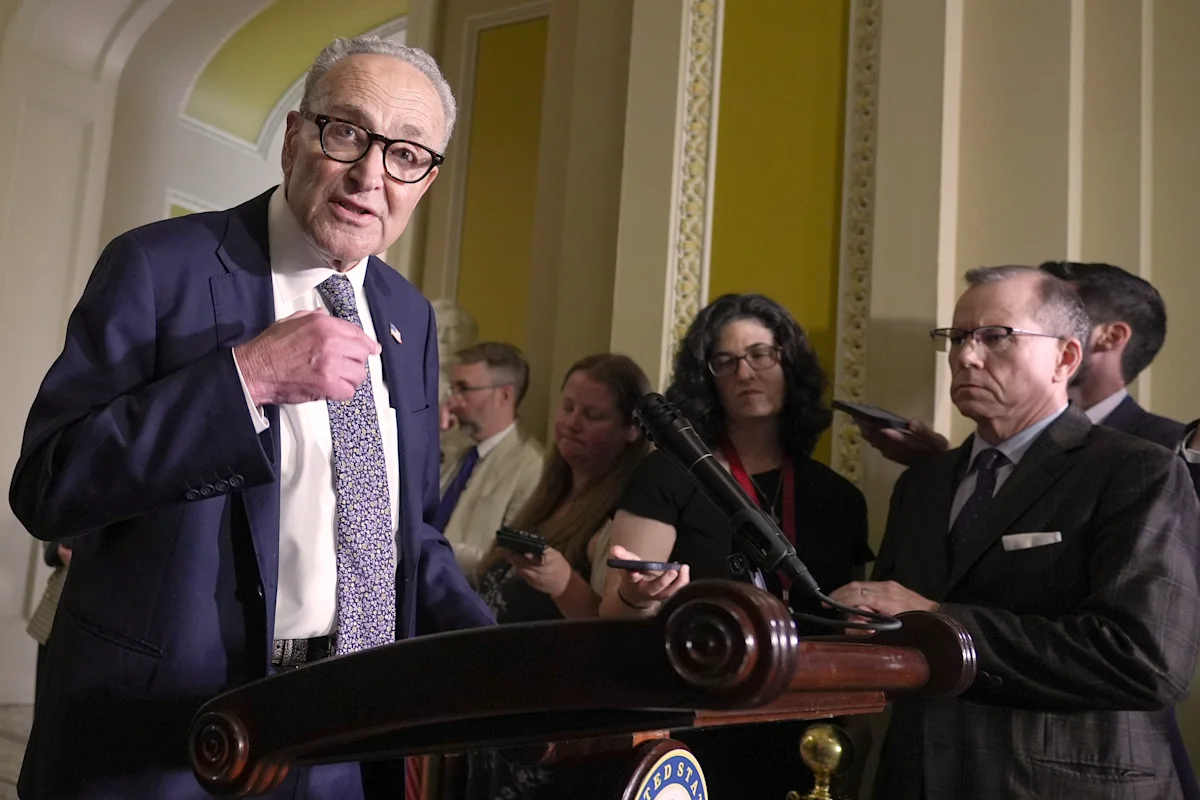
"If the election were held today, we would win the majority," Senate Minority Leader Chuck Schumer (New York) said in an interview with The Washington Post.
Schumer said he felt "considerably more bullish" about Democrats' chances of retaking the Senate than he did a few months ago. He described the environment as uncannily similar to 2006, when discontent with the war in Iraq helped Democrats recapture the Senate and the House.
House Minority Whip Katherine Clark (D-Massachusetts) said Democrats' recent momentum is driven by their focus on the economy, with voters believing that the party understands the financial pain they've felt in the years since Republicans swept into unified control.
"That is what is driving these polls," Clark told The Post on Thursday.
Democrats need at least four more seats to take the Senate majority and would have to win at least two in states Trump carried by double-digit margins in 2024. Republicans are seeking to blunt any Democratic gains by flipping Democratic-held open seats in Michigan and New Hampshire, where polls show competitive races. The nonpartisan Cook Political Report shifted its rating of the Senate contest in New Hampshire from "Lean Democrat" to "Toss Up" this week.
Republicans focused on keeping control of the House argue that they have a more favorable map, partly because a GOP redistricting effort has limited the number of battleground districts, and partly because they believe that Democratic primary voters nominated weak candidates in a handful of key races.
Then there is the incoming flood of GOP money.
Republicans are set to spend nearly $140 million more on ads than Democrats are in the nine most competitive races in the final weeks of the campaign, according to ad tracking firm AdImpact. The disparity is especially yawning in the Senate contest in Texas, where Republicans have reserved $39.6 million in ads and Democrats have reserved just $5.1 million.
On the House side, the National Republican Congressional Committee plans to run coordinated ads in 39 districts, with more than $24 million in ads reserved.
The Democratic Congressional Campaign Committee has plans for coordinated ads in 14 districts.
"The Republican campaign engines are firing on all cylinders, and we are burying House Democrats in battleground districts across the country," said Mike Marinella, spokesperson for House Republicans' campaign arm. "Republicans have the historic fundraising advantage, a more favorable map, stronger candidates, and the firepower to defy history and grow our House majority."
Schumer acknowledged Republicans' financial advantage but said it would not stop Democrats from retaking the Senate.
"We don't need as much money as them given the political climate, given the terrain," he said. "All we need is enough to stay in the ballpark and be able to answer them."
Republicans have begun to openly acknowledge electoral concerns in recent weeks, particularly with polls showing that Democrats are far more eager to vote than Republicans are.
Sen. John Kennedy (R-Louisiana) told reporters Thursday that he was going to Kansas, Nebraska and Iowa to raise money for GOP Senate candidates.
"If you told me six months ago I was going to be having to spend my time in those three states, I wouldn't have believed you. Those ought to be fat guy layups for us," he said, though he predicted Republicans would hold those seats.
"The far left, they're angry," Sen. Ted Cruz (R-Texas) said this week on the "Pod Force One" podcast, describing this as a "challenging environment" for his party. "They hate President Trump with a burning passion. And they're going to crawl over broken glass to vote."
Senate Majority Leader John Thune (R-South Dakota) acknowledged Wednesday that Republicans are facing "headwinds" but said the Senate races that will decide control of the chamber remain competitive.
"It's not a great environment for us," Thune said. "But we've got really quality candidates in all the competitive races, and the polling that we're seeing in those races shows that these races are tight."
Republicans have been debating how to increase enthusiasm beyond spending more money. Some, largely those closely tied to the president and his political operation, argue that the path to victory is to re-create the electorate Trump built in 2024. Other Republicans - primarily those in battleground districts where private and public polls show that voters are deeply upset with the president - believe the way to win is to distance themselves from the administration and its policies, a difficult task following a decade of Trump remaking the party in his own image.
"I'm asking you to pretend that I'm on the ballot," Trump said during one of two speeches he gave at the Republicans' midterm convention in Dallas recently. "Just one more time."
Trump has made it difficult for many candidates, especially those in tight races, to embrace this tactic. In large part, that's because he has repeatedly dismissed the issue that voters say is their main stressor: prices. His trade war has raised prices on goods across the country. And gas prices, which have shot up because of the president's war against Iran, are nearing $4.50 per gallon on average.
However, speaking at a campaign rally Wednesday in North Carolina, a state he has won in three straight presidential elections, Trump said high fuel prices were "a very inexpensive price to pay for what we have done" in Iran.
A Republican operative working on House races, speaking on the condition of anonymity to be candid, responded to Trump's comments with an animated image of actor Bryan Cranston screaming, "F---!"
The president has promised to get out the vote for Republican candidates, including those in trouble deep in Trump country. Some have taken him up on his offer, but not every candidate wants him around, and administration officials' visits to red states have been seen as warning signs for Republicans.
Vice President JD Vance traveled to Kansas this week to stump for Republican Sen. Roger Marshall, who is in a tighter-than-expected race against Democrat Adam Hamilton. Trump and Vance won Kansas by 16 percentage points in 2024.
Vance is also set to campaign in Iowa on Friday. But the state's Republican Senate nominee, Rep. Ashley Hinson, will not appear next to the vice president. A Hinson spokesperson cited previously scheduled events, but the absence comes as the candidate seeks to tout her bipartisan record in a state Trump won by 13 percentage points in 2024. Hinson is locked in a tight race against Democratic state Rep. Josh Turek.
And in South Florida, an area Trump dominated in 2024, Republican Rep. María Elvira Salazar openly broke with the president Thursday.
"Mr. President, some of your immigration enforcement efforts have gone too far," Salazar says directly to the camera in a new campaign ad. "The same Hispanics who helped you get to the White House in 2024 feel betrayed today."
Democrats say they began to see a change during what was supposed to be Republicans' hallmark 2026 event: the party's unorthodox midterm convention. The gathering was billed as a way for the GOP to showcase its front-line candidates, but instead it featured Trump defending his record and pledging to give each American adult a $5,000 check if Republicans hold Congress this year, a proposal many Democrats saw as a sign of desperation.
"We're not measuring the drapes, but the ground has shifted," said Xochitl Hinojosa, a longtime Democratic operative and top spokesperson at the Democratic National Committee after the 2016 election.
Some Democratic operatives running campaigns said they had been waiting to see whether Republicans would coalesce around a clear affordability message during the Texas event. But when it became obvious that the event would be a Trump-centric celebration that offered no direct case for why Republicans deserved unified control for two more years, their confidence grew.
"Turns out breaking all your campaign promises and doing everything possible to make life more expensive for everyone is bad politics," said Viet Shelton, spokesperson for House Democrats' campaign arm. "Shocker."
The last time Democrats experienced a wave election was in 2018, when the party swept into control of the House two years after Trump's first presidential win.
Meredith Kelly, a Democratic operative who was the top spokesperson at House Democrats' campaign arm at the time, said that there are plenty of similarities between that year and this one - primarily around Trump's unpopularity - but that the biggest difference is how Republicans' worries are coming from voters who helped them win in 2024, such as rural voters and Black and Latino men.
"Their coalition's floor is falling out from underneath them," said Kelly.
The prospect of a wave election has Democratic candidates in districts once thought entirely unreachable for the party feeling like they may have a shot to do the unexpected in November.
Eileen Laubacher, a retired Navy veteran running against GOP Rep. Lauren Boebert in a district that spans eastern Colorado, knows that her odds of winning have always been long. Trump won the district less than two years ago by 18 percentage points. But powered almost entirely by anger at Washington and voters' fears about their personal finances, Laubacher thinks she has an opportunity to take down her outspoken Republican opponent.
"People vote frequently about their pocketbooks and their wallets, but I think the situation is growing ever more fraught for people," said Laubacher. "Every aspect of their life has become more expensive, and they do not feel that the government is doing anything about any of it."
Jarrell Dillard contributed to this report.
Topics in this story
Gathered from external sources. Rights to this text belong to whoever originally published it.