Democrats see midterm gift in Trump embrace of data centers
House Democrats see President Trump’s embrace of data centers as a political gift, hoping the radioactive issue will help the party flip control of the chamber in November’s midterms. The topic has emerged as a late campaign juggernaut given the sheer proliferation of data centers in a great many communities around the country, which has…
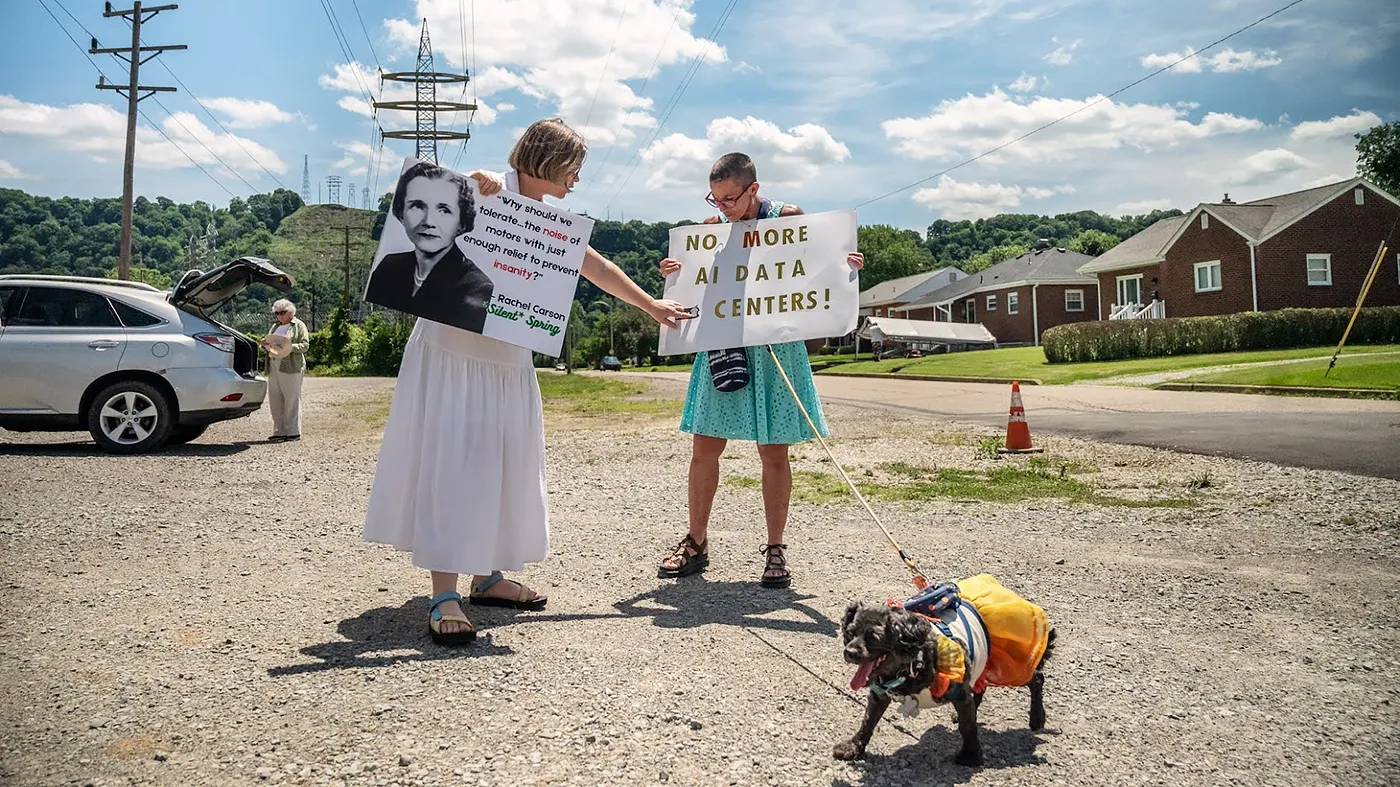
House Democrats see President Trump’s embrace of data centers as a political gift, hoping the radioactive issue will help the party flip control of the chamber in November’s midterms.
The topic has emerged as a late campaign juggernaut given the sheer proliferation of data centers in a great many communities around the country, which has sparked protests from residents of all stripes over the impact on electrical costs, water usage, land values and other local quality-of-life concerns.
Trump this week stirred a political storm when he bashed those protestors with a warning that they were relegating their communities to be forever “backwards and poor.”
Democrats see the remarks as a boon in an election cycle where an unpopular president, the rising cost of consumer goods and an unpopular war in Iran are already putting Republicans on the defensive as they fight to retain their fragile majority.
In states as diverse as Iowa, Michigan, Nevada, Pennsylvania and Nebraska, Democratic candidates — incumbents and challengers alike — are leaning on Trump’s aggressive promotion of data centers to portray Republicans as indifferent, or oblivious, to local anxieties. And top Democratic leaders are fueling the campaign from Capitol Hill.
“The president didn’t just say that data reigns supreme and that there should be data centers all over the place. He actually literally wrote that, if a community chooses not to have a data center, then they are ‘backwards and poor,’” Rep. Ted Lieu (Calif.), the vice chairman of the House Democratic Caucus, told reporters this week in Washington.
“He is straight up saying that you are backwards and poor,” he added. “November is coming.”
The controversy over data centers is hardly new on Capitol Hill. Last year, House GOP leaders caused an uproar when they barred local and state governments from regulating data centers as part of their Big, Beautiful Bill Act. The backlash caused the Senate to strip out the provision, which was absent from the legislation that became law.
But virtually every House Republican voted for the regulatory moratorium in the initial House-passed bill. And the final law also encourages the construction of new data centers by providing generous tax credits for the companies that build them.
With the AI boom driving data centers back into the headlines, those legislative details are resurfacing now, more than a year after the law was enacted, as Democrats race to remind voters that dozens of battleground Republicans supported the proposals.
“Every single House Republican, but one or two, voted to unleash data centers on the American people in an unfettered fashion. That’s facts right there,” said House Minority Leader Hakeem Jeffries (D-N.Y.).
“They can try to run away from their votes right now, we will not let them hide.”
In the wake of Trump’s remarks, Democrats are highlighting the issue in a host of battleground races, including in Michigan’s 7th District, where Democrat William Lawrence is challenging GOP Rep. Tom Barrett; in Nebraska’s 2nd District, where Democrat Denise Powell is invoking Trump’s remarks as she vies to replace outgoing Rep. Don Bacon (R); in Nevada’s 1st District, where Rep. Dina Titus (D) is facing a tough reelection against Republican Carrie Buck; and in Pennsylvania’s 7th District, where Republican Rep. Ryan Mackenzie faces a tough challenge from Democrat Bob Brooks, who is linking the GOP incumbent to Trump.
“Donald Trump just called Pennsylvania families ‘backwards and poor’ for asking reasonable questions about data centers in their own backyard,” Brooks wrote this week on X.
Republican leaders have defended their position, arguing that data center construction is crucial if the U.S. wants to win the global race for AI dominance. They also say the threat the facilities pose to local resources has been blown out of proportion.
“Data centers are a necessary thing if we’re going to keep our edge in AI over China,” House Speaker Mike Johnson (R-La.) told reporters this week, according to Punchbowl News .
“That said, [the] local concerns have to be addressed. Trust is earned. It’s not automatic,” he continued. “And in places like in my home state of Louisiana, where this has been done well, the companies who come in, they do right by the local community. They sign agreements for ratepayer protection pledges. They make a commitment. They’re going to put more power onto the grid than take it off. They’re not going to overuse water resources and all the rest.”
Numerous public opinion polls reveal that most Americans oppose new data centers, especially in their own communities. An Economist/YouGov survey released this month found that 63 percent of respondents — and 52 percent of Republicans — would reject such a local facility, while only 19 percent voiced support.
Such numbers have done nothing to dissuade Trump from aggressively promoting new data centers. On Monday, he blasted a social media post decrying those who would resist the construction of new facilities.
“The only reason that communities throughout the U.S.A. should not want Data Centers is if they want to end up being backwards and poor. If they want to be successful and rich, with far lower taxes and jobs all over the place, let Data Reign,” he wrote on his Truth Social account .
“If we kill the Golden Goose, you will only have yourselves to blame,” he continued. “China could not be happier with this anti Data Center movement.”
Speaking to reporters on Friday, Trump doubled down on that assessment, saying data centers are only a boon to local communities.
“If you want to get rich as a state or as a town, if you want to pay lower taxes, if you want to create tremendous wealth, if you want your house to be more valuable and everything else, you’re going to want a data center,” he said. “If you want to go through poverty, crime, and squalor, I would say don’t approve data centers.”
Still, many Republicans are taking their cues from the public backlash, rather than the president. Several vulnerable House Republicans, including Barrett in Michigan, have sponsored legislation designed to empower local communities in the decision-making process. Even In Texas, GOP Gov. Greg Abbott — who last year vowed that the state would be the “epicenter of AI development” — recently announced a “pause” on all new construction to allow state officials to evaluate the effects on local resources.
A GOP operative acknowledged that Trump’s promotion of data centers in the face of the backlash has put some Republicans in a tough spot. But the issue also allows vulnerable GOP candidates to demonstrate their independence from the president, if they choose to do so, the operative added.
“It’s fair to say that Trump coming out does cause some challenges for members,” the operative said Friday by phone.
“But in a unique way, it’s [potentially] helpful for them to push back on Trump sometimes. It depends on the member, if they’re willing to do so. But it’s kind of a unique way to flex their bipartisan muscle and say, ‘Hey, no. I think this should be decided on the local level.’”
Democrats aren’t buying it, arguing that the data center controversy — and the effect on local resources — is just another example of Trump’s preferred policies leading to higher costs.
“Donald Trump and Republicans continue to insult their own voters,” Jeffries said. “This is an affordability concern, broadly shared by the American people. And it should come as no surprise that Donald Trump once again is dismissive of this affordability issue.”
Topics in this story
Gathered from external sources. Rights to this text belong to whoever originally published it.