We all had Trump Derangement Syndrome
Author Jonathan Zimmerman argues that both Democrats and Republicans overemphasized Donald Trump’s influence during recent elections, leading to a significant Democratic sweep of the Senate, House and several governorships.
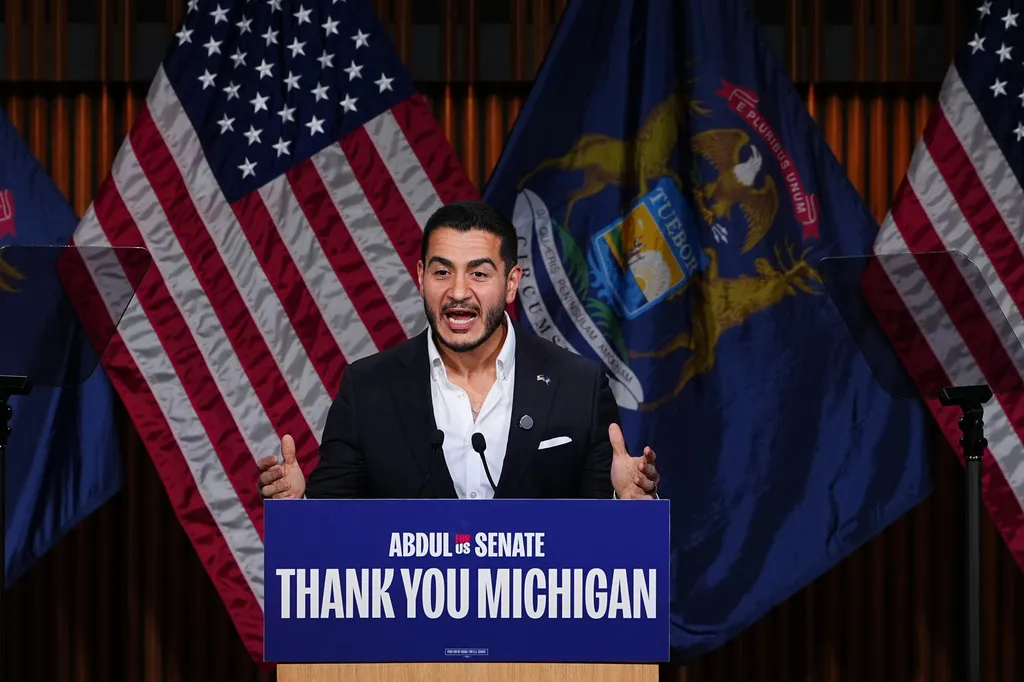
First off, nobody thought that the Democrats would score such an overwhelming victory . They flipped the Senate, the House, and five governor’s offices. And they won almost everywhere, including in longtime Republican strongholds like Texas and Kansas .
Sure, some people had predicted a Blue Wave . But this was a Blue Tsunami , and none of us saw it coming.
But more than that, we were wrong about You Know Who. Both parties radically exaggerated the power and influence of President Trump. Put simply, we were all suffering from a strain of Trump Derangement Syndrome — Republican shorthand for people who blame everything on Trump.
Sometimes, the shoe really does fit. The biggest reason for the Republican defeat was voters’ disdain for Trump. He encouraged them to pretend he was on the ballot , and that’s exactly what they did .
But don’t tell that to our reality-challenged president, who has never assumed blame for anything. “I don’t view it as a hit on me,” he told Fox News on Tuesday night, as the returns came in. “We’ve had the greatest two years in the history of the presidency.”
Yes, he really said that. And he was echoed by the soon-to-be-dethroned Speaker of the House, Mike Johnson (R-La.), who waxed on about Trump’s wonderful accomplishments. Democrats who deny them “truly do have Trump Derangement Syndrome,” Johnson said .
You know who truly has Trump Derangement Syndrome? Mike Johnson. He is so addled by it that he can’t see what Trump just did to his own party.
To be fair, not all Republicans were victims of TDS. As one Republican operative said , Trump “was ignoring what the voters were caring about” — affordability, jobs and healthcare. Trump seemed to care only about the Reflecting Pool in Washington and Jon Husted’s backside . And that’s on him, no matter what he says.
But my fellow Democrats had their own version of Trump Derangement Syndrome, which imagined him as a fascist poised to destroy democracy. And I’ll admit it: I was infected by the same virus. I worried that he would try to overturn the elections, just as he did when he lost the White House in 2020.
And I had new reasons to be concerned. Trump spent much of the last year sowing doubt about election security with further false claims about the 2020 race. And on Election Day, White House officials posted messages threatening to arrest noncitizens who tried to vote.
But federal immigration agents did not swarm voting sites , as many of us had feared. And, most of all, Trump said he was “absolutely willing” to accept the results of Tuesday’s election.
So I was wrong about that. And so were the Democrats who thought Trump’s prior victories signaled the demise of the American experiment . Conceived in liberty and hope, the argument went, the nation had descended into rancor and hate. We were irredeemably racist, sexist and homophobic. We lost our way, as a republic, and there was no way back.
That’s another form of TDS. And I hope this week’s results can cure us of it.
To be sure, Trump and his disciples engaged in plenty of hateful rhetoric during the elections. Trump repeatedly called Michigan Senate candidate Abdul El-Sayed a “jihadist,” and Vice-President JD Vance suggested that Texas candidate James Talarico was gay and “obsessed” with transgender children.
And guess what? El-Sayed and Talarico both scored resounding wins. The hatred was there, but it fell mostly on deaf ears.
Talarico’s signature catchphrase was “Love Thy Neighbor,” a direct challenge to Trump’s politics of division and disdain. And it worked. We are better than the Democratic doom-scrollers thought we were.
And if you think otherwise, listen to the Republican mayor of Oklahoma City. A former member of the George W. Bush administration, David Holt wrote that his party had become “morally and intellectually bankrupt” by hitching its wagon to Trump. But there was hope on the horizon.
“It’s time to make America good again,” Holt declared.
It was always good. We just lost faith in it for a while, because Trump deranged us. I’m glad the fever has broken.
Jonathan Zimmerman teaches history and education at the University of Pennsylvania and serves on the advisory board of the Albert Lepage Center for History in the Public Interest. He is the author of “Schooling Citizens: How Education Can Save Our Democracy,” which will be published next spring by the American Philosophical Society Press.
Topics in this story
Gathered from external sources. Rights to this text belong to whoever originally published it.