This week on the Hill: Senate eyes final passage on college sports bill
With the House out of session for the final two weeks of September, the legislative spotlight is squarely on the Senate, where lawmakers face a packed stretch of work on several of the GOP’s remaining priorities. On top of their agenda is legislation that would create national rules for compensating college athletes, limiting transfers and…
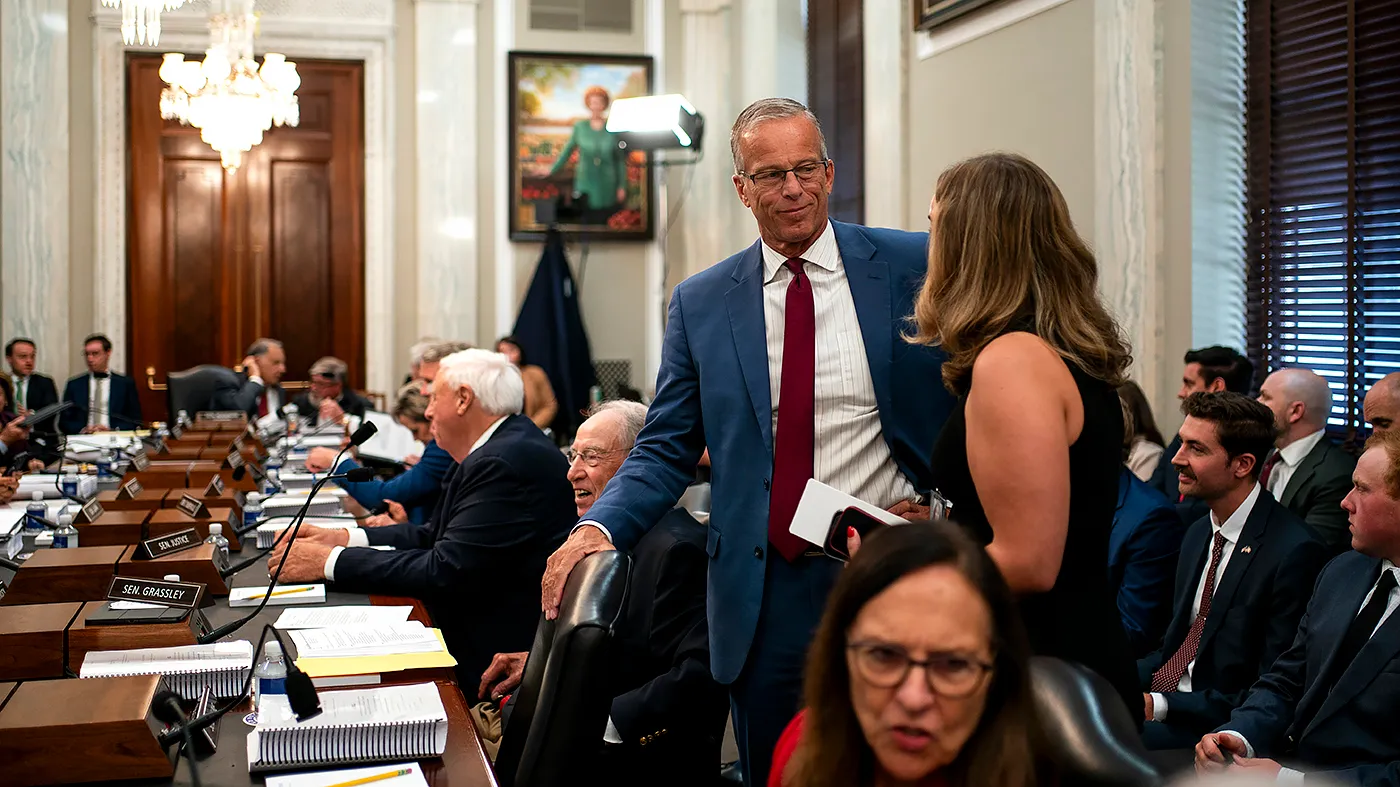
With the House out of session for the final two weeks of September, the legislative spotlight is squarely on the Senate, where lawmakers face a packed stretch of work on several of the GOP’s remaining priorities.
On top of their agenda is legislation that would create national rules for compensating college athletes, limiting transfers and midseason coaching moves, and setting a five-year window for athletic eligibility, among other reforms.
The upper chamber is targeting a final vote on the bill — dubbed the Protect College Sports Act — this week. President Trump said in a Truth Social post last week that the bill was “vital to future Sports in America.”
“Great news on NIL [name, image and likeness], in other words, straightening out the horrible situation taking place with respect to College Sports. It is out of control, and will lead to bankruptcies and disaster for many Colleges. If nothing is done, it is also very bad for Women’s Sports, all Olympic Sports, and everything else other than Football — But even Football is bad because, without ‘caps,’ all Colleges will be financially consumed and, in many cases, it will ruin them,” Trump wrote .
“We can’t have Professional Athletes going back to College for Big Dollars, and playing against much younger competitors. It’s both dangerous and unfair!” he added.
Senate to take up college sports bill: The legislation is expected to receive support from Senate Democrats to get it across the finish line.
Ratepayer Protection Act at a standstill: A Senate Democrat from New Mexico blocked the bill, aimed at lowering the impact of data centers, last week.
Nomination hearing on Heidi Overton: The Senate Committee on Health, Education, Labor and Pensions (HELP) will hold a hearing on Overton, Trump’s pick to be the commissioner of food and drugs, on Thursday.
Senate targets final vote on Protect College Sports Act
The Protect College Sports Act would protect the NCAA — the college athletics governing body — from antitrust lawsuits, establish caps on revenue sharing and allow schools to have retention funds for star players.
It also requires agents to register with a state before representing student-athletes and caps their fees at 5 percent. It guarantees scholarships for 10 years after eligibility so athletes can complete their degrees after their playing days. It requires Division I schools to provide medical coverage while athletes are participating in sports.
The Senate voted 74-24 to advance the legislation last week, despite the opposition from the NAACP, the AFL-CIO and its sports council, and the Congressional Black Caucus (CBC).
The CBC wrote in a letter to Senate Commerce Committee Chair Ted Cruz (R-Texas) and ranking member Sen. Maria Cantwell (D-Wash.) that “for generations, Black athletes have helped build college athletics into one of the most powerful and profitable industries in American life.”
They added that the caucus “believes institutions that profit from Black talent and Black communities have a responsibility to stand with those communities when their fundamental rights are under attack,” the group wrote. “Silence in the face of injustice is not neutrality—it is complicity.”
But Cruz argued in remarks on the Senate floor before the procedural vote last week that “college sports today are in crisis.”
“For years court decisions, litigation, conflicting state laws, unlimited transfers, eligibility issues and inconsistent enforcement has chipped away at the foundation of college athletics. The result is what we’re seeing right now, the Wild West,” he said.
Cantwell said in remarks on the Senate floor that she wants these rules put in place “because sports is about any given Saturday.”
“It is not about whether you have a billionaire in your backyard. It is about whether you can coach and recruit and develop and maintain and have academic performance and have fairness … and have everybody compete and keep the ecosystem in place. But that fairness does not exist today without this bill,” she added.
Senate stuck on Ratepayer Protection Act
Sen. Martin Heinrich (D-N.M.) last week blocked Sen. Jon Husted’s (R-Ohio) effort to unanimously pass the Ratepayer Protection Act, a bill aimed at mitigating the impact of data centers on Americans’ electric bills.
It is unclear when the upper chamber will take up the bill next. However, Husted said in remarks on the Senate floor last week that he “will be back to push this issue forward.”
“We have a bipartisan opportunity to get this done. We should do it immediately,” Husted said.
The legislation requires states to consider taking up standards that would force tech companies to shoulder the electricity cost increases associated with large data centers but doesn’t actually require states to regulate them.
The House passed the bill 417-3 last week under a fast-track process known as suspension of the rules. The bill’s supporters describe it as a solid push that could ultimately spur state-level action to protect consumers.
“The Ratepayer Protection Act helps to safeguard these benefits by ensuring that the companies who are building data centers — and not American families and small businesses — are paying for the electricity they use,” Rep. Brett Guthrie (R-Ky.) said in a statement. “U.S. leadership in the race to AI dominance is critical to our economic prosperity and national security, so we need to keep building the needed infrastructure with appropriate accountability measures.”
Critics, however, have argued that it is toothless and may not spur significant changes at a time when AI data centers threaten to drive up electricity costs and destabilize the grid. Heinrich, for one, has said the bill doesn’t go far enough in addressing the issue at hand.
Senate to hold nomination hearing for Overton
The Senate HELP Committee is expected to hold a nomination hearing for Overton — Trump’s pick to be his new Food and Drug Administration (FDA) commissioner — on Thursday.
Overton, a physician, is a top White House domestic policy adviser on health issues. If confirmed, she would take over an agency roiled by an exodus of top staff and viewed by many in the healthcare industry as less trustworthy and more politicized than it has been in any previous administration.
Overton is a major proponent of Health and Human Services Secretary Robert F. Kennedy Jr.’s “Make America Healthy Again” movement. She stood with Trump when he announced an executive order last month to reduce and separate the childhood vaccine schedule.
She previously served as vice chair and chief policy officer of the America First Policy Institute, a conservative think tank founded by Agriculture Secretary Brooke Rollins.
Trump had tapped Overton for the position in August, after the resignation of Marty Makary, his first FDA commissioner.
“Dr. Heidi has been a ROCKSTAR in my Administration,” Trump wrote in a Truth Social post then. “We need her leadership at the FDA now to ensure that the U.S. remains the WORLD LEADER for Scientific Discovery and CURES.”
Rachel Frazin, Nathaniel Weixel and Alexander Bolton contributed.
Topics in this story
Gathered from external sources. Rights to this text belong to whoever originally published it.