From 'remigration' to home-schooling: what does Germany's AfD want?
The Alternative for Germany (AfD) was founded in response to the euro crisis, but its focus has shifted firmly to the far right. A stridently hardline anti-i...
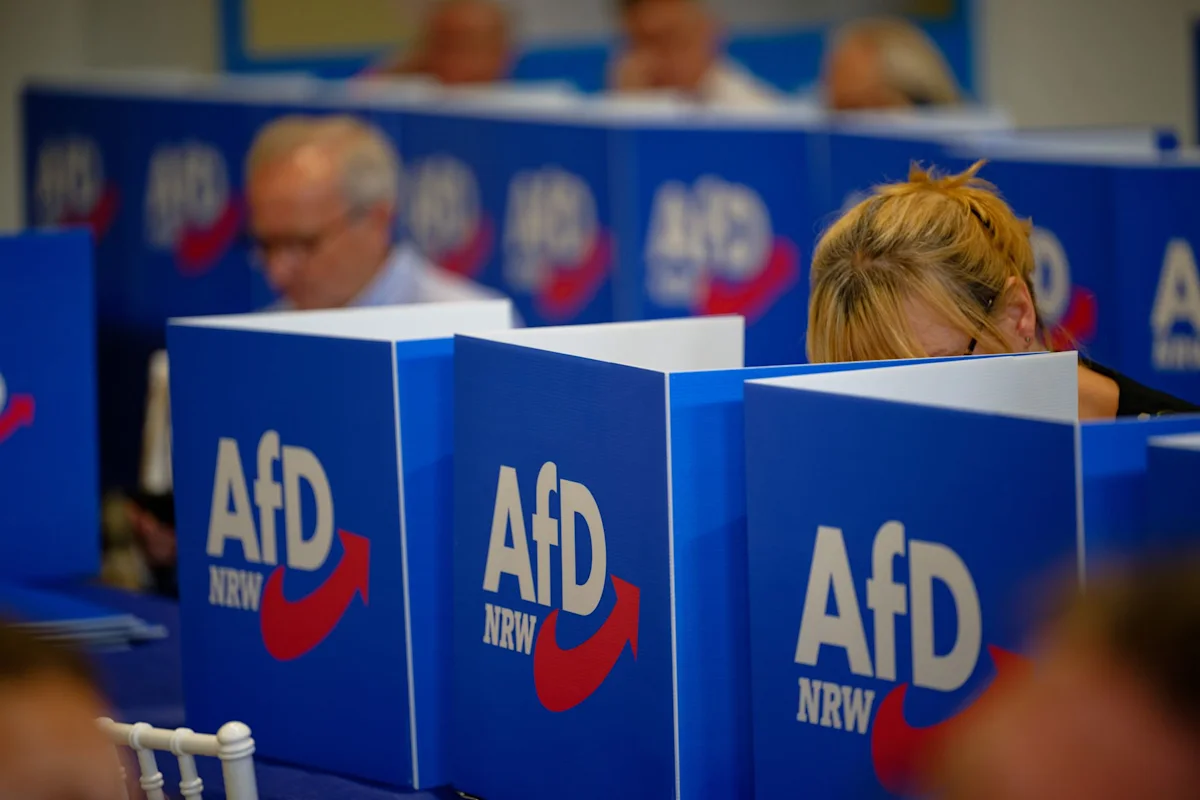
The Alternative for Germany (AfD) was founded in response to the euro crisis but has shifted its focus to the far right, with a stridently hardline anti-immigration stance as its signature issue.
The AfD in Saxony-Anhalt is polling above 40% ahead of an election, with plans to introduce segregated classes for asylum-seekers' children, ban rainbow flags in schools, and cancel contracts with regional public broadcaster MDR among other controversial proposals.
The party's manifesto also includes commitments to allow home-schooling, block wind turbine construction, and set up a task force to speed up deportations, with potential tensions arising from its explicit backing of family structures based on marriage between a man and a woman.
The Alternative for Germany (AfD) was founded in response to the euro crisis, but its focus has shifted firmly to the far right.
A stridently hardline anti-immigration stance, developed during the European migration crisis of 2015-16, is now the party's signature issue.
The AfD is seen to have profited from years of concern among many German voters over the huge numbers of refugees seeking asylum in the country from war-torn countries such as Syria and Ukraine.
Its manifesto at the last national election called for controls at the country's borders and "remigration," a term used in far-right circles to refer to the forced resettlement of certain immigrants.
Founded by eurosceptics in 2013, the party is highly critical of the European Union and believes in having nationalist pride in German history and culture. But the party did not explicitly call for withdrawal from the bloc in its 2025 Bundestag election manifesto.
On Russia, the AfD's position is widely seen as more pro-Kremlin than any mainstream party. The party has criticized the sanctions that have been imposed on Moscow for its war against Ukraine, calling for renewed purchases of Russian gas and an end to arms supplies to Kiev.
Like many parties, the AfD is not uniform and has various factions. The firebrand regional leader of the AfD in the eastern state of Thuringia, Björn Höcke, has been convicted for using a banned Nazi slogan.
In neighbouring Saxony-Anhalt, the party's lead candidate Siegmund strikes a more moderate tone, but its manifesto is highly controversial.
Ahead of Sunday's election, the AfD is polling above 40% and hoping to take control of a German state government for the first time in its history.
The party has outlined a 10-point plan of priorities for its first 100 days in office, committing to introduce segregated classes for the children of asylum-seekers, ban rainbow flags in schools, cancel contracts with regional public broadcaster MDR, cut a state ministry and set up a commission to investigate the response to the coronavirus pandemic.
Other commitments include allowing children to be home-schooled, blocking the construction of wind turbines, and setting up a task force to speed up deportations.
The Saxony-Anhalt manifesto also explicitly backs family structures based on marriage between a man and a woman, exposing tensions between the state and national party, whose co-leader Alice Weidel is in a same-sex relationship.
The AfD's policies would have a real impact on the daily lives of the state's 2.1 million residents, but how many of them can actually be achieved in the face of likely opposition in the courts and the federal government remains to be seen.
In Germany's federal system, state governments wield significant powers over health care, education, cultural affairs and media, while the national government in Berlin retains exclusive power over foreign affairs, defence, federal taxes and, crucially, immigration.
Topics in this story
Gathered from external sources. Rights to this text belong to whoever originally published it.