Trump is using antisemitism claims as a pretext for a cash-grab
The contrived charges have obscured the very real incidents of antisemitism that have occurred on campuses and elsewhere.
The Trump administration corrupts almost everything it touches. Even seemingly commendable efforts to address very real social issues have turned out to be underhanded schemes to extract money from vulnerable institutions.
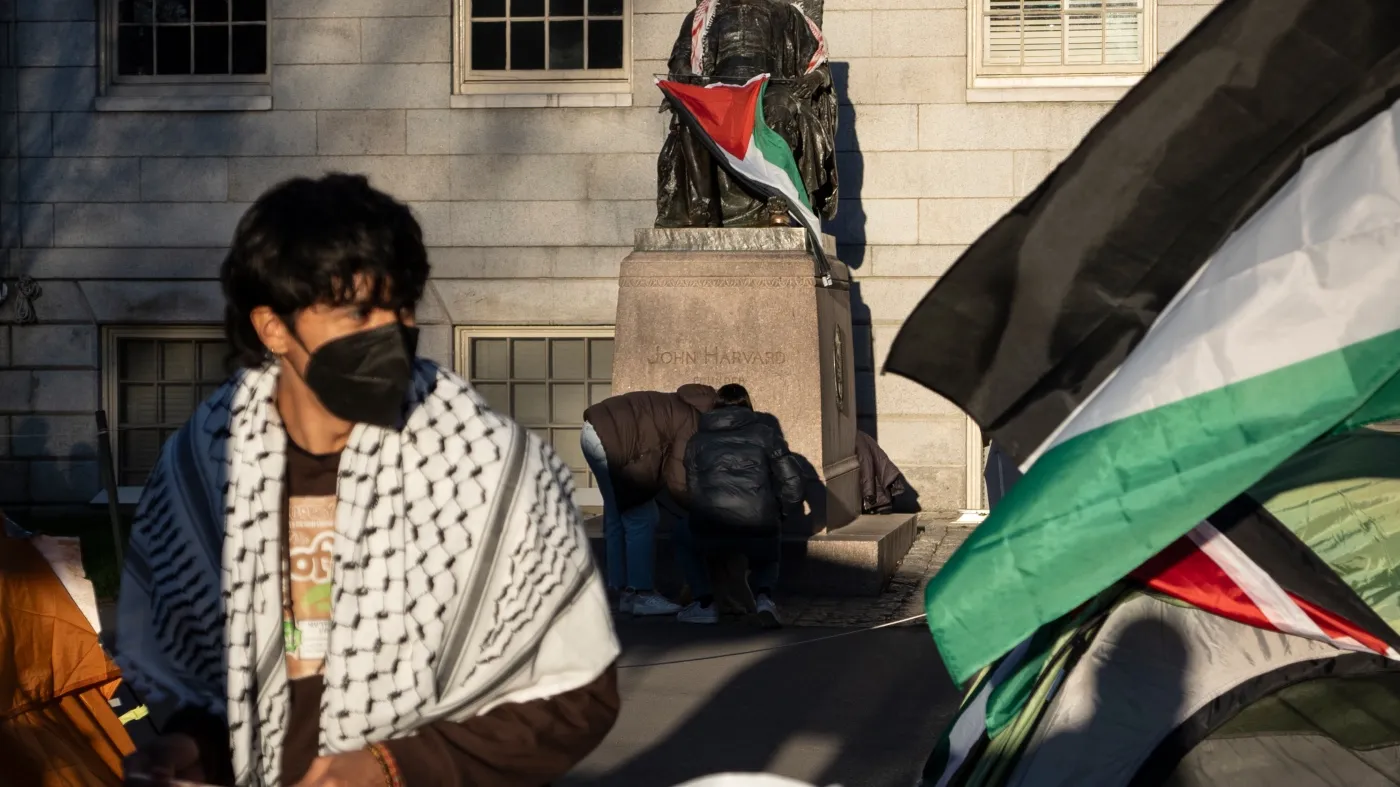
So it has been with the campaign against antisemitism on university campuses, as executed by a Task Force to Combat Anti-Semitism under the Department of Justice and the Department of Health and Human Services. Largely focused on the pro-Palestine encampments set up in protest of Israel’s Gaza war, the administration’s accusations of pervasive antisemitism have been exposed as seriously exaggerated.
That is doubly unfortunate, because the contrived charges have obscured the very real incidents of antisemitism that have occurred on campuses and elsewhere.
In early 2025, Trump’s task force launched an investigation , under Title VI of the Civil Rights Act, into alleged “antisemitic discrimination and harassment” at 60 colleges and universities, claiming that Jewish students “continue to fear for their safety amid the relentless antisemitic eruptions that have severely disrupted campus life.”
Prominent Ivy League universities were among the top targets, including Harvard, Columbia and Brown. Although based on actual incidents, the charges were overblown to say the least. They eventually fell apart almost completely, falling short of the prevalence and severity required by Title VI.
A former Justice Department attorney assigned to the task force recently submitted a whistleblower disclosure to Congress, asserting that the investigation had been a ruse to extort money from the universities.
According to the disclosure , the investigations had been “marked by extraordinary procedural irregularities, predetermined outcomes without factual or legal support, and disregard for Title VI’s legal requirements and the First Amendment,” all in a “politically mandated effort to disgorge enormous amounts of money from the universities.”
Despite the lack of evidence for pervasive discrimination, the Trump administration froze hundreds of millions in federal grants at targeted universities. Columbia and Brown eventually agreed to pay a total of $270 million to settle the administration’s claims of antisemitism and obtain the release of federal funding. Northwestern, where I am an emeritus professor, paid $75 million to settle antisemitism and other claims under similar terms.
Harvard refused to settle, leading to an enforcement action under Title VI, and a federal judge, dismissed the government’s case . Acknowledging the seriousness of cited antisemitic incidents, which included the storming of an event featuring an Israeli speaker, the court found them “singly and collectively, to be too isolated and episodic to support a plausible inference” of widespread discrimination.
Neither the court nor the whistleblower disclosure questioned the gravity of antisemitism on campuses. Rather, they concluded that the instances were not sufficiently extreme to meet the high threshold for enforcement actions under Title VI.
In a more honorable administration, the result of the investigations would most likely have been a descriptive report, outlining the actual occurrences of anti-Jewish rhetoric and conduct, while refraining from extortion in the guise of civil rights enforcement. Sadly but predictably, the administration’s overheated accusations have caused true antisemitic incidents at Gaza encampments to be discounted or denied.
What should have been an educational opportunity, addressing the moral distinction between political advocacy and threatening rhetoric, was lost once the Trump administration’s bullying entered the picture.
None of this absolves students who thoughtlessly joined antisemitic chants, such as “Globalize the Intifada,” which, although covered by the First Amendment, is no less offensive. Whatever the professed rationale of the protesters, the slogan is widely understood by Israelis and most Jews as an endorsement of indiscriminate violence against Jewish people and institutions around the world, irrespective of any connection to Israel or Zionism.
In Manchester , England, a driver globalized the Intifada by ramming his car into a synagogue on Yom Kippur, then stabbing two congregants to death. In Sydney , Australia, a father and son globalized the Intifada by massacring 15 people, and wounding dozens, on Bondi Beach at a “Hanukkah by the Sea” celebration. In Mumbai , gunmen from Lashkar-e-Taiba globalized the Intifada by invading a Jewish community center and murdering its rabbi and his wife.
Other such attacks are too numerous to list, occurring in Paris , Jersey City, Brussels , Monsey , New York, and Colleyville , Texas, among other locations.
Given that context, it ought to be possible to have a reasoned discussion of the chants and posters, explaining why “Globalizing the Intifada” has an effect on many Jews, regardless of intent — not unlike the Confederate Flag for African Americans. At least some Gaza protesters might choose a less threatening slogan.
Alas, we do not live in that world. Trump’s cynical use of antisemitism as a bludgeon against universities has, for many, made reasoned distinctions impossible. And everyone suffers.
Steven Lubet is the Williams Memorial Professor Emeritus at the Northwestern University Pritzker School of Law.
Topics in this story
Gathered from external sources. Rights to this text belong to whoever originally published it.