On the Ballot: Markey-Moulton match-up underlines competing visions for change in Democratic Party
Rep. Seth Moulton and Sen. Ed Markey are squaring off for Massachusetts’s Democratic Senate nod next week in the latest primary to spotlight young challengers vying to push out the party’s old guard. Moulton, a 47-year-old who’s been in the House for six terms, is mounting a long-shot bid to unseat Markey, who at 80 has served on Capitol Hill for…
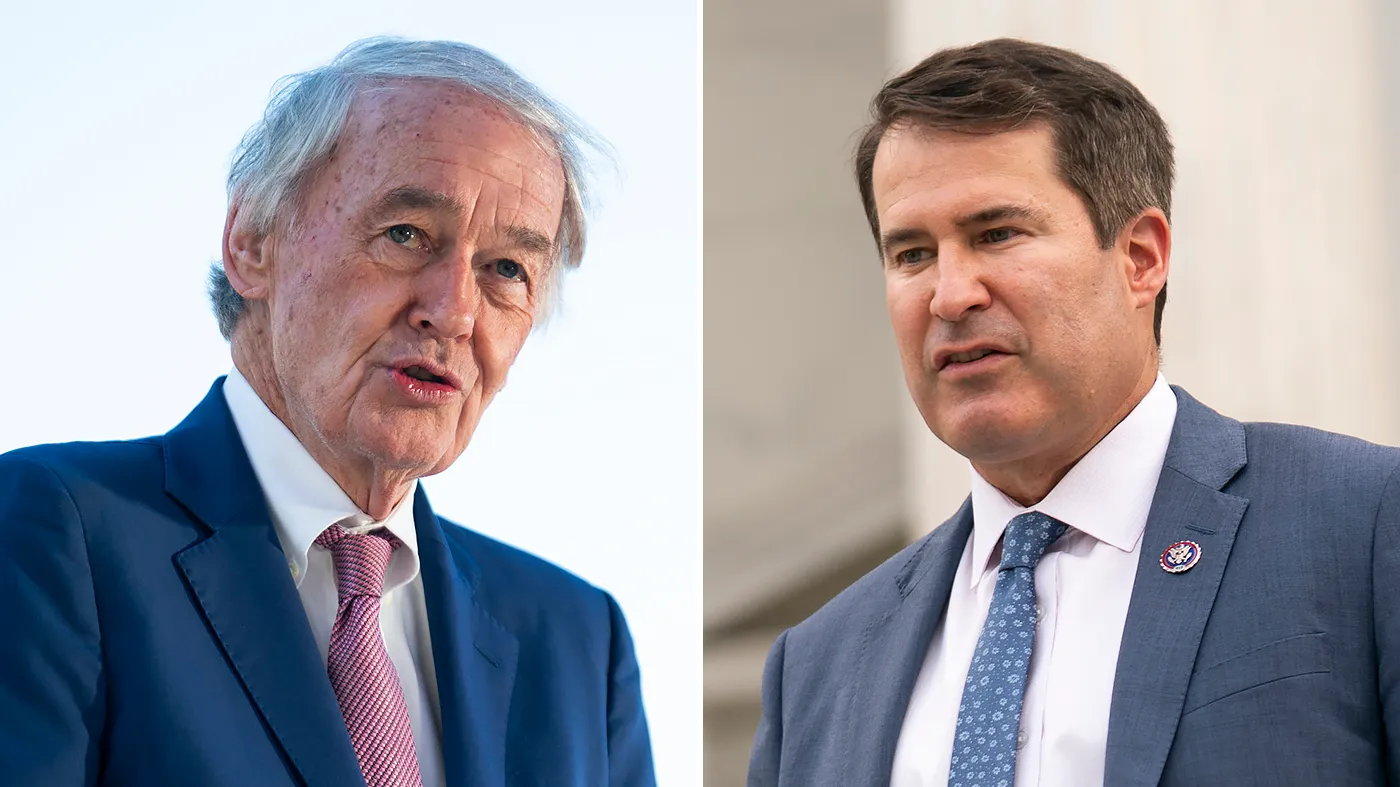
Rep. Seth Moulton and Sen. Ed Markey are squaring off for Massachusetts’s Democratic Senate nod next week in the latest primary to spotlight young challengers vying to push out the party’s old guard.
Moulton, a 47-year-old who’s been in the House for six terms, is mounting a long-shot bid to unseat Markey, who at 80 has served on Capitol Hill for five decades, including 20 terms in the House.
The younger challenger has framed the race around generational change and questioned Markey’s progressive bona fides, while the incumbent has touted his long record in Congress, his progressive ethos and support from juggernauts like Sen. Bernie Sanders (I-Vt.).
The campaigns offer dueling visions of “what constitutes change,” according to Jesse Rhodes , a political science professor at the University of Massachusetts Amherst and co-director of the UMass Poll.
“There’s the symbolism around age and a shift to a new generation, and that is, for Moulton and his supporters, the key dimension of change that they envision,” Rhodes added.
“But I think Markey and his supporters have countered with the argument that what really is needed is a vigorous progressive Democratic Party,” he continued.
Markey maintains the edge in polling ahead of Tuesday’s primary, but momentum has nevertheless built around Moulton in what’s one of this primary season’s last major tests of Democratic appetite for younger Senate hopefuls.
Moulton has made the generational conversation a key part of his campaign since launching his challenge last year — in a cycle marked by the passing of multiple Capitol Hill Democrats in office, renewed talk of age and term limits , as well as the fallout from former President Biden’s decision to end his 2024 campaign amid age and health concerns .
“I’m running against the senator’s decision after 50 years in Washington, to run for another term at age 80,” the congressman said in a final debate last week, where he voiced support for age limits in Congress. “I believe in a new generation of leadership. I believe we can do better than the status quo.”
The Boston Globe endorsed Moulton over Markey last week, suggesting that the younger candidate “can bring new vision and vigor to an aging, ailing, and deeply unpopular Democratic Party.”
Markey, though, argued at the recent debate that it’s Moulton who has had “a hard time keeping up” with the incumbent on the campaign trail, pledging that he’s “more energized than ever before.”
Rep. Alexandria Ocasio-Cortez (D-N.Y.) backed Markey last week, lauding the incumbent’s record.
The primary is one of several this cycle in which younger challengers have taken aim at longtime lawmakers. But in many of the races, the challengers were also running clearly to the left of the incumbents.
Democratic Reps. Diana DeGette (Colo.), Shri Thanedar (Mich.) and Adriano Espaillat (N.Y.) — aged 69, 71 and 71, respectively — all lost to younger challengers backed by the Democratic Socialists of America (DSA). Colorado’s Melat Kiros , Michigan’s Donavan McKinney and New York’s Darializa Avila Chevalie r are 29, 34 and 32, respectively.
In the Massachusetts race, it’s the longtime incumbent who’s rallied progressive support, while his challenger is seen as more moderate.
“The Markey-Moulton primary is a little bit of an outlier, because the positions are kind of reversed in interesting ways: that the challenger Moulton is younger, but he’s also more moderate,” said Rhodes.
But Jennifer Holdsworth , a former Moulton adviser and Democratic strategist, pushed back against the popular framing of the race, calling it “unfortunate tribalism” and arguing that Moulton has called for a number of “very progressive” platforms.
“It’s not easy to place him in an ideological clan of the party, and I think that’s actually what voters are looking for moving forward. They’re tired of the left, right, center debate. Voters themselves don’t see themselves that way,” Holdsworth said of Moulton.
“It really is a question about whether someone in their 80s is simply too old to weigh in on the biggest policy debates of our time,” she added, pointing to the rivals’ debate stage clash over AI last week.
With just days to go before the Markey-Moulton showdown, UMass polling last week found the incumbent was backed by more than 4 in 5 likely Democratic primary voters, signaling that Markey’s age “may actually be advantageous” to the incumbent as voters labeled him progressive, experienced and trustworthy.
“In general, we just need to be attentive to, I think, two interrelated but distinct battles in the Democratic Party. One is about incumbency and ossification and just getting too cozy in office, but the other is about the kind of ideological soul of the Democratic Party and where it’s going to go,” Rhodes said.
He pointed to Sanders, who at 84 is the second-oldest senator, behind only 92-year-old Sen. Chuck Grassley (R-Iowa). He’s served in the Senate for 20 years and will finish his current term in 2031, at age 89 — but as one of the leading progressives on Capitol Hill, he hasn’t faced significant calls to step aside.
“Is Bernie an example of the past that needs to go, or is he a forerunner of the future where the Democratic Party is going to be leaning in as we go forward?” Rhodes said.
Another unique contour in the race is that, while Markey has served in Washington for 50 years, Moulton has already put in a decade in the House.
“While undoubtedly experience matters, the question is: what kind of experience?” Holdsworth said.
Regardless, Markey remains in a strong position to retain his Senate seat for another six-year term. He faced a strong challenge from former Rep. Joe Kennedy III (D-Mass.) in 2020 but defeated his rival by roughly 10 percentage points in the primary, marking the first time a Kennedy family member lost a statewide race in Massachusetts.
The marquee Senate race is not the only race in the Bay State with age on the ballot. Thirty-nine-year-old lawyer Patrick Roath , backed by David Hogg’s Leaders We Deserve, is challenging 71-year-old Rep. Stephen Lynch (D-Mass.) in the Democratic primary for Massachussett’s safely blue 8th Congressional District.
Roath has centered the race around change, while hammering Lynch over past votes against former President Obama’s signature healthcare policy in 2010 and in support of the Laken Riley Act last year.
Democrats see the Lynch-Roath primary as more emblematic of the broader themes bedeviling the party of age and generational change.
“That race is a wild card race,” one Massachusetts Democratic strategist supporting Markey in the Senate primary told The Hill regarding Lynch’s reelection.
“Roath is challenging Stephen from the left,” the strategist said, adding that “Moulton is really challenging Markey from the right.”
Roath told The Hill in a statement that Democrats “are looking for outsider candidates challenging the status quo.”
Lynch, however, has touted his experience, the amount of money he’s directed toward his district and pointed to legislation like the DREAM Act that he’s supported while in office.
“And remember, I accomplished much of that as a member of the minority party in Congress,” Lynch said during opening statements at a candidate forum this month. “You can only imagine what we can do together if the situation changes.”
A second Massachusetts Democratic strategist who has previously worked for Moulton, but is not involved in either the Senate or House race, suggested Roath could have a shot at ousting Lynch.
“I think the looming question for Moulton and Roath is have they deemed themselves acceptable alternatives to the incumbent?” the second strategist added. “And that’s a challenge in any primary.”
Welcome to The Hill’s On The Ballot. We’re Julia Mueller and Caroline Vakil — reach out to us on X ( @jmthewriter + @CarolineVakil) or via email ( jmueller@thehill.com + cvakil@thehill.com.)
The 2028 shadow primaries are on display in key states. And these potential candidates want you to know they’re traveling.
Does the early bird catch the worm? A handful of Democrats and even some Republicans are testing that idiom out in real-time as they flock to Iowa, New Hampshire and South Carolina.
Former Transportation Secretary Pete Buttigieg headlined an Iowa Democratic Party event in July and traveled to Reno earlier this month to campaign alongside several candidates. He swung through South Carolina this month, too, attending a state party conference in Florence and making an appearance at Claflin University, a historically Black university (HBCU), in Orangeburg.
Those Palmetto State stops prompted a curt reply from Izzy Gardon, a spokesman for another likely 2028er, California Gov. Gavin Newsom (D), who replied to a post of Buttigieg attending an NAACP event, writing on the social platform X, “First time in SC in 3 years? Nice!”
It’s a prickly issue, particularly because Buttigieg dropped his presidential campaign in 2020 after placing fourth in the South Carolina Democratic contest. Buttigieg notably won the Iowa caucuses that year and placed second in New Hampshire. South Carolina will be the first state to vote in the Democratic primary in 2028.
Newsom, too, has attracted attention for a tour through Michigan , which is also part of Democrats’ early roster of presidential primary states. He posted about visiting Fellowship Chapel in Detroit and campaigned alongside Michigan legislative candidates as Democrats look to flip back the state House this fall.
Though the California governor caught some flack for not meeting with a pair of Michigan’s key power players, like Rep. Debbie Dingell (D-Mich.) and Democratic National Committee (DNC) Black Caucus chair Virgie Rollins, Politico reported .
Newsom, of course, is no stranger to the early states. He did a multi-county swing through South Carolina last year and stopped in the Granite State earlier this year to promote his memoir, “Young Man in a Hurry.”
Republicans also haven’t been shy to show off their recent travels. Sen. Ted Cruz (R-Texas), a potential 2028 candidate, made an appearance in the Hawkeye State in May for an event and campaigned for Iowa Attorney General Brenna Bird last month.
Cruz is one of the most prominent likely 2028ers to weigh in on GOP primaries this year, even if it’s meant putting himself at odds with President Trump .
U.S. Attorney General Todd Blanche and Defense Secretary Pete Hegseth also attended events at the Iowa State Fair earlier this month alongside Bird and Rep. Zach Nunn (R-Iowa), respectively. Blanche told NBC News in a recent interview that he was not running for president. The Pentagon made clear that Hegseth was traveling to Iowa in his “personal capacity.”
Republicans’ growing skepticism over data centers is forcing President Trump to balance his steadfast support for the industry as party candidates reckon with constituents’ concerns over the AI infrastructure, The Hill’s Miranda Nazarro and Mallory Wilson report.
A federal judge in Boston on Wednesday lifted a nationwide block on mail-in voting restrictions, temporarily clearing the way for the Trump administration to begin implementing them ahead of the November midterms. Read more from The Hill’s Sophie Brams.
Democrat David Crowley and Republican Tom Tiffany are tied in a new poll of the Wisconsin gubernatorial race, suggesting a tight race in the presidential swing state, The Hill’s Tara Suter reports.
As the midterm cycle heats up, we’re asking folks in the elections space what they’re consuming on and off the campaign trail. Sophia Vento is The Hill’s campaign editor.
A Minnesota native, she attended the University of Wisconsin-Madison and now lives in Washington, D.C. Sophia edits this very newsletter.
I’m currently reading “The Colony” by Annika Norlin. It’s about a burnt-out journalist (lol) that encounters a commune of sorts in the Swedish forest. I’m about halfway through the novel, and it’s gripping. I don’t want to give too much away, but you learn how each member of the mysterious group came to reside in the isolated countryside.
I also recently finished reading “Famesick” by Lena Dunham and “The Night of the Gun” by David Carr. I love a memoir.
On a typical day in the office, you can find me snacking on carrots and peppers with hummus. On election nights, I’m indulging in any and all sour candy.
What album or podcast do you have on repeat?
I’m usually listening to music at the gym or on a run, so it’s a lot of pop — Charli XCX, Lorde, Harry Styles. Bad Bunny of course. I also am a pretty regular listener of the podcast “How Long Gone.” It scratches a gossipy itch.
In the morning, coffee with honey and a splash of half-and-half. Usually hot, preferably iced. Diet Coke as a treat on occasion.
What TV show are you watching right now?
I’m always watching whichever “Real Housewives” franchise is airing. I’m patiently waiting for “Real Housewives of Salt Lake City” to start in September. I’ve also been re-watching “Veep,” which has been cathartic yet slightly triggering.
What are your favorite restaurants in Minnesota (and Wisconsin)?
I have too many thoughts and opinions to share on this topic. When I’m back home in Minnesota, I’m always picking up dinner from Nong’s Thai Cuisine in my hometown (shout out to Golden Valley). I also love The Monte Carlo in Minneapolis — particularly the martinis, chicken wings and green beans (trust me).
It would be criminal to not mention the Minnesota State Fair (which runs from Aug. 27 to Sept. 7). It’s the happiest place on Earth. Get the deep-fried Reese’s Peanut Butter Cups from Deep Fried Candy Bars, a burger from the Midway Mens Club and garlic fries from Ball Park Cafe.
In Madison, Wis., it’s got to be The Globe. If you are not going to The Globe you are absolutely missing out.
Aug. 27: President Trump attends Texas Attorney General Ken Paxton’s Senate fundraiser in Houston
Aug. 28: National Action Networks holds “March on Washington 2026: Defend the Vote” with Sen. Bernie Sanders (I-Vt.) and Rep. Alexandria Ocasio-Cortez (D-N.Y.) as speakers
Aug. 29: Rep. Ashley Hinson (R), Iowa Senate candidate, hosts 6th annual BBQ Bash, with Sen. Ted Cruz (R-Texas) and singer Lee Greenwood as special guests
Aug. 30: Republican Jewish Coalition hosts annual summit in Las Vegas, with speakers including RNC Chair Joe Gruters as well as candidates Mike Rogers (Mich.), Ed Gallrein (Ky.), Vivek Ramaswamy (Ohio) and Joe Lombardo (Nev.)
Sept. 1: Massachusetts holds primary elections
Sept. 1: Sen. Pete Ricketts (R) and Independent Dan Osborn debate at Nebraska State Fair
Meet the teenager running for Vermont governor and ready for ‘impact’ ( The New York Times )
Derrick Van Orden turns out deepfakes to lampoon Rebecca Cooke ( Milwaukee Journal Sentinel )
‘Maine has been through a lot’: Democrats sharpen pitch to women after turmoil in must-win Senate race ( CNN )
Tracking the money raised and spent in the U.S. Senate race between James Talarico and Ken Paxton ( Texas Tribune )
Topics in this story
Gathered from external sources. Rights to this text belong to whoever originally published it.