Trump heads to China ahead of unprecedented joint meeting with Xi and Putin
President Donald Trump’s trip to Asia includes an unprecedented three-way meeting with the leaders of China and Russia. Follow for live updates
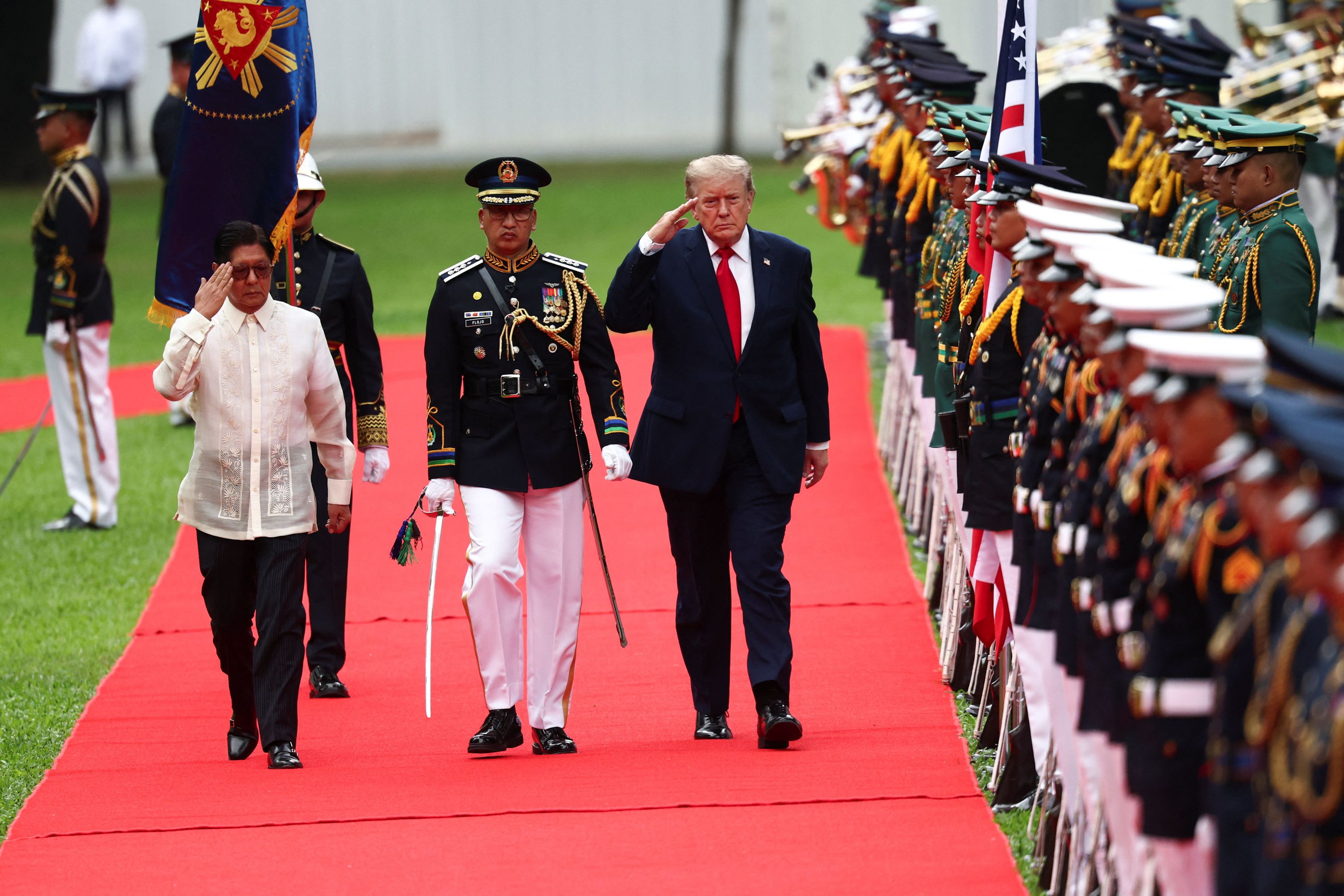
• Trump in Asia: Donald Trump has left the Philippines, where he was met with red carpets for talks with world leaders. He’s now flying to China, where leader Xi Jinping is hoping to use the APEC summit to showcase tech capital Shenzhen .
• Xi slams “protectionism”: At the summit, Xi pitched China as a defender of the globalized economy . While he did not mention the US, his speech appeared to be Beijing’s counterpoint to the US effort to limit China’s access to high-end technologies — and keep Chinese tech out of certain global supply chains.
• Historic meeting: Trump’s trip includes unprecedented joint talks with the leaders of China and Russia , from which Vladimir Putin said he expects “considerable potential benefits.” Trump may also meet with North Korean leader Kim Jong Un . US Secretary of State Marco Rubio said Trump does not view the potential sit-down as a concession — but stressed no meeting was confirmed.
Over multiple days , protestors in the Philippines came out bearing anti-Trump placards opposing the US president’s visit.
President Donald Trump’s visit to the Philippines has wrapped up and he’s making his way to China after less than 24 hours in the capital Manila.
While there, he attended a dinner with Southeast Asian leaders — where he praised the Philippines’ former dictator — and had a meeting with his counterpart President Ferdinand Marcos Jr. (In between, Marcos sent Trump and his delegation fried chicken from Jollibee as a late-night snack.)
Before and during his visit, protesters demonstrated against the Iran war’s economic impact and the US-led Pax Silica initiative , aimed at securing supply chains for semiconductors, critical minerals and AI.
On the South China Sea: Trump said he was “ not concerned at all ” about China’s rising aggression at sea, saying that “it’ll be taken care of” without offering explanation. Vessels from China and the Philippines, a US mutual defense ally, have faced dangerous run-ins in the contested sea.
On Iran: Trump said the country would pay a major price if it carried out an attack on Washington, after CNN reported that Iran is developing plans to target senior Trump administration officials by detonating a so-called dirty bomb or a chemical weapon in the capital.
On meeting Kim: Trump said he may also meet with Kim Jong Un if the North Korean leader travels to China. US Secretary of State Marco Rubio said Trump does not view the potential sit-down as a concession — but stressed no meeting was confirmed.
On issues back home: Rubio tried to reassure the American public that the recent string of tech outages in the US are unrelated and that no nefarious actors were involved.
In Shenzhen: Xi pitched China as a defender of the globalized economy at the Asia-Pacific Economic Cooperation (APEC) summit, where Trump is due to land in a few hours. In the tech metropolis, which Xi hinted could rival Silicon Valley , the leaders of Russia and China touted the stability of their relationship and its benefit to the world order.
Also to come: Trump’s trip includes an unprecedented joint meeting with the leaders of China and Russia – the first ever between the leaders of the three countries. Russian President Vladimir Putin said he expects “considerable potential benefits” from the talks. He may also meet with Kim Jong Un , should the North Korean leader travel to China.
CNN’s Kevin Liptak, Kathleen Magramo, Lex Harvey and Sylvie Zhuang contributed reporting.
President Donald Trump has left the Philippines after a short stop in its capital Manila and is now en route to Shenzhen, China, where he plans to meet with Chinese leader Xi Jinping and Russian President Vladimir Putin.
Trump was in Manila for less than a day. He came for a meeting of Southeast Asian leaders, though only caught the tail end of the ASEAN summit. He also met for a lengthy lunch with President Ferdinand Marcos Jr. at the Malacañang Palace , which was decked out for Christmas.
Trump announced new trade measures with Thailand and the Philippines while he was here, but they did not appear to amount to full-blown trade deals.
US officials hoped Trump’s presence here would demonstrate his commitment to a region where competition with China is fierce.
Philippine President Ferdinand Marcos Jr said his government would not be signing an agreement with the United States on the Pax Silica AI supply chain initiative during President Donald Trump’s brief trip to Manila.
While the Philippines is among 26 signatories the US-led initiative aimed at securing supply chains for semiconductors, critical minerals and AI, exact details on a framework and foreign investment deals have not been announced.
Asked about details on a signing for a Pax Silica deal, Marcos said: “No…We are not covering that on this trip.”
Pax Silica has met resistance from environmental and indigenous groups in the Philippines, and sparked protests ahead of Trump’s arrival.
When he sat down with Trump on Wednesday, Marcos said there were “tremendous opportunities to work more closely with American leadership and superintelligence.”
US President Donald Trump is being accompanied by a delegation of top officials and advisers on his trips to the Philippines and China.
His entourage comprises prominent members of his administration including Secretary of State Marco Rubio, Commerce Secretary Howard Lutnick, Treasury Secretary Scott Bessent, and US Trade Representative Jamieson Greer.
Bessent and Lutnick have clashed recently over restrictions on high-powered AI chips going to China. But Trump said Tuesday the two have handled their disagreement “very well.”
Also alongside the president is Chief of Staff Stephen Miller, on his first overseas trip since he took over from Susie Wiles last week.
Natalie Harp, a top aide whose close relationship with the president has sparked headlines , is also in Asia with Trump.
The world’s richest man, Elon Musk, whose $445 million in political spending failed to deliver Republican majorities in the midterm elections, will be part of the US delegation in Shenzhen.
President Donald Trump touted a potential nuclear energy deal with the Philippines as he sat down with his counterpart Ferdinand Marcos Jr. for a meeting in Manilla.
Washington has expanded its defense cooperation with Manila, a mutual defense treaty ally, with the Trump administration approving $5 billion in arms sales.
One of the Philippines’ key defense challenges is Beijing’s push to solidify claims over disputed territories in the South China Sea, where vessels from the two nations often clash. CNN has reported extensively on confrontations between China and the Philippines at sea this year.
China is accused of ramping up its “bullying” tactics out on the South China Sea. During an exclusive embed with the Philippine government, CNN’s Ivan Watson travels by ship and plane to witness the high-stakes confrontations at sea – as the unfolding clashes threaten to spiral into the next global conflict.
The expansive waterway, through which trillions of dollars in trade pass annually, is one of the most contested regions of the world.
Trump said Wednesday the alliance between Washington and Manila “has never been better.”
Trump received a red-carpet welcome with full military honors as Marcos greeted him at the Malacañang Palace in Manila. Marcos spent much of his childhood at the palace as his father ruled the country under a tight dictatorship before his family fled into exile forty years ago.
Malacañang became the residence of the American Governor-General William Howard Taft in 1901, during the period of American rule following the Spanish-American War.
The leaders of Russia and China touted the stability of their relationship and its benefit to the world order during a bilateral meeting Wednesday at the Asia-Pacific Economic Cooperation summit in Shenzhen, China.
President Vladimir Putin said Russia-China relations are “on the rise” and that both countries are taking a constructive approach to shaping a fairer, multipolar world order, Russian state media TASS reported. Putin also said the foreign policy coordination between the two countries remains stable.
China’s leader Xi Jinping said the relationship between Beijing and Moscow serves as a model for a new type of relationship between great powers, TASS reported.
On Thursday, both leaders are set to sit down with US President Donald Trump for unprecedented trilateral talks . Putin earlier said he expects “considerable potential benefits” from the discussions.
As world leaders descend on the southern Chinese city of Shenzhen for the Asia-Pacific Economic Cooperation summit this week, life for the tech hub’s 20 million residents will be far from ordinary.
All roads near the conference venue in the city center are subject to strict traffic controls. And no non-local vehicles are allowed to drive in the city’s six main urban districts.
Drivers are also being encouraged to switch to public transport. Those who do not drive for four consecutive days are eligible for a 100-yuan ($15) public transport subsidy. As of Monday, nearly 2 million vehicle owners had applied for the scheme. Fares for subways and buses are also cut by half during APEC.
Companies have also been encouraged to let their employees work from home to ease commuting pressures. And all primary and junior high schools will be shut from November 17-20 for a fall break.
The skies will be quieter too — the city has banned drones, kites, balloons and other flying objects from November 11 to 21.
While the roads may be relatively empty, they’ve been beautified with blooms, most of them bougainvillea — Shenzhen’s official flower. Flowers have been installed on over 600 bridges across the city, stretching for a combined length for over 360 kilometers (224 miles), according to a local state-owned outlet .
Russian President Vladimir Putin said Wednesday he expects “considerable potential benefits” from his trilateral meeting with China’s leader Xi Jinping and his US counterpart Donald Trump, Russian state media TASS reported.
Speaking at the Asia-Pacific Economic Cooperation summit in Shenzhen, China, Putin highlighted a “tectonic shift” in the global economy, with the Asia-Pacific region at its center, TASS reported.
Putin said the European Union has failed to adapt to the loss of Russian energy, and that Brussels is losing its position, according to TASS. He also touted his country’s economic growth and said Asia-Pacific currently accounts for 53% of Russia’s foreign trade.
Putin said he expects support for Russia’s bid to chair APEC and host its summit in 2035, TASS reported.
The Trump-Putin-Xi meeting Thursday — the first ever between the leaders of the three countries — is expected to focus on nuclear non-proliferation, a topic the US president said could yield a new agreement between the world’s biggest nuclear-armed states. Trump has also said he plans to discuss Russia’s war in Ukraine.
Chinese leader Xi Jinping hinted that China’s technology is on par with Silicon Valley’s by touting its own Greater Bay Area at the Asia-Pacific Economic Cooperation summit in Shenzhen on Wednesday.
“Asia-Pacific is home to the world’s most important Bay Area economies, which are characterized by distinct features such as openness, synergy, and spillover effects,” Xi told business executives at the APEC summit, which President Donald Trump will attend.
Without mentioning the San Francisco Bay Area, home to Silicon Valley, Xi touted China’s own tech capital.
The Greater Bay Area is Beijing’s strategic initiative linking Shenzhen, Hong Kong, Macau, and several other Chinese coastal cities into an integrated economic and high-tech powerhouse.
Shenzhen has launched tech advances that have put Trump and Xi on a collision course over access to raw materials, advanced chips, and lucrative markets.
In the tech hub, Xi said, robots work in factories, robot dogs work on farms and drones deliver food.
China supplies the vast majority of the world’s humanoid robots , but has been cut off from its largest export market as the US government moves to curb its reliance on foreign technology.
At a dinner with Southeast Asian leaders in the Philippines, President Donald Trump fondly recollected his ties with the country’s former dictator, who fled to Hawaii in 1986 following a popular uprising against his rule.
“I just don’t want to date myself, but I knew your parents very well,” Trump told Philippines leader Bongbong Marcos, son of former dictator Ferdinand Marcos Sr, who ruled the country under martial law.
The Marcos family plundered the country’s coffers before they fled to exile in Hawaii in 1986 carrying crates of gold, cash and jewels.
Trump and Marcos family are old acquaintances. Marcos Sr.’s wife, Imelda, now 97, and Trump attended parties together in New York and were photographed side by side in 1991.
“Great family, great family legacy and highly respected in his country,” Trump told Marcos Jr. the last time they met face to face in July 2025 in Washington.
When Marcos Jr. congratulated Trump for his re-election inauguration in 2025, Trump asked him: “ How’s Imelda?”
Chinese leader Xi Jinping called on Asia-Pacific countries to reject trade protectionism and pitched China as a defender of the globalized economy in his opening address at a regional economic summit in Shenzhen.
Speaking to business moguls attending the Asia-Pacific Economic Cooperation (APEC) gathering – which President Trump will attend during his Asia trip – Xi addressed the state of global affairs, saying “growth lacks momentum and unilateralism and protectionism are rampant.”
While Xi did not mention the US, his speech appeared as Beijing’s counterpoint to a years-long US effort to limit China’s access to high-end technologies – and keep Chinese high-tech out of certain global supply chains and sectors.
Those calls have grown louder in the US in recent weeks in the wake of a scandal linked to US AI chipmaker Nvidia and concerns about Chinese companies remotely accessing advanced American chips.
“China has stood up to unilateralism and protectionism and remained committed to true multilateralism… it has steadily brought stability and predictability to world economic growth and international trade and economic cooperation,” Xi told his guests.
The leader also pledged to cut tariffs and expand market access to China’s vast economy.
US Secretary of State Marco Rubio said President Donald Trump does not see sitting down with North Korean leader Kim Jong Un as a concession but stressed that no meeting has been confirmed.
“It’s a serious (meeting) in the sense that I think the president has never viewed meeting and talking to someone as a concession,” Rubio said when asked by reporters in Manila, whether a meet with Kim during Trump’s trip to China is a serious idea.
“How are you going to solve problems with people you have disagreements with if you don’t speak to them, if you’re not willing to engage with them?” Rubio said, describing the case Trump has often made.
Rubio said the only way the US will ever solve its problems with North Korea is by engaging with Pyongyang, but was careful on lowering expectations on a meeting, without ruling one out.
Trump has said he “may meet” with Kim Jong Un, should the North Korean leader also make an appearance in China this week.
When Secretary of State Marco Rubio emerged here in Manila to address the cascading outages back home that have caused headaches and worry for Americans, he appeared to be making a tacit acknowledgment that the administration had been less than open about the outages until now.
“People are nervous and they’re anxious,” he told reporters.
It was an attempt to sooth nerves after days of confusing and sometimes conflicting statements from other administration officials that had drawn harsh criticism, even from some staunch Trump allies.
That had largely been lacking until Tuesday. A number of officials, including Homeland Security Secretary Markwayne Mullin and Transportation Secretary Sean Duffy, had struggled to contain fears of a coordinated attack on American technology.
Rubio is viewed by many inside the administration as a more seasoned communicator, and a most trusted voice on national security matters. One person who has largely shrugged off the worries is Trump himself. “It’s life,” he said when asked about banking outages on Tuesday. “When you’re big and powerful and you have all the money, things like that happen. It’s fine.”
It’s Wednesday morning in Manila, where President Donald Trump will soon hold talks with his Philippines counterpart.
Then he’s off to China’s tech hub of Shenzhen for the the two-day annual summit of leaders of APEC economies.
Here’s what he’s got on his schedule for the day, according to the White House :
The president will join a welcome ceremony with the president of the Philippines at Malacanang Palace.
After, Trump will join a bilateral lunch meeting.
Trump will then leave Manila and head to Shenzhen, China, where the US president is expected to be in through Thursday.
US Secretary of State Marco Rubio acknowledged that the recent string of outages shows how technology comes “with the vulnerabilities,” and how it’s a serious topic to be addressed.
Rubio said the outages were not caused by cyberattacks, but that they “highlight the reality that we are now deeply interconnected with technology, and virtually every aspect of our life is impacted by technology.”
Rubio sought to reassure the public, recognizing “people are fearful, people are uncertain.”
“The best way to deal with people’s uncertainty and discomfort is to share with them transparently what we know and what we believe and that’s why I came before you today,” Rubio said. “We are not under systemic attack.”
Secretary of State Marco Rubio said there is no evidence that hackers, criminals or foreign governments were behind the recent wave of major tech outages, or that the incidents are connected, but he acknowledged that the drumbeat of failures has been unsettling for Americans.
“We have no indication, no evidence, and no reason to believe at all that any of these incidents are related to each other,” Rubio added.
The secretary said the Microsoft outage “has nothing to do with what we saw with the FAA,” and that the FAA failure was separate from recent problems at banks.
“We fully acknowledge that this is unsettling, to see these reports, day after day of some technical failures,” Rubio continued. “We get it.”
“We take these things very seriously,” he added. “Obviously, we’re always vigilant.”
US Secretary of State Marco Rubio said that he would not speculate on whether artificial intelligence has played a role in causing the slew of major technical disruptions that have occurred over the last week, insisting that all of the incidents are not related.
Rubio noted that “sometimes when you are going in to fix your system because you’ve identified a vulnerability, it creates a short-term disruption in the way your system works.”
He also said that it’s a “good thing” that companies “are now immediately sharing vulnerabilities because they don’t want to be accused of covering up something.”
For Xi Jinping, a summit in the high-tech hub of Shenzhen this week is an opportune moment to showcase a vision of China’s unrelenting rise.
Xi is hosting business moguls and world leaders for an annual regional economic summit, where he’ll sit down to sideline talks with US President Donald Trump and hold a three-way meeting with Trump and Russia’s Vladimir Putin, a first-ever trilateral for the nuclear-armed powers.
And for his backdrop, Xi has chosen a host city that’s synonymous with China’s rapid transformation into a high-tech powerhouse — and its resilience in the face of US tech and trade frictions.
Once known as the capital of luxury knockoffs and cheap electronics, today the city’s high-tech products have helped propel China’s export juggernaut to a record $1 trillion trade surplus already this year.
Visiting VIPs who step out onto Shenzhen’s streets this week will find traffic that moves to the whir of homegrown electric vehicles and novelty kiosks where robots serve up coffee. Self-driving taxis ferry passengers and drones deliver take-out in some areas. Surveillance cameras are ubiquitous.
Russian President Vladimir Putin has arrived in Shenzhen, China, for the Asia-Pacific Economic Cooperation leaders’ summit, according to state news agency Xinhua.
Putin is expected to meet with Chinese leader Xi Jinping and US President Donald Trump on Thursday in an unprecedented trilateral meeting . Trump has hinted that the three will discuss the war in Ukraine during the talks.
Topics in this story
Gathered from external sources. Rights to this text belong to whoever originally published it.