Trump’s campaign funding colossus is the midterms’ biggest unknown
The Republicans’ cash advantage is staggering.
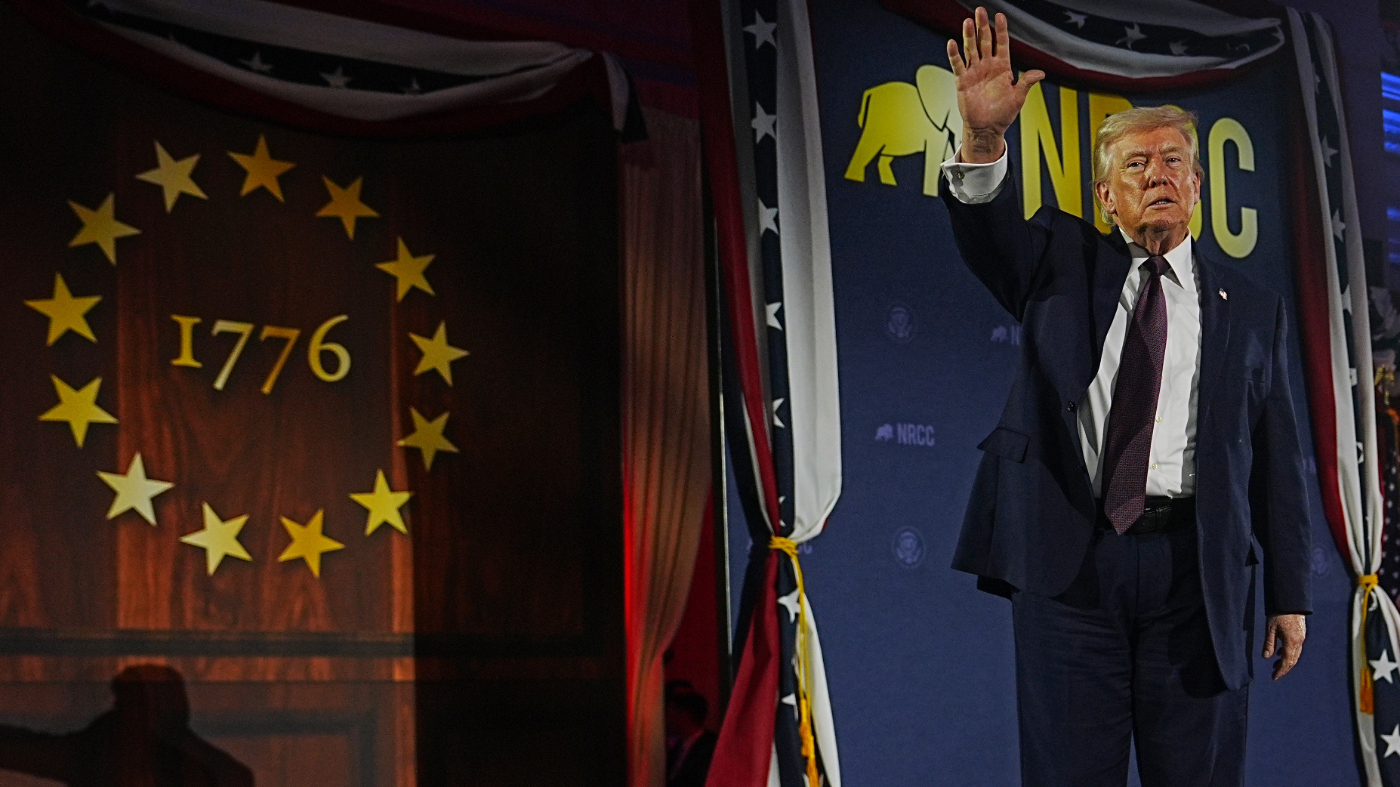
The midterms’ biggest unknown is when Trump will unleash his $400 million hoard. It is the biggest campaign war chest; it is also November’s biggest mystery variable. As Trump’s last important political campaign approaches, it has the power to significantly influence the outcome of his last two years in office.
California Democrat Jesse “Big Daddy” Unruh famously said : “Money is the mother’s milk of politics.” No one doubted that then; no one doubts this now. Seconding the sentiment while slightly softening the metaphor, ahead of November’s midterms, President Trump has a dairy farm’s worth at his disposal.
The Republicans’ cash advantage is staggering. Politico recently reported that Trump’s super PAC, MAGA Inc., has over $403 million cash on hand. Trump himself recently claimed that he has raised over $850 million. And as huge as these sums are, they are only part of Republicans’ advantage. The Republican National Committee reported $128.5 million in cash on hand. In comparison, the Democratic National Committee reported just $16.3 million with $18.5 million in debt.
While these amounts change regularly, the scope of Republicans’ advantage is clear. Republicans’ three major fundraising arms and two affiliated super PACs have a reported $657 million in cash; Democrats have only half that at $334 million .
With the midterms just over two months away, the question is: When will this potential spending tsunami flow? That Trump has every incentive to unleash it is clear. Democrats put his administration through the wringer after taking the House in 2018. What’s more, during the last two years of Trump’s first term, Democrats didn’t hold the Senate. This time they could.
Democratic control of either body would eliminate Trump’s legislative ability in his last two years in office. Losing the Senate would end confirmation for his nominees. Losing the Senate and House would put him on the defensive across-the-board domestically. The stakes are huge and no one should understand them better than Trump.
While money favors Republicans, history does not, because the party holding the White House is overwhelmingly likely to lose seats in any midterm.
My calculations show that from 1926 through 2022, the party holding the presidency has lost on average 11.3 percent of its House seats and 6.7 percent of its Senate seats. Second midterms are even worse. From 1926 through 2022, I found the presidential party lost on average 12.9 percent of its House and 11.6 percent of its Senate seats.
Republicans have done all they can to mute the historical midterm impact. Mid-decade redistricting has netted them potentially 10 House seats . But these are just that — potential. There is nothing Republicans can do in this regard to protect statewide Senate races.
Democrats have helped Republicans somewhat when it comes to the Senate by nominating ultra progressives into some tight races in Michigan , Texas and Minnesota while seemingly botching others entirely in Maine (at least, initially) and Florida .
Conversely, with defeats in some primary contests, it is unclear how much Trump himself can help in some of these close races. What undoubtedly could help and remains to be done is for Republicans — particularly, the president — to tap their huge spending advantages.
Further bolstering the Republicans’ spending potential is the limited number of realistic targets. Republicans are guaranteed to win many seats; they are guaranteed to lose many.
The money available only needs to go to the comparatively small number of truly and potentially competitive seats. According to Cook Political Report , that means focusing on just 38 House seats. Even including the “likely” races adds only another 31 seats.
The Senate total is even smaller. According to Cook , there are just six tossup seats and six “likely” or “lean” seats.
An enormous cash dump beginning after Labor Day could greatly influence close races and prevent others from becoming close. Senate races in Alaska, North Carolina, Ohio, Kansas, Maine and Texas spring readily to mind. It would also allow Republicans to expand the field, and thereby, hedge their bets in places like Georgia and Minnesota.
Holding either house would be a major win. Holding both would be even bigger, and increasing majorities in both would be nothing short of a coup.
Nothing would smooth Trump’s last two years in office more than holding the House or Senate. Nor would anything likely have a greater impact on defining Trump’s legacy. This would potentially extend Trump’s influence beyond his time in office, leaving Republicans with majorities as Trump leaves the White House and a launching pad for even larger majorities beyond 2028.
It would also unscored his power in fundraising and what he can accomplish with it. This is not something to be taken lightly because it is a power that Trump can take with him when he leaves office. His ability to raise and direct resources could easily influence the 2028 primary and general elections.
Trump has every incentive to unleash the financial fury ahead of this November. He has all the means to do so. The question is, will Trump do so — and if so, when?
J.T. Young is the author of the recent book, “Unprecedented Assault: How Big Government Unleashed America’s Socialist Left” from RealClear Publishing. Follow him on Substack .
Topics in this story
Gathered from external sources. Rights to this text belong to whoever originally published it.