Democrats may be on the cusp of a Senate majority: Here are their top priorities
As Democrats batten down the hatches for a harrowing election night, some are already tossing ideas around about what the first priorities would be in the event they win back the Senate majority. Democrats have about a 56 percent chance of winning the Senate majority in November, according to Decision Desk HQ (DDHQ), although they…
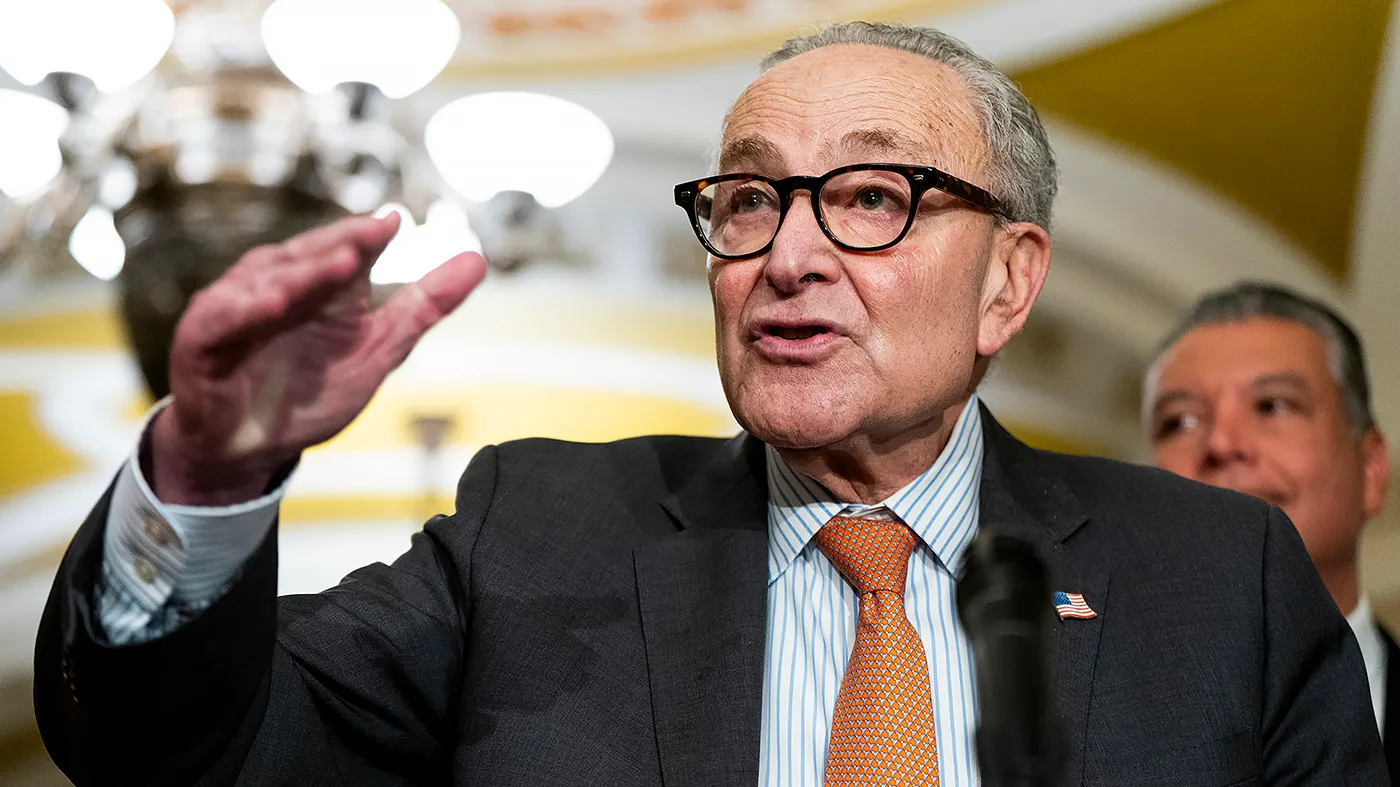
As Democrats batten down the hatches for a harrowing election night, some are already tossing ideas around about what the first priorities would be in the event they win back the Senate majority.
Democrats have about a 56 percent chance of winning the Senate majority in November, according to Decision Desk HQ (DDHQ), although they still face tall hurdles to getting there. DDHQ forecasts Democrats as having a 77 percent chance of taking the House majority.
If they are successful, they’ll face an administration unfriendly, if not openly hostile, to most of their policy agenda. And they’ll also have a short time period before 2028 jockeying takes over the environment.
That provides risks and rewards for the party.
“It is an opportunity for Democrats to audition for the American people for why they should have complete power after 2028,” said Joshua Miller, government affairs director for Public Citizen, a progressive nonprofit focused on consumers’ rights.
“It’s very easy for the campaign trail to begin to dictate the terms of what happens here in D.C. and I think one of the challenges that they’re going to have to overcome is just ensuring that the agenda that they’re trying to push is helping to set the debate instead of the debate being set for them,” Miller said.
The immediate priority will be oversight of the Trump administration.
With majorities, Democrats will have the power to bring subpoenas and schedule hearings to examine the executive branch’s moves.
Given sharp tensions between the Republican White House and the Democrats in both chambers of Congress, Cabinet secretaries and administration officials are likely to see frequent summons to Capitol Hill for testimony.
But some Democrats are cautioning each other not to lean too much into impeachment efforts, as the Democratic majorities did in the first Trump administration.
Republican leaders have already used this as an attack line . Some candidates, including former Sen. Sherrod Brown (D-Ohio), who is leading his comeback race against incumbent Sen. Jon Husted (R-Ohio), have said they do not support trying to impeach President Trump again. Democratic leaders have been largely noncommittal in either direction.
Phil Gardner, a Democratic strategist and co-founder of Blue Dog Action, a centrist Democratic group, discouraged trying to impeach Cabinet secretaries or, especially, Trump. He said such moves would likely not play well with swing voters.
“If we start to think of 2026 as history repeating itself from 2018, then I don’t have faith that Democrats took lessons from their past defeats or mistakes,” Gardner said, referring to the push for impeachment in 2018 even after then-Speaker Nancy Pelosi (D-Calif.) threw cold water on the idea at the outset .
“But then again, clearly even some of the people who you know would be ready and eager to impeach Donald Trump do get the fact we did it twice. It didn’t work. It’s probably not going to happen again,” Gardner said.
Democrats in both chambers are likely to make a big push for legislation lowering costs, after spending the whole campaign cycle talking about this chief concern of voters.
Senate Minority Leader Chuck Schumer (D-N.Y.) led the caucus in releasing a series of proposals throughout the past year highlighting Trump’s policies that Democrats say have driven costs up and pitching individual bills and broader frameworks for fixing the problem.
“As President Trump mocks affordability as a ‘hoax,’ Senate Democrats have launched a year-long initiative to tackle the high cost of living, focusing on the issues that matter to American families,” reads one of the proposals, which aims to bring down grocery prices by breaking up meatpacker monopolies, among other things.
Healthcare has been a hallmark Democratic priority for decades, and Democrats have already signaled interest in tackling healthcare costs and undoing cuts to Medicaid in the Republicans’ 2025 tax package. Democratic senators also blocked Republican attempts to fund the government last fall over concerns about expiring premium tax credits on Affordable Care Act health plans. Restoring those enhanced tax credits is likely to be high on their priority list.
Wendell Primus, a scholar at the Center for Health Policy at the Brookings Institution, said he expects Democrats to go straight for the Medicaid cuts and the tax credits, although they’ll struggle to get anything past Trump’s desk without making deals. And the looming 2028 election fight could provide an incentive or disincentive to do so.
“It’s a question of, do you try to get something done that may be a little smaller than what you want, because you know you’ve got to deal with a Republican presidency right now, or do you say, ‘We’re going to make a big deal out of this issue, so it helps us, you know, get the ultimate prize, you know, a Democrat president in 2028, or I mean, early 2029,” Primus said.
The playbook that Schumer released in April on healthcare mentions “lower costs,” “reliable care” and “less hassle” as broad tenets of the reforms Democrats want, although it is light on specific legislative approaches. Sen. Brian Schatz (D-Hawaii), who is all but certain to be Schumer’s deputy as Democratic whip, has specifically mentioned either delaying or repealing the Medicaid cuts as a No. 2 priority (after ending the Iran war) of a Democratic majority.
“It’s true that that doesn’t actually reduce the rate of inflation, but it does reduce the rate at which people can’t afford their lives,” Schatz told The Washington Sun on Tuesday.
Primus also mentioned reforms to long-term care and drug pricing as potential avenues for healthcare policy in a Democratic majority.
Some House caucuses have released frameworks on specific issues, too, including healthcare, with more specificity.
The New Democrats, a broad coalition of pro-business moderates, released a healthcare action plan last year that lays out priorities including reversing the Medicaid cuts and preserving the tax credits plus cracking down on Medicaid and Medicare fraud, supporting women’s health and bolstering medical research and innovation.
Another policy area likely to be near the top of the to-do list is housing, which could have more robust bipartisan support, unlike many of Democrats’ healthcare goals.
Congress over the summer muscled through a housing package, called the 21st Century ROAD to Housing Act, that rolled back regulations and created some new programs designed to bring down housing costs, but even that was briefly stalled over tensions with the White House.
Some of those provisions will also need federal funding set aside to go into effect. Dennis Shea, executive vice president for housing at the Bipartisan Policy Center, said he expects bipartisan support for appropriating money to those programs, since many lawmakers have provisions included in the housing bill they want to see come to life.
“I don’t believe HUD [Department ofHousing and Urban Development] will set up these programs, and understandably so, unless there’s some resources put behind them,” Shea said. “So I think that should be priority No. 1 on housing, is to sort of complete the job with ROAD and get the programs established in ROAD funded.”
There are plenty of other policy areas Democrats have their eye on.
Josh Freed, senior vice president for energy policy at Third Way, said he expects interest in permitting reform, which the Senate is set to consider after the elections but that Democrats will likely revive if that effort fails before the holidays.
Freed also mentioned the New Democrats’ energy policy framework , which he called “appropriately ambitious.” Like the Senate permitting deal, several of these policy objectives could have cross-partisan appeal since they focus on cutting down on regulations and addressing grid problems that affect rural areas and red states.
“Most of these things should get 60 votes. Whether they do or not is going to depend on what Republicans are in the Senate and how Donald Trump responds to a Republican minority, and how much the Republicans in the Senate are still listening to him,” Freed said. “So there are a lot of wild cards there that Democrats don’t have much control over, but the actual policy agenda should be able to get six, eight, 10 Republicans to support it.”
Another policy area Democrats are likely to look to is childcare. Several incoming candidates have made childcare costs and access a key part of their platform, and there have been bipartisan efforts this Congress to support the childcare workforce.
Lena Bilik, program manager at Roosevelt Forward, the advocacy arm of the progressive Roosevelt Institute, said the emphasis on childcare as a form of public infrastructure across campaigns and in legislation in recent years is a helpful development. She mentioned several states have adopted sweeping childcare reforms, including New Mexico .
“We’re at a point where we’re seeing an acknowledgement that we have to treat childcare as the economic priority that it is, and as one key that actually can be improved to ease some of the affordability crisis, so I think that’s exciting,” Bilik said. “So obviously, lowering costs-that’s foundational. But it’s exciting to see a focus on supply building, like in this Senate doc , for example, and in other places, and a realization that the childcare workforce is key, so that’s good to see.”
But childcare reforms — especially ambitious ones like universal childcare, which New Mexico has put in place — are likely to face strong headwinds from Republicans. Such moves would also likely need federal funding support, underscoring the need for bipartisan government funding negotiations that balance the budget.
Any of these issues will make for complicated and drawn-out negotiations amid the narrow margins expected from any majority. Miller, from Public Citizen, emphasized that opposing Republicans and Trump is not enough as a guiding platform for Democrats going into next year, and neither is seeking to return to a pre-Trump status quo.
“The bar should not be set at the level, ‘look what the Trump administration is burying, or what they’re doing with you know DHS or DOJ.’ That’s a very low bar,” Miller said, referring to the departments of Homeland Security and Justice. “The bar should be very high in terms of we’re pointing this out because we categorically believe that we are different and will operate differently.”
Topics in this story
Gathered from external sources. Rights to this text belong to whoever originally published it.