Susan Collins tries to keep Trump off the ballot in Maine
During a campaign stop in South Carolina last week, President Trump urged Republicans to turn out and vote as if he were on the ballot. Sen. Susan Collins (R), fighting an uphill re-election battle in blue-leaning Maine, is sending the opposite signal, flexing her independent streak and keeping her distance from Trump and Vice President…
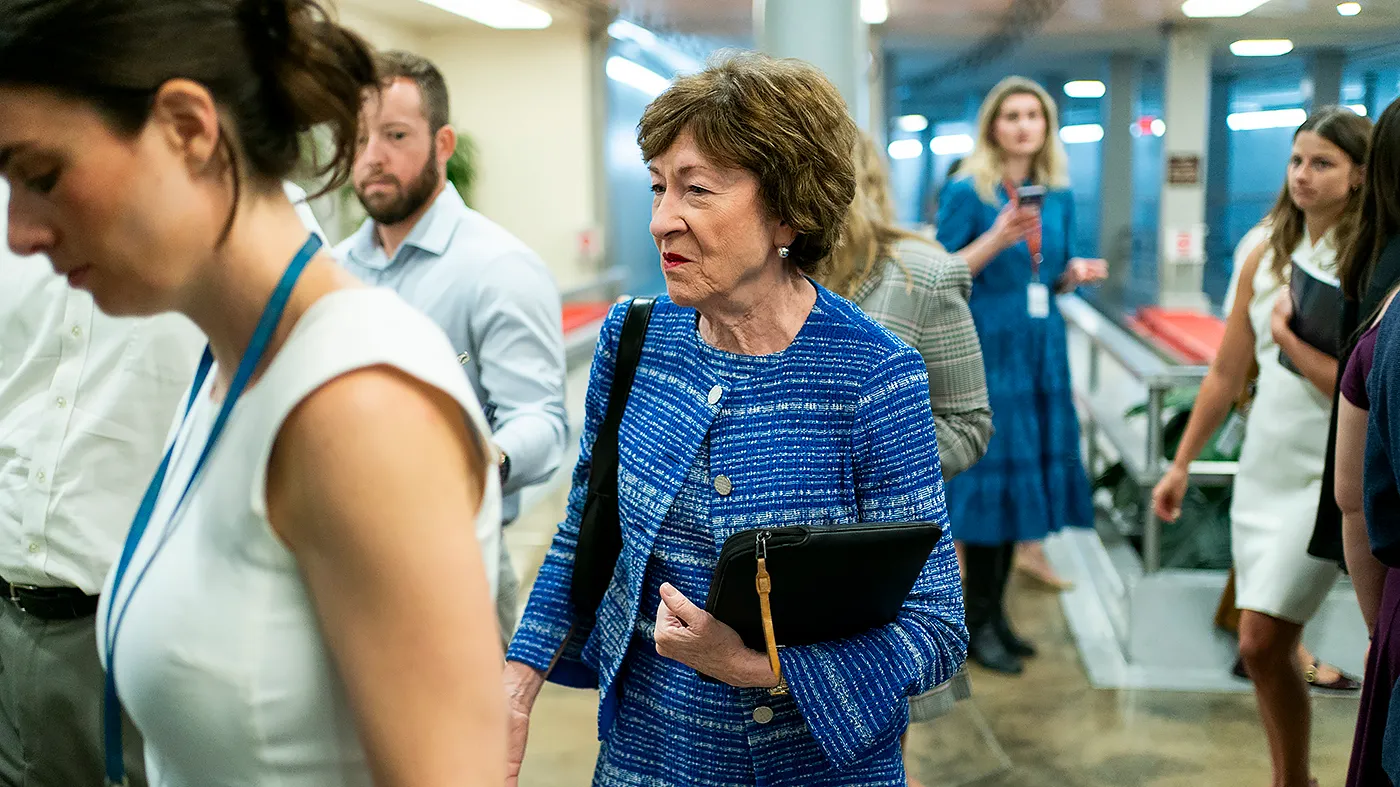
During a campaign stop in South Carolina last week, President Trump urged Republicans to turn out and vote as if he were on the ballot.
Sen. Susan Collins (R), fighting an uphill re-election battle in blue-leaning Maine, is sending the opposite signal, flexing her independent streak and keeping her distance from Trump and Vice President Vance.
In recent days, she has been the loudest elected Republican criticising Trump’s tariff war with Canada. Earlier this month, Collins was one of two GOP no votes on Todd Blanche, Trump’s new attorney general. And in July, she was a rare voice on the right calling for federal immigration officers to halt non-urgent traffic stops this summer after a deadly shooting in Biddeford, Maine.
Lance Dutson, who served as a senior adviser on Collins’s 2020 Senate reelection and is not involved in her campaign this cycle, said the president served as Collins’s biggest challenge in her reelection.
“The discussion of [Supreme Court Justice Brett] Kavanaugh … or Canadian tariffs or any of these individual issues just absolutely pales in comparison to the general nausea people have about this administration right now,” he said, referring to her deeply controversial vote to confirm the conservative justice despite decades-old sexual assault claims.
Collins was noticeably absent on Monday when Vance rallied the party in Brewer, Maine.
“Senator Collins has a great working relationship with the Vice President,” her campaign told The Hill on Monday in a statement, citing a “personal schedule” that conflicted with Vance’s visit. Dutson also played down the significance of the Vance event.
While Collins has pointed out that she joined Energy Secretary Chris Wright on a recent event promoting an energy storage facility, the dynamic is emblematic of Trump’s drag on Republicans in purple-state races, as his approval ratings hit all-time lows, both overall and on the economy.
Troy Jackson, a logger and former state Senate president who won the Democratic nomination after Graham Platner dropped out, has missed no opportunities to capitalize on the vulnerability.
Commenting on a clip of Vance’s speech on Monday, Jackson noted the vice president “called Susan Collins his ‘dear friend.’ No wonder why — she’s voted for Trump’s agenda 96% of the time.”
Jackson campaign spokesperson Maggie Amjad said in a statement that “Maine voters aren’t stupid, and they see the game that Susan Collins is playing.”
Collins campaign spokesperson Blake Kernen said she puts state over party when it comes to consequential legislation.
“No matter who’s in the White House, Susan Collins works with the president when she agrees with his policies and opposes him when she disagrees,” she said in a statement, noting Collins first spoke out against tariffs on Canada on the Senate floor in April of last year.
Collins is the only Senate Republican running for another term in a state that former Vice President Harris won in 2024.
The Maine Senate race has been caught in some stiff national political winds.
Trump’s approval rating has slid in Maine as it has across the country. According to a University of New Hampshire survey released last month, Trump’s approval rating sits at 40 percent in the state. A separate Reuters/Ipsos poll shows Trump’s national approval rating at 33 percent.
The Trump administration’s tariff policies have also swept up Maine as the U.S. has begun imposing a 50-percent tariff on certain Canadian goods after negotiations fell through late last week. The president took it a step further and threatened to impose tariffs on imported cars, auto parts and aluminum starting in January.
Canada has said it will match U.S. tariffs “dollar for dollar” on a range of American goods – a situation that drew criticism from Collins, whose state borders and does trade with Canada.
“I really want us to go back to the very friendly, economically beneficial relationship that we have with our Canadian neighbors,” Collins told News Center Maine this week. “We produce a lot in Maine — our blueberries, our potatoes, our lobster, our lumber — that is processed across the border. If it comes back with a huge tariff on it, perhaps as much as 50 percent, that increases the cost of eating, building homes and merch[andising] our best-known products.”
On top of that, the party is facing headwinds that presidents in power historically face during the first midterm election of their term.
“You’ve got to give those candidates room to breathe and not try to force yourself onto their shoulders. Stay out of Maine. Give her space to say what she needs to say, do what she needs to do to hold that seat,” said one Republican strategist.
Vance praised Collins for her independent streak on Monday, but jokingly voiced his frustrations over her past breaks with Senate Republicans.
“Whenever I’m in Maine, I’ve got to give Susan a little bit of crap because as you know, Susan is the most independent member of the United States Senate,” the vice president said. “And as the president of the United States Senate, she sometimes makes my job just a little bit harder.”
“But she makes it harder because she is coming to work every single day and fighting not for a political party or not for any abstraction. She comes to work every single day, and she fights for the great people of Maine,” he said.
Vance also gave a shout-out to Maine gubernatorial candidate Bobby Charles, who was also absent. The nonpartisan Cook Political Report rates the state’s governor’s contest as “solid Democratic,” while rating the Senate race as a “toss up.”
The vice president’s remarks are emblematic of the narrow tightrope that Republicans, in particular Collins, have to walk in Maine.
“It’s probably as smart of messaging you can have where he’s almost trying to amplify her independence, but the fact of the matter is, most people in Maine, most voters, aren’t going to pay attention to every word, and slice and dice what the vice president is saying,” the Republican strategist said.
“They’re simply going to see headlines and hear stories that the vice president was in the state campaigning, and probably campaigning for her,” the strategist said. “I don’t think it’s worth the risk to have the vice president or anyone in the admin in that state right now.”
Democrats have sought to portray Collins as a “rubberstamp” for Trump in the Senate, often featuring a picture from Collins, Trump, and other GOP lawmakers in the Oval Office during a bill signing to end the partial government shutdown in February. Trump handed Collins and others a red, MAGA style “America is back!” hat, telling her he heard she was doing “a good job.”
“She voted with Trump 96 percent of the time, was a decisive vote for the Supreme Court nominees that overturned Roe, and even earned the title ‘team player’ amongst her GOP colleagues for being a reliable vote when they need her to push through their destructive policies or nominees. Mainers are sick of it and will vote her out,” said Maddy McDaniel, a spokesperson for the Democratic Senatorial Campaign Committee.
Dutson said these Democratic attacks were intellectually dishonest, pointing out that they’ve made the same case before — with little success so far.
“We have the quantifiably most independent member of Congress in [Rep.] Jared Golden and the quantifiable most independent member of the United States Senate [in] Susan Collins,” Dutson said, adding “that’s our state’s identity.”
Golden, a Democrat, is not running to re-election. Former Gov. Paul LePage, a loyal Trump ally, is running for the open seat against state Auditor Matthew Dunlap.
Trump has not always been as polite as Vance about Collins’s independent streak.
Earlier this year, Trump laid into Collins over the phone after she supported a Democratic war powers resolution over his actions in Venezuela. And in June, the president referred to Collins, Sens. Lisa Murkowski (R-Alaska), Rand Paul (R-Ky.), and Bill Cassidy (R-La.) as “losers” after the war senators joined Democrats on a resolution calling on the U.S. to remove troops from Iran.
If Collins survives in November, it won’t be her first time bucking statewide trends against Trump. In 2020, Trump lost Maine by nine points, while Collins won her reelection bid by just over eight points.
The Republican strategist noted that Trump staying away from the race could pay off for him in the long run.
“As maybe embarrassed as you feel by that, and I get it, it’s still a hell of a lot better for Trump and the White House to have her in that Senate seat than the Democrat,” the strategist said.
Topics in this story
Gathered from external sources. Rights to this text belong to whoever originally published it.