What the Supreme Court’s mail ballot ruling means
The Supreme Court’s mail-in voting ruling on Monday in favor of President Trump stirred up the dust just ahead of the midterms. “Only time will tell,” the court cautioned on the lawfulness of Trump’s policy in question as it ruled on an early challenge to it. Mail ballots are set to go out in a matter of days. And the battle could quickly boomerang to the high court. To hear some prominent Democrats tell…
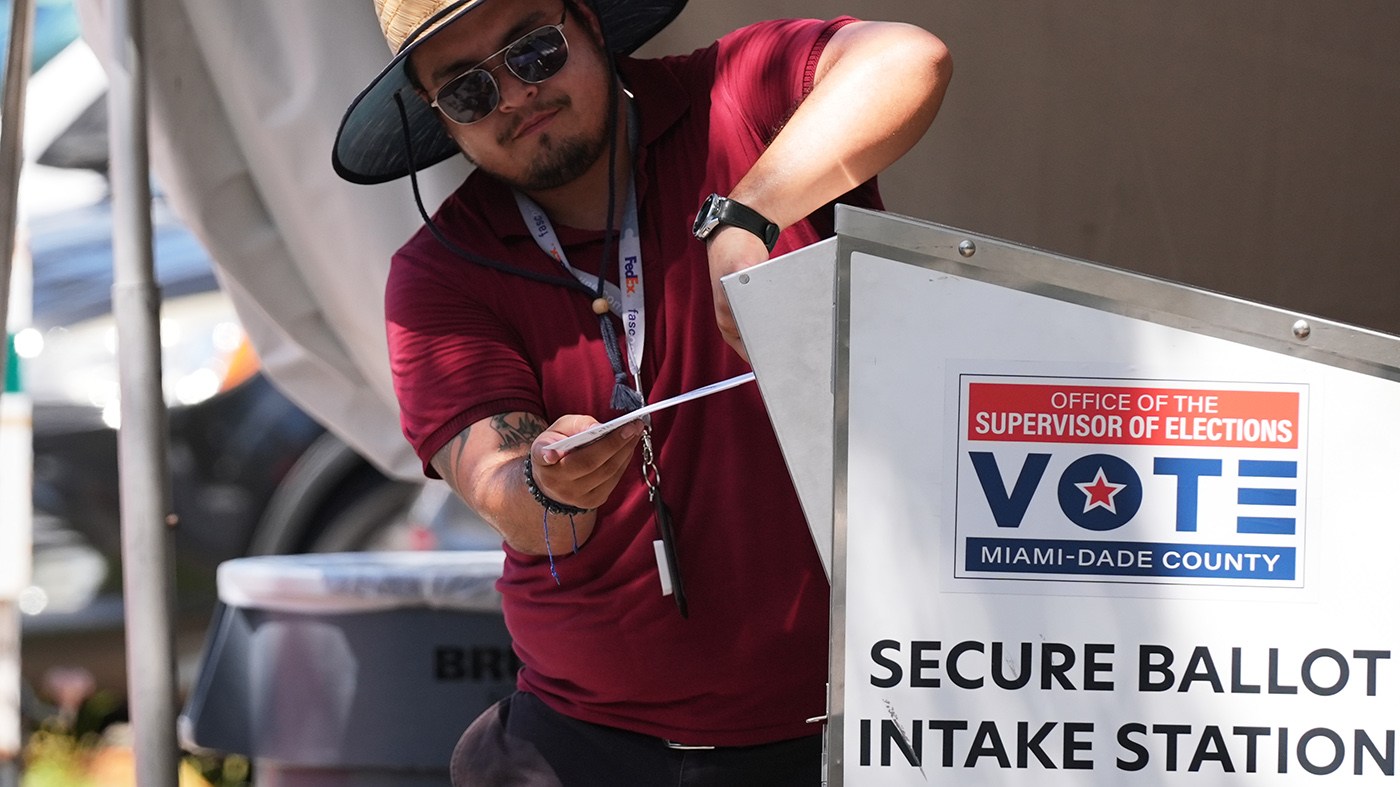
The Supreme Court’s mail-in voting ruling on Monday in favor of President Trump stirred up the dust just ahead of the midterms.
“Only time will tell,” the court cautioned on the lawfulness of Trump’s policy in question as it ruled on an early challenge to it.
Mail ballots are set to go out in a matter of days. And the battle could quickly boomerang to the high court.
To hear some prominent Democrats tell it, the justices have already upended the midterms. Senate Minority Leader Chuck Schumer (D-N.Y.) called it a “dagger into the heart of our democracy.” Former House Speaker Nancy Pelosi (D-Calif.) described it as an “insult to the vision of our founders.”
Others in the party were more measured. Sen. Dick Durbin (D-Ill.), the ranking member of the Senate Judiciary Committee, described the ruling as just a “temporary procedural win” for Trump. Norm Eisen , whose group has filed dozens of lawsuits against Trump, told his followers on social media, “Please don’t overreact.”
Let’s start with what the Supreme Court actually ruled in its apparent 6-3 vote:
First, the justices said blue states have no legal standing, meaning their right to sue, over Trump’s executive order. The court found the order itself doesn’t cause the states any concrete harm.
Second, the justices ruled the case unripe. They] said any hypothetical injuries wouldn’t happen until the U.S. Postal Service (USPS) implements the president’s directive. The agency’s final plan is being formally published Wednesday.
They did not decide whether who may eventually have standing once USPS moves forward, or if it will be legal.
That’s why some blue states still sound confident, despite their loss.
New York Attorney General Letitia James (D) called the Supreme Court’s decision a “setback.” Washington Attorney General Nick Brown (D) said it merely meant his office must wait “slightly longer.” And others, including Pennsylvania Gov. Josh Shapiro (D), took issue with headlines suggesting the court had greenlit Trump’s policy.
“Not so fast. Today’s SCOTUS decision does NOT deal with the substance of Trump’s unconstitutional Executive Order and does not mean his illegal attempt to restrict mail-in voting will go forward,” Shapiro wrote on social media.
There’s no clear answer yet as to how much of Trump’s policy can be implemented for November’s elections. Expect the next word to come from U.S. District Judge Indira Talwani , an appointee of former President Obama who serves on the federal trial bench in Boston.
While one block was lifted, Trump’s executive order remains blocked nationwide under a second injunction Talwani issued. That case is a separate lawsuit from the states’ case. It’s filed by the League of Women Voters of Massachusetts and wasn’t directly before the Supreme Court, so the block technically remains in effect. The organization says it should stay put.
“We will fight to keep it that way or to secure new relief,” the league said in a statement.
But the Justice Department (DOJ) wants it gone, saying in court filings that “the Supreme Court’s order leaves no room for any further dispute.” The judge had no authority, so she’s compelled to wipe her ruling, DOJ argues.
Side with Trump: The judge agrees to lift her remaining injunction and refuses requests from both the blue states and the voting group to intervene again. It would pave the way for the Trump administration to implement as much of its policy as it can before mail ballots go out.
Enforce the existing injunction: The judge rules her existing injunction in the voting group’s case withstands the Supreme Court’s decision. She agrees the executive order and any steps to implement it must remain blocked.
Issue a new injunction: The judge agrees her existing injunction must be tossed. However, now that USPS has finalized its new policy, she issues a new block preventing further implementation.
Do nothing: The judge continues to consider the parties’ arguments, leaving her existing injunction in effect.
DOJ demanded Talwani agree to the first option by Tuesday evening, a deadline she declined.
The clock is ticking. Mail ballots in some states begin going out in less than two weeks. And USPS’ final rule implementing Trump’s executive order is slated to be published in the Federal Register on Wednesday, so it can go into effect immediately if the courts get out of the way.
The administration is threatening to immediately start climbing the appellate ladder to the U.S. Court of Appeals for the 1 st Circuit if Talwani doesn’t side with them.
Meanwhile, Democratic Party leaders are making moves of their own. They, too, had filed a legal challenge. But it was brought in the nation’s capital, where judges rejected it. On Tuesday evening, they filed a new motion asking to stop the USPS from carrying out its newly finalized plan.
The 95-page document makes some previous ballot recommendations required. Mail ballots must include an official logo, unique barcodes with the person’s ZIP code embedded and other specifications. Designs must be submitted to a federal design analyst.
Local or state election officials also must upload voters’ names and addresses into a portal, though it doesn’t collect birthdates or Social Security numbers.
USPS will intervene if a state sends a ballot to someone without uploading their information to the portal. However, the rule stresses the agency isn’t consulting external databases at the Department of Homeland Security or elsewhere. The data comes from state and local election officials.
“The Postal Service will not second-guess the states’ submissions,” the rule reads. “State election officials will thus retain full control over who is permitted to vote in federal elections in their state by U.S. mail.”
Welcome to The Gavel, The Hill’s weekly newsletter unpacking the intersection of courts & politics from Zach Schonfeld and Sophie Brams. Email us tips at zschonfeld@thehill.com and sbrams@thehill.com . You can also reach out to us on X (@ZachASchonfeld and @sophiebrams) or Signal (zachschonfeld.48 and sbrams.32).
1. Maxwell’s long-shot bid for release denied : A long-shot bid by Jeffrey Epstein associate Ghislaine Maxwell to toss her conviction and 20-year prison sentence has been rejected , with the judge warning against further “frivolous” claims.
2. Epstein files FOIA fight continues: The Justice Department appealed a federal judge’s order that required the release of additional unredacted records from the Epstein files, lawyers have told the court. Attorney and independent journalist Katie Phang has accused DOJ of withholding information in violation of the Epstein Files Transparency Act.
3. Extradition battle brewing over Minnesota ICE officer : A battle is brewing over whether an Immigration and Customs Enforcement (ICE) officer should be extradited from Texas to Minnesota to face charges for allegedly shooting a Venezuelan migrant during enforcement operations. Minnesota is seeking a court order to force the extradition of officer Christian Castro, as Texas Gov. Greg Abbott (R) argues he is not legally obligated to sign the warrant.
4. Nevada sues over Colorado River cuts : Nevada is suing over the Trump administration’s plans to cut how much water the state can use from the Colorado River, arguing the steep reductions would threaten the health, safety, environment and economy of southern Nevada.
5. Visa processing pause struck down : A federal judge in New York has ruled that a Trump policy that paused visa processing for immigrants from 75 countries is unlawful.
Perks of working at DOJ: We spotted Solicitor General John Sauer taking in this weekend’s IndyCar race from a balcony on the Justice Department’s fourth floor ( see the photo here ). He had a great view of the course.
Roberts paddling protest: A group of kayakers protested Chief Justice John Roberts while he was vacationing at his home in Maine, the Midcoast Villager reports .
Money pours in for GOP AG candidates: The Republican Attorneys General Association announced an initial $7 million spending blitz to support candidates in 13 states. The group describes it as “phase one” of their fall advertising campaign.
More SCOTUS lawyer moves: It’s a game of musical chairs right now among Supreme Court advocates. Paul, Weiss announced William Jay is joining the firm to lead its high court practice. He replaces Kannon Shanmugam, who recently left to start a new Supreme Court practice at Davis Polk.
The fight over whether Trump’s name can be legally added to the facade of the renowned Kennedy Center is far from over.
On Thursday, it will be back in the hands of U.S. District Judge Christopher Cooper .
Cooper ruled in May that the institution’s board — handpicked and chaired by Trump — unlawfully voted to rename the building and ordered the lettering of the president’s name be removed. He also temporarily blocked plans for a two-year closure for renovations.
The administration ultimately complied after unsuccessful attempts to fight the order, and Trump’s name was stripped overnight in mid-June only to be obscured from view by a tarp.
Democrats hailed the removal as a symbolic win for “democracy and the rule of law,” seemingly closing this chapter of the president’s efforts to remake the nation’s capital in his image.
That is until earlier this month when the board again approved adding a reference to Trump underneath the Kennedy Center name, this time in the form of an inscription that reads: “Restored and Renovated by President Donald J. Trump.” It also revived closure plans and voted to rename a plaza after Trump.
Rep. Joyce Beatty (D-Ohio), an ex-officio board member who has long been fighting the changes in court, quickly challenged the new resolution. Her lawyers argued it “openly flouts” the court’s previous order and asked Cooper in an emergency motion to “put an end to this childish gambit.”
The Kennedy Center has said that it would hold off on the changes until at least Sept. 8 while the legal process continues to play out.
Late Monday, the Justice Department (DOJ) asserted the board’s decision was entirely lawful and did not run afoul of Cooper’s order because the center would continue to bear the congressionally mandated “John F. Kennedy Center for the Performing Arts” name.
The DOJ filing paints the picture of an institution in “terminal decline,” one that is bleeding cash and in desperate need of repairs. It lauds Trump as the “sole hope” for the center’s long-term survival, pointing to his efforts to procure donors for an endowment fund.
“An order blocking the Board from appropriately recognizing President Trump will cause donors to flee, financial contributions to dry up, and structural rehabilitation to stop,” DOJ attorneys wrote. “There will simply not be the expertise or funding necessary to rebuild and renovate this decimated structure.”
“The Trump Administration is ready to go but, without it, the Kennedy Center cannot be saved,” they added.
Nathaniel Zelensky , who is representing Beatty, criticized the DOJ’s suggestion that the building could be at risk as a “not-to-so-subtle threat to demolish the Kennedy Center if [the] President doesn’t get his way.”
“This is unconscionable; it is unbecoming of the Department of Justice to even put this in a filing, and we will answer in court,” Zelinsky, the principal and managing counsel of the Washington Litigation Group, told The Gavel in a statement.
Both parties will be in Cooper’s courtroom for a 2 p.m. EDT hearing on Thursday, as he weighs whether the board can move forward with its plans.
Don’t be surprised if additional hearings are scheduled throughout the week. But here’s what we’re watching for now:
Jeanine John Taele, who was arrested at Trump National Golf Club in Rancho Palos Verdes days before a planned visit by the president in early August, set to appear in a California courtroom for a preliminary hearing. He faces federal weapons charges.
Rep. Joyce Beatty ’s challenge over efforts to re-add Trump’s name to the Kennedy Center and close the venue for a two-year renovation will be back before a federal judge in D.C.
Conference to finalize a $72.5 million settlement between a group of Jeffrey Epstein survivors and Bank of America to be held in the Southern District of New York.
Andrew and Tristan Tate will appear in a Miami courtroom for a detention hearing as they fight extradition to the United Kingdom on rape, assault, trafficking for sexual exploitation and other related charges.
Status hearing scheduled for Michael Jeffries , the former CEO of Abercrombie & Fitch, in the Eastern District of New York. Jeffries has been found mentally competent to stand trial on federal sex trafficking and interstate prosecution charges.
Federal judge in California to hold hearing on whether to grant preliminary injunction in lawsuit filed by Chinese e-commerce giant Alibaba over the Pentagon ’s “Chinese military company” label.
Federal judge in San Antonio to hear arguments in dispute over construction of a border wall in Big Bend National Park.
The 2nd and 5th U.S. Circuit Courts of Appeals resume oral arguments for the fall term.
A federal judge in Brownsville, Texas, will consider Minnesota’s bid to force extradition of ICE officer Christian Castro, who is accused of shooting a Venezuelan during Operation Metro Surge.
The Wall Street Journal’s Rebecca Ballhaus , Joe Palazzolo , Dana Mattioli , Josh Dawsey and Dave Michaels: The Trump Intervention That Got the DOJ Off Live Nation’s Back
Yale Law School’s Bruce Swartz , Kit Beyer , John David Cobb and Riler Holcombe: Sword of the People: The Power of Grand Juries to Investigate Administration Corruption
Topics in this story
Gathered from external sources. Rights to this text belong to whoever originally published it.