Maxwell Frost sees greater Gen Z influence on Congress as an improvement
Congress is getting younger, and Rep. Maxwell Frost (D-Fla.) is at the forefront of it. Frost, 29, is the only Generation Z member of Congress. It’s a Congress still dominated by octogenarians — from Sen. Mitch McConnell (Ky.), 84, to Reps. Maxine Waters (D-Calif.), 88, and Steny Hoyer (D-Md.), 87. And then there’s Sen. Chuck…
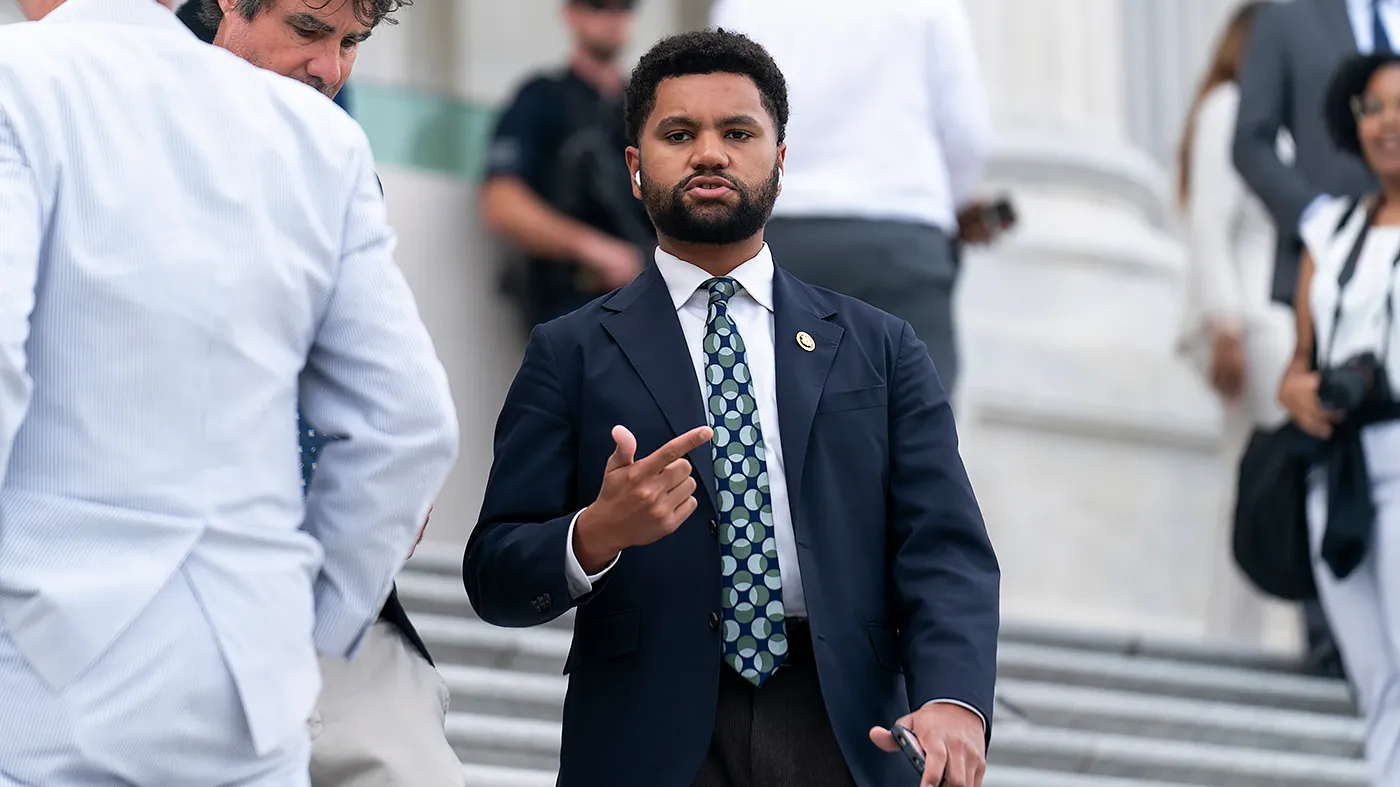
Congress is getting younger, and Rep. Maxwell Frost (D-Fla.) is at the forefront of it.
Frost, 29, is the only Generation Z member of Congress.
It’s a Congress still dominated by octogenarians — from Sen. Mitch McConnell (Ky.), 84, to Reps. Maxine Waters (D-Calif.), 88, and Steny Hoyer (D-Md.), 87. And then there’s Sen. Chuck Grassley (R-Iowa), who turns 93 later this month.
But believe it or not, the average age in the Congress is getting younger.
As of the start of the 119th Congress, the average age of members in the House was 57.5 and in the Senate was 64.7 — down from 57.9 and 65.3, respectively, according to the Pew Research Center.
Frost, who was elected in 2023 to represent Florida’s 10th District, believes that’s a good thing and could stoke positive change in America.
“I do believe that we are a generation by and large that has these issues front of mind,” he said in an interview with The Feed, The Hill’s column on Gen Z.
Frost later added that Gen Z “would govern differently because we’re freshly going through what it means to be a young person in this country.”
Frost has hope for Gen Z, which he sees as a highly politically involved faction in the country that is “voting at the highest numbers we’ve seen young people vote in our country’s history” and “running for office at historic numbers.”
However, despite his excitement at a potentially younger legislative branch, Frost doesn’t think age is everything.
It’s a politician’s ideas, he says, that are ultimately what’s important.
“What we have to be careful of as voters and as people is younger leadership doesn’t always mean new ideas,” Frost said.
And not all older politicians are a problem. Perhaps not surprisingly, given Frost’s own progressive politics, he’s a big fan of one octogenarian member of the Senate.
“Breaking news, Bernie Sanders is not a young guy,” Frost said.
While there’s a danger that a government dominated by older politicians might neglect the problems facing younger Americans, Frost points to Vermont’s Independent senator — who ran for president in 2016 and 2020 — as someone who’s connected with Gen Z.
Like many younger Democratic candidates and politicians, Frost prioritizes “new ideas” that center around affordability and improving conditions for working Americans.
In particular, he expressed a desire for Medicare for All, affordable housing and tangible changes to address a cost-of-living crisis, which Frost says is the most pressing issue among his Gen Z constituents.
While Frost is focused on his peer group, he argues that on a number of issues, people have commonalities across the generations.
“I actually don’t believe there’s such things like young people’s issues,” Frost said. “Young people are disproportionately impacted by all the things we’re all talking about.”
All that said, Frost does think there are some unique characteristics of Gen Z.
Perhaps the largest distinction between Gen Z and previous generations is how closely its upbringing was intertwined with the internet, social media and, now, artificial intelligence.
“The thing that sets Gen Z apart from the generation before us is we’re the first generation to be completely immersed in technology since birth,” Frost said.
That doesn’t necessarily mean Americans born between 1997 and 2012 think AI should be unregulated.
Recent reporting shows that Gen Z is increasingly hesitant to adopt artificial intelligence and is increasingly fearful of its influence . It’s possible some of that fear is related to the idea — common across generations but particularly at the forefront for those now entering the workforce — that AI will replace jobs.
Frost said it’s not a fear of new technology that drives this, but a wariness of no regulations on the new technology.
“We’re not Luddites. We’re not saying, ‘Hey, no technological advancements.’ What we’re saying is: ‘Our government isn’t working fast enough to provide guardrails to protect the American worker,’” Frost said.
The Florida representative added that he believes the government’s inability to implement commonsense regulations on AI mirrors its past inaction addressing social media companies and often chasing the wrong culprit.
“The big idea Congress has is, ‘Let’s ban TikTok. If we ban TikTok, everything’s gonna be okay,’” he said.
Congress — and the Trump administration — has shifted away from banning TikTok to the point that Grassley this week joined the platform.
The consequence with Congress’s inability to implement commonsense regulations, according to Frost, is that things don’t change.
“Children are still not really safe on social media, our data is still being used against us, and the division continues,” he told The Hill.
Frost also said that commonsense measures in regard to artificial intelligence are a largely popular “80/20” issue with bipartisan support and pointed to recent conversations about data centers .
Frost predicts that “something bad’s gonna happen. And when we come back to the table, we’re not going to be asking for the commonsense guardrails anymore.”
The first Gen Z member of Congress says that’s “part of the reason why we need younger people in office.”
While Frost is the only Gen Z member of Congress, he may soon have company.
Melat Kiros, 29, is the favorite to win in November to represent Colorado’s 1st Congressional District after the democratic socialist defeated incumbent Rep. Diana DeGette (D-Colo.) in the state’s Democratic primary in June.
Topics in this story
Gathered from external sources. Rights to this text belong to whoever originally published it.