Bessent slow rolls ‘Economic D-Day’ on Iran
In today’s issue: ▪ Voters head to polls in GOP runoffs ▪ Supreme Court upholds mail-in order for now ▪ Trump threatens another round of Canada tariffs ▪ Nevada sues over Colorado River use cuts Treasury Secretary Scott Bessent rolled out the Trump administration’s much-anticipated “Economic D-Day” offensive against Iran on Monday but signaled the plan entails more of…
▪ Supreme Court upholds mail-in order for now
▪ Trump threatens another round of Canada tariffs
▪ Nevada sues over Colorado River use cuts
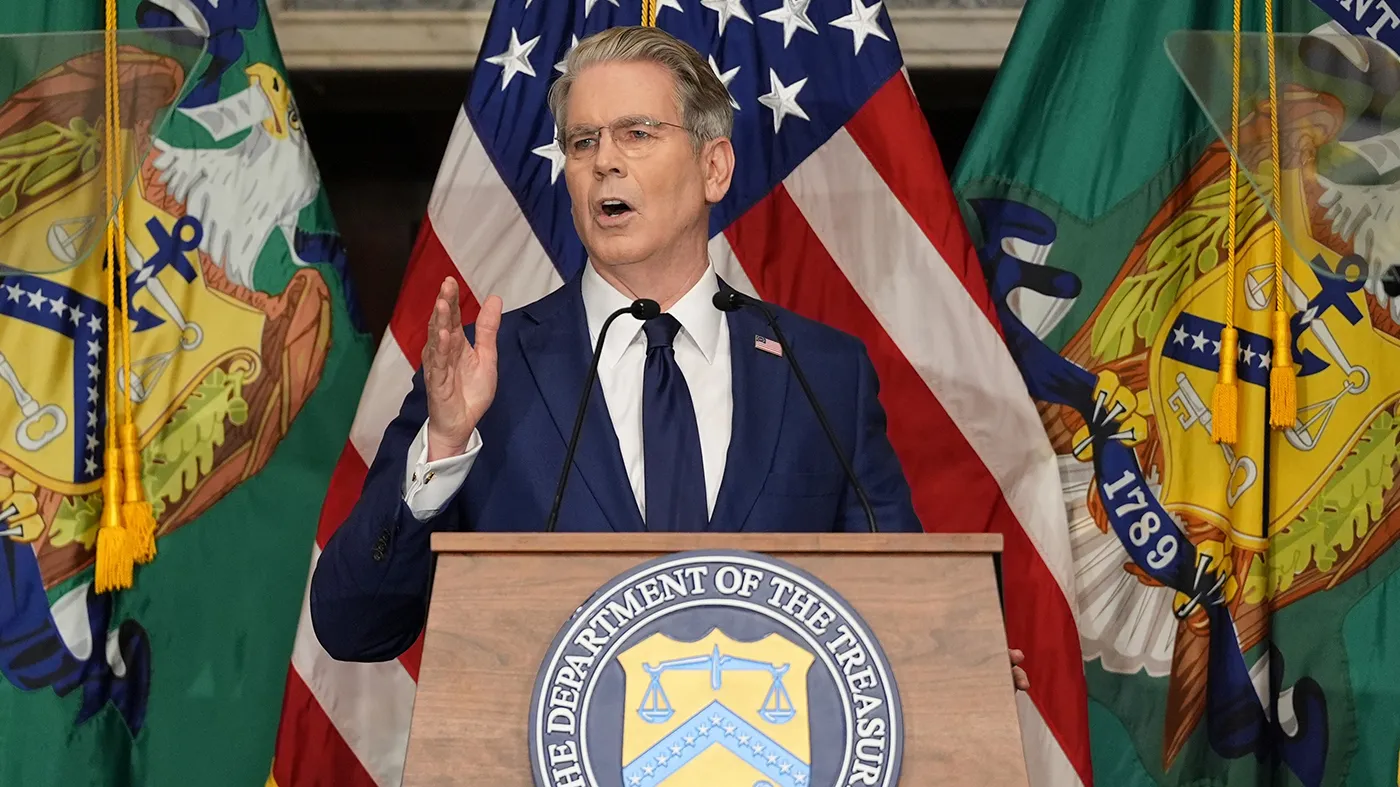
Treasury Secretary Scott Bessent rolled out the Trump administration’s much-anticipated “Economic D-Day” offensive against Iran on Monday but signaled the plan entails more of a threat than immediately bringing the hammer down, at least for now.
Bessent issued a warning during a press conference for all countries to cut off business and other financial ties with Iran or else face significant sanctions.
The plan has been named “Operation Economic Outcast” and promoted as comparable to the U.S. invasion of Normandy during World War II. But Bessent avoided naming specific countries that the U.S. is seeking to pressure and didn’t share many specific actions or a timeline that the federal government would take.
“Well, we are giving everyone the opportunity to remedy bad behavior, why would I want to blow up the global financial system?” he said, when asked at a press conference why sanctions wouldn’t take effect immediately.
Bessent said diplomacy is happening behind the scenes, as President Trump is calling world leaders to get them to cut off Iran. He said officials from the State, Treasury and Defense departments are also calling their counterparts around the world.
He expressed confidence about the plan, saying that the U.S. has “already seen some results” and emphasizing that Trump can be “quite persuasive.”
But the announcement fell short of quite the boisterous threats that the president has been making for days leading up to the move, as he seeks to force Iran back to the bargaining table and reopen the Strait of Hormuz.
“Therefore, today, I am announcing the MOST CRUSHING ECONOMIC OPERATION EVER TAKEN AGAINST ANY COUNTRY!” Trump said in a Truth Social post Wednesday. “This will be Economic Warfare and Isolation on an unprecedented scale.”
Trump said any country that allows its financial institutions, businesses, airports or government entities to provide “any type of lifeline” to Iran will face “TREMENDOUS” economic consequences.
While the president hasn’t ruled out additional military action against Iran, he has shifted his focus to the economic realm amid growing warnings over depleted U.S. weapons stockpiles.
One complicating factor to the “outcast” plan is the role of China, which is Iran’s largest trading partner. Bessent said “no country is above the reach of U.S. sanctions” when asked plans for China.
Experts told NBC News that the success of Bessent’s announcement will depend on whether Iran’s most powerful trading partners — China, India and Russia — deem the U.S. threats credible.
Bessent also announced other actions designed to squeeze Iran economically, including placing sanctions on 60 entities, individuals and vessels related to Iran’s nuclear and missile technology programs, its ability to conduct cyber operations and generate oil revenue.
The Treasury Department said it was expanding its authority to sanction any person, regardless of location, for operating specific sectors of the Iranian economy, including digital assets, technology, aviation and shipping.
Iran’s currency, the rial, continued to take a hit on Monday, falling to a record low of about 2.02 million to the U.S. dollar. U.S. markets seemed to mostly shrug at the news, as the Dow Jones finished slightly up compared to the start of the day, while Nasdaq and the S&P 500 finished slightly lower.
Signs of Iran’s economic struggles amid the war continue to multiply. The International Monetary Fund said its economy will contract by 5.4 percent this year, while the government is signaling a coming hike to fuel prices in a bid to buoy the economy, a move that will compound rising prices.
What’s less certain is whether that pain is increasing pressure on the hardline regime to end the war.
Iranian President Masoud Pezeshkian and parliamentary Speaker Mohammad Bagher Ghalibaf , who has led negotiations with the U.S., have pointed to the economic anxiety in remarks about the country’s war posture in recent days.
However, leaders of the Islamic Revolutionary Guards Corps are seen as digging in, promoting a more assertive approach to the war focused on “offensive operations.”
An adviser to Supreme Leader Mojtaba Khamenei said the “strategy of shifting the war to an offensive posture if Iran’s conditions are not met will undoubtedly transform the balance of power in the world,” CNN reported.
How much Iran’s military is willing to test that theory, or whether the U.S. is willing to put the screws to global powers still supporting Iran, are key questions in a war that has now gone on for almost six months.
▪ The Hill : The Memo: Trump cranks up Iran economic pressure.
▪ The Hill : Democrats demand war cost details from Trump, Hegseth.
▪ Reuters : U.S. cancels joint Marine drills with South Korea over war constraints.
Republican California gubernatorial candidate Steve Hilton revealed to NewsNation his plan to try to stop parents and teachers from having to pick up the cost of school supplies. It’s another way to address the affordability issue . As we saw last week, Trump had his own idea regarding importing beef to lower prices for consumers. However, American ranchers have panned the plan. So did Hilton when I spoke with him on Monday.
“I’m not a fan of that policy at all. I’ve been with our ranchers across the state, and they are really struggling,” Hilton told me . He also pointed the finger at Democrats. “The struggle in California is because of California policies, the regulations that they have to comply with, way more onerous than other states,” he added.
Bringing down prices in any form remains a key issue for Republicans, whether it be in the meat section, or school supplies section, of your local grocery store.
By the way, we are bringing back our Viewer’s Voice segment on Wednesday. Have a question for Congress? Email me at viewersvoice@newsnationnow.com . We’ll put your questions to Rep. Glenn Ivey (D-Md.).
Burman hosts “The Hill” weeknights, 6 p.m. EDT/5 p.m. CDT on NewsNation.
The federal government is reportedly planning to revoke the visas for up to 200,000 foreigners who have applied for or are seeking asylum in the U.S. If the move goes through, it would be the largest single mass revocation of visas in U.S. history.
The Trump administration formally removed Syria from the state sponsor of terrorism list , a significant milestone for the country as its government under Ahmad al-Sharaa seeks to restore ties with the international community. The move will allow Damascus to fully rejoin the global financial system.
House Minority Leader Hakeem Jeffries (D-N.Y.) assured the public that no one in the president’s circle would “get a pass” if Democrats win back control of the House in November. His comments came in response to some backlash to his reported meeting with Jared Kushner to discuss areas of common ground with the administration.
President Trump watches Sen. Darline Graham (R-S.C.) speak at her campaign event at the Myrtle Beach Convention Center in Myrtle Beach, S.C., Aug. 21, 2026. (Mic Smith, Associated Press)
RUNOFFS : Tonight’s primaries will provide two of the final major tests of Trump’s endorsement power in this year’s midterm primaries.
Trump has weighed into today’s GOP primary runoffs for South Carolina’s Senate seat and for Oklahoma’s governorship, expending political capital in two races that are anyone’s to win.
In South Carolina, Trump has thrown his weight behind Sen. Darline Graham (R-S.C.), who is serving out the final months of her late brother’s term as she seeks a full six-year term of her own. She faces Rep. Ralph Norman (R-S.C.), a longtime member of the ultraconservative House Freedom Caucus who is leaning on his experience in office.
Graham and Norman advanced to a runoff after earning about 33 percent and 25 percent, respectively, in the Aug. 11 special primary, setting off a two-week sprint to today’s runoff.
But without much public polling — and after Graham’s fumble over a national security question during last week’s debate — the race is up for grabs. One poll released late Monday night showed the race essentially tied .
Over in Oklahoma , Trump’s pick, Republican Mike Mazzei , finished less than a percentage point behind his opponent, Oklahoma Attorney General Gentner Drummond (R), who was viewed as an early favorite in the race before Trump weighed in just two weeks before the June primary.
Drummond has faced the president’s ire over his resistance to a Trump-backed project to bring what would be the country’s largest aluminum smelter to his state and filed a suit to block the plant, arguing it would hurt residents and their land. Trump has also suggested Drummond was not supportive enough during his impeachment trials.
The president joined back-to-back tele-rallies last night with each candidate as he urged voters to turn out to the polls.
▪ The Hill Insider : Graham hopes Trump propels her across finish line.
▪ The Hill : Drummond says Trump is ‘wrong’ on tariffs.
SCOTUS SURPRISE : The Supreme Court has lifted a federal judge’s block on Trump’s executive order implementing requirements for mail-in voting, with the majority finding that a handful of Democratic-leaning state sued too early for courts to weigh in.
The conservative majority ruled over the dissents of the court’s three liberals that the judge didn’t have the authority to block the order before the U.S. Postal Service (USPS) implements the new standards.
The ruling allows the president to move closer to instituting his order ahead of the midterms. Trump signed the order in March to direct his administration to create a list of verified citizens who are eligible to vote and for USPS to only send ballots to citizens on a state’s approved mail-in ballot list.
California, Massachusetts, Nevada and Washington co-led the lawsuit challenging the order, leading a total of nearly two dozen states and Washington, D.C.
The ruling covers the timing of the case but not the merits. Additional legal challenges may be to come, leaving whether the order can be implemented in time for November uncertain.
▪ The Hill : Justice Department signals appeal coming on Epstein files redactions.
NEXT ROUND : Trump is already looking ahead to implementing another wave of steep tariffs on Canada following Canadian Prime Minister Mark Carney ’s announcement that his government will impose retaliatory tariffs against the U.S.
The president threatened Monday that he would place additional 50 percent tariffs on Canadian cars, trucks, auto parts and steel starting Jan. 1. That would be on top of the 50 percent tariffs that went into effect at the end of last week on a range of Canadian goods, including wine, furniture and cement.
Carney’s retaliatory tariffs on U.S. goods — including dairy, appliances, agricultural equipment and electronics — will take effect Sept. 8.
Trade talks between the countries collapsed at the end of last week. Carney has said the U.S.’s terms were unacceptable, including a late demand that restrictions be placed on Canada’s ability to reach trade deals with other countries.
Trump administration officials have accused Canada of being the one making last-minute changes, with the president saying on Truth Social on Monday that Canada has been “ripping off” the U.S. for years.
▪ The Hill Insider : What to know about US-Canada trade war impacts.
▪ The Hill Insider : Tariff war threatens GOP candidates in border battlegrounds.
TRY TRY AGAIN :The Trump administration is again planning to charge employers more than $100,000 for skilled international workers they hire through the H-1B work visa program, according to a notice of proposed rulemaking issued Monday by the Department of Homeland Security (DHS).
A federal judge in June struck down the Trump administration’s proposal for a $100,000 fee for H-1B visa applications, ruling only Congress could levy taxes and set immigration laws.
But DHS’s proposed rule indicates that the fee would function as a “dedicated revenue mechanism” to recover some of the cost of administering the immigration system.
“The proposed H ‑ 1B fee is intended to recover the costs incurred across the federal government to adjudicate, vet, and support lawful immigration programs that otherwise must be funded by taxpayers,” U.S. Citizenship and Immigration Services spokesperson Zach Kahler said in a release.
▪ The Hill : Texas governor fights Minnesota extradition request for immigration officer.
The president will participate in a pre-taped interview at 2 p.m. He will participate in signing time at 4 p.m.
A grocery store worker prepares to display ground beef for purchase in Dallas, April 15, 2026. (LM Otero, Associated Press)
INTRAPARTY BEEF : Senate Republicans are breaking with the president over his plan to pause tariffs on beef imports as he escalates duties on key Canadian products.
The Hill’s Alexander Bolton reports several Republicans from agriculture-heavy states are urging Trump against the plan to exempt 300,000 tons of product for ground beef from out-of-quote tariffs.
Trump decided to use the pause to address consumers’ worries about rising food costs, but the Republicans said they’re concerned about cheap beef imports flooding the market in the coming months.
“They’re skating where the puck is versus where it needs to be. If you think that providing subsidized beef for some period of time is going to make farmers happy and prices go down on systemic basis, you’re wrong. It doesn’t happen,” said Sen. Thom Tillis (R-N.C.).
Sen. Mike Rounds (R-S.D.) brushed off Trump’s move as a “quick fix,” while Sen. Jerry Moran (R-Kan.), a member of the Agriculture Committee, said the relatively strong beef prices are a “bright spot” for a “struggling” agricultural industry.
Bolton reports Trump seems to be sensitive to ground beef costs, which have risen about 20 percent since he took office last January. Some Democratic candidates, including Iowa Senate candidate Josh Turek , are emphasizing “skyrocketing” beef prices while campaigning.
Trump has vowed that imported beef will be sold at 25 percent below current market prices over the next three months. But many Republicans said allowing cheap imports isn’t the best solution.
▪ The Hill : Sen. Susan Collins (R-Maine) calls Canada tariffs a ‘mistake.’
▪ NewsNation : Why farmers oppose Trump’s plan to import beef.
The Colorado River flows near the Glen Canyon Dam, Tuesday, July 14, 2026, near Page, Nev. (AP Photo/John Locher)
WATER FIGHT: Nevada is suing the federal government over its finalized plan to force certain states to reduce their Colorado River water usage over the next 10 years, saying the cuts are too steep and could threaten people’s health and safety and devastate local economies.
“This isn’t about political posturing; this is a matter of survival for a community that represents about two-thirds of our state’s citizens and the lion’s share of its economy,” Nevada Gov. Joe Lombardo (R) said in a statement.
The Colorado River provides water for agricultural, municipal and industrial uses for seven states: Arizona, California, Colorado, Nevada, New Mexico, Utah and Wyoming.
The river has been facing a major drought and, as the climate gets drier, the states have had to negotiate the river’s future management, especially since the interim guidelines expire at the end of the year.
But, after the states failed to reach an agreement, the federal government had to step in, and last month, the Interior Department released a 10-year framework that would force California, Arizona and Nevada to cut up to 3 million acre-feet per year.
The three states recoiled at the proposal, and the Interior Department responded with a short-term plan that would instead require the three states to reduce their water use by 1.25 million acre-feet per year in 2027 and 2028.
But the department on Friday also finalized the 10-year plan, which the Trump administration has said is meant to be a flexible framework that is responsive to whatever the water conditions may be in the future.
▪ The Arizona Republic : Is Arizona next to sue?
▪ The Associated Press : Firefighters make progress against Nevada wildfire.
South Carolina runoff pits America First against MAGA , The Hill’s Chris Stirewalt writes .
The FCC’s power over broadcasters was a mistake from the start , Dominic Pino writes in The Washington Post.
U.S. Supreme Court Associate Justice Clarence Thomas answers questions during a visit to the University of Texas at Austin, in Austin, Texas, April 15, 2026. (Eric Gay, Associated Press)
And finally … Supreme Court Justice Clarence Thomas thanked Sen. Ted Cruz (R-Texas) for standing up for him in the face of ethics complaints in recent years when the judge appeared on an episode of Cruz’s podcast released Monday.
“You’re one of the people who actually stands up, particularly at times when others seem to wither, and I appreciate it,” Thomas said on the episode of “Verdict with Ted Cruz.”
Thomas has faced scrutiny in recent years over allegations that he failed to disclose gifts, luxury travel and property transactions involving billionaire Harlan Crow , a GOP megadonor. He’s also faced criticism over perceived conflicts of interest given political activism from his wife, Ginni Thomas .
“That is very kind of you, and especially for you to observe that I stand up in the face of criticism and attacks, that is powerful coming from you because you’re someone who knows what that’s like and has done so in a way that has been world-changing,” Cruz responded.
Topics in this story
Gathered from external sources. Rights to this text belong to whoever originally published it.