With Kerch bridge strike, Zelensky shows he isn’t asking Trump’s permission any more
Ukraine’s first major attack on the Kerch Strait Bridge was delivered by a truck bomb in October 2022, followed by strikes using unmanned surface vessels, S-200 rockets, and underwater explosives placed near pillars supporting the bridge. This week, the Ukrainians finally finished the job. As President Volodymyr Zelensky described it in a post on X, the operation surrounding the new strike had been…
Ukraine’s first major attack on the Kerch Strait Bridge was delivered by a truck bomb in October 2022, followed by strikes using unmanned surface vessels , S-200 rockets , and underwater explosives placed near pillars supporting the bridge.
This week, the Ukrainians finally finished the job.
As President Volodymyr Zelensky described it in a post on X , the operation surrounding the new strike had been “carried out over several weeks, developed and coordinated by the Security Service of Ukraine together with the General Staff of the Armed Forces of Ukraine. Our warriors gradually destroyed air defense systems, radars, electronic warfare equipment, and other designated targets on the way to the final objective.”
Recall how, in February 2025, Trump lectured Zelensky in the Oval Office: “You’re not in a good position. You don’t have the cards right now.”
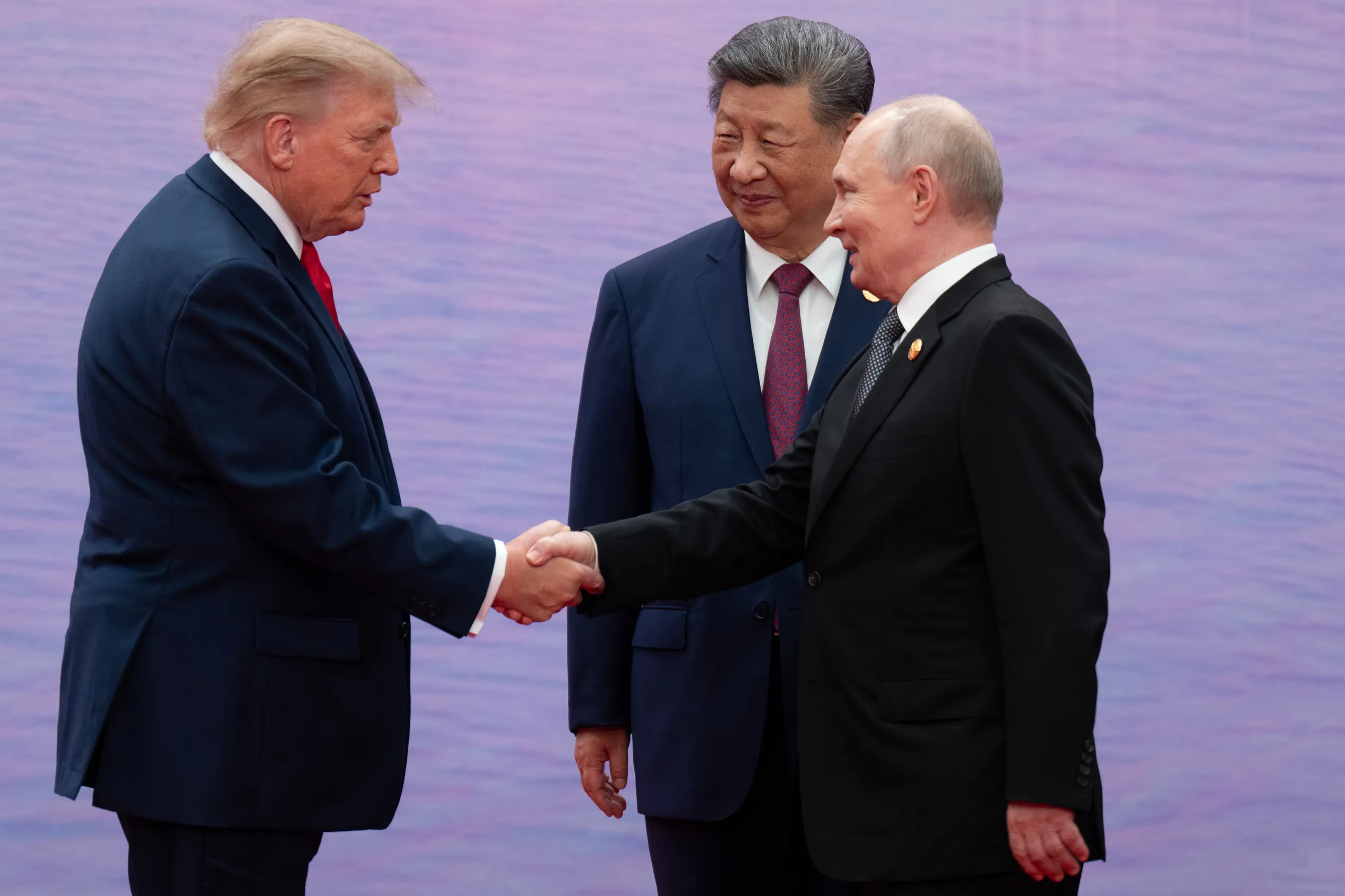
As of Tuesday, Zelensky had the cards. And he had given his own kinetic answer to President Trump and his envoys regarding their chosen path proposal on Tuesday: He would not let Trump’s meeting today with Chinese President Xi Jinping and Russian President Vladimir Putin become Yalta 2.0 , in which his country is divided up behind his back.
Last May when CNN’s Jim Sciutto interviewed Ukraine’s Ambassador to the U.S. Olha Stefanishyna’s , he asked her, “Is it safe to say Ukraine does have cards in this conflict?”
Her response was priceless: “We printed them. … We made our own.”
That they did. According to Ukrainian Defense Minister Yevhenii Khmara , “The [Kerch] strike was carried out exclusively with Ukrainian weapons — using our technologies and our solutions.”
Zelensky confirmed that domestically manufactured missiles and drones were used on both the road and rail sections of the bridge. That created an awkward backdrop for Trump’s meeting last night with Xi Jinping and Putin in Shenzhen.
The more Trump’s negotiation team has tried to advance its agenda, the more Zelensky has pushed back. And Zelensky has paid a price: His Starshield defense network service was throttled. His access to Patriot missiles was diminished . Yet he has fought the Russians to a standstill. And the Kerch Bridge attack may signal that the tide is turning in his favor. He is not about to abandon the Donbas region in exchange for promises of lucrative deals or economic opportunities .
For Ukraine and for Europe, national security takes precedence over both oil and mineral riches. As German Chancellor Friedrich Merz warned during his visit to Kyiv in October, “If Russia is not stopped, it will turn its war machine against us sooner or later.”
The White House must adopt a different course of action. Instead of trying to make Ukraine quit, he should defund Russia. Waiving sanctions and seeking economic opportunities with Russia only keeps the Kremlin’s war machine going.
The White House must join Europe and enable Kyiv to defeat the Kremlin’s remaining source of power — aerial attacks.
Trump claims he wants to stop the killing. To date, Putin’s special military operation has yielded 1,629,010 Russian casualties — more than 54,000 in October alone . In the first 15 days of November, the Kremlin sustained on average 2,343 casualties per day — 35,145 casualties, nearly twice the number of Russian soldiers killed in its 10- year war with Afghanistan , and on pace for 70,000 by month’s end.
The best way to stop the killing is not to force Ukraine to give up — rather, it is to get Russia to stop attacking.
The Kremlin is displaying a false confidence of victory, with senior officials telling Putin-aligned lawmakers to “ prepare for victory ” in Ukraine. We have seen that before. In April 2022, as they drove the Russians back from their initial thrust toward Kyiv, Ukrainian forces found parade uniforms in their abandoned baggage. They thought they would be celebrating a victory within days of their invasion.
When Zelensky’s request for ammo fell short, he simply made his own and stopped asking permission. Persistence, resilience, adaptation and continued support from those still fully willing made Tuesday’s strike possible.
Needless to say, U.S. mediated trilateral negotiations are probably off the table in the near term. But there will be a Russian response, and the targets will likely be Ukrainian civilians in their homes. Kyiv will need to get its home-grown anti-ballistic missile defense system into the field sooner rather than later.
Col. (Ret.) Jonathan Sweet served 30 years as a military intelligence officer and led the U.S. European Command Intelligence Engagement Division from 2012 to 2014. Mark Toth writes on national security and foreign policy They are the co-founders of INTREP360 and the INTREP360 Intelligence Report on Substack.
Topics in this story
Gathered from external sources. Rights to this text belong to whoever originally published it.